Get Full Government Meeting Transcripts, Videos, & Alerts Forever!
Get email alerts on the Land Development Code topic
No spam. Unsubscribe anytime.
Council hears Century Code update; debate centers on tree rules, zoning map and housing tradeoffs
Summary
City staff presented a long-running repeal-and-replace of Eau Claire's land development rules, including new zoning districts, a revised stormwater rule and changes to tree‑preservation and permitting. Staff and some council members said adoption could increase housing choices; tree advocates and builders urged refinements and an ongoing review.
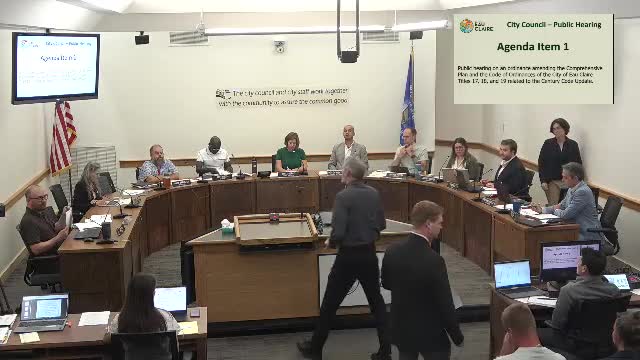
City staff presented a final public hearing on a broad ordinance to repeal and replace land‑use chapters of the municipal code and to amend the comprehensive plan and stormwater rules, drawing public comment and detailed council questions.
Eric Noel, a city staff member presenting the Century Code/Land Development Ordinance project, told the council the package would repeal and replace Titles 17 and 18 (zoning and subdivision) and amend Title 19 (stormwater). Noel said the package collapses multiple documents and design manuals into a single, illustrated code intended to improve clarity for developers and staff and to align zoning language with the comprehensive plan and state law. "This is a large project that you've been working on for over two years," Noel said.
The nut graf: The ordinance bundle contains three linked policy areas that the council has repeatedly signaled as priorities—streamlined development rules intended to boost housing supply, new stormwater/erosion thresholds driven by state DNR guidance, and a revised tree‑preservation regime that council members and speakers said affects infill feasibility. The council heard technical detail from staff, then heard 10 public comments representing arborists, builders, business groups and neighborhood interests.
Key provisions and staff clarifications - Titles: The package would repeal existing chapters and create a consolidated Land Development Ordinance (Title 17), updated subdivision/zoning rules (Title 18), and amendments to stormwater (Title 19). - Stormwater/erosion: Noel said the Wisconsin Department of Natural Resources pushed the city to adopt model‑ordinance provisions. A new land‑disturbance permit threshold would apply to sites that disturb 2,000 square feet or more (a lower threshold than before) to address erosion on smaller residential lots. - Tree preservation and simplified permits: The council has already approved four related amendments; Noel summarized staff recommendations including a simplified permit pathway for projects that remove up to 10 high‑value trees (raised from the prior threshold) and a mitigation requirement that staff described as 30% in the proposed approach, compared with a 60% mitigation practice noted in Duluth. - Design and housing goals: The new code is designed to encourage more compact, walkable development, reduce parking minimums in some districts, and introduce zoning districts to allow smaller multi‑unit housing in more locations. Noel said many design requirements were refined after three rounds of public and council feedback.
Zoning map, nonconforming buildings and neighborhood concerns Noel reviewed draft maps and the contested Randall Park and Third Ward amendments. He said adopting one option would leave 31 nonconforming buildings in the mapped boundary; treating the area as originally proposed would reduce nonconformities to 13 for certain building types. He told council members the GR district limits three‑ and four‑unit buildings to collector streets and reminded the council that state law limits reinvestment in nonconforming structures to 50% of assessed value.
Council process and timing Noel reiterated that if council adopts any substantive new amendments at the next meeting the entire package would return to the planning commission for a new public hearing (the earliest date staff gave was Sept. 15) and then back to council on Sept. 23; staff expects final cleanup items (including DNR‑driven floodplain changes) and an effective date likely in mid‑November if no new amendments are added. "If you make another amendment, it has to go back to plan commission," Noel said; the city attorney clarified that amendments that are truly new would require another commission review, while changes on matters already considered by commission can sometimes be handled directly by council.
Public comment highlights - Luke Mahal, owner of Tree Savvy and a longtime local arborist and former city forestry employee, said he supports some of the proposed amendments but urged the council to fund implementation and to strengthen post‑planting care and mitigation. "If the goal of tree preservation and an urban forest is to be sustainable, you need to be looking at tree planting and aftercare also," Mahal said. - Scott Rogers, vice president of governmental affairs at the Eau Claire Area Chamber of Commerce, urged adoption to boost housing supply but warned that tree‑preservation rules could add costs and slow development: "Affordability itself is significantly affected by the real cost of construction and the cost of complying with regulations," Rogers said. - Pat Smith, representing the Chippewa Valley Home Builders Association, urged passage of the four amendments that reduce burdens on small infill projects and reiterated concerns about park impact fees and other cost drivers.
What was not decided No formal council vote was taken during the hearing. Staff asked the council to consider final adoption at the next regular meeting; multiple council members asked procedural clarifying questions about how future amendments would be processed.
Ending City staff told council members they will prepare a cleanup packet and implementation materials—sample simplified permit forms, fee schedules and templates—if the council completes adoption at its next meeting. Noel said staff expects to return with additional implementation guidance in September and a formal effective date after the DNR‑driven cleanup work is finished.