Get Full Government Meeting Transcripts, Videos, & Alerts Forever!
Get email alerts on the Campus Free Speech topic
No spam. Unsubscribe anytime.
Committee backs campus free‑speech bill after debate over fees, remedies and definitions
Summary
House Bill 240, which would limit campus free‑speech zones and prescribe notice, security‑fee and remedy provisions, was reported out of committee after testimony from university representatives, legal advocates and interest groups.
The House Committee on Education voted to send House Bill 240 to the floor with a due‑pass recommendation after sponsors and witnesses described the measure as aligning Idaho law with U.S. Supreme Court First Amendment precedents and creating clearer campus speech policies.
Representative Barbara Ehart, sponsor of the bill, said the measure addresses university “speech codes” and would prevent institutions from confining protected expression to small designated zones. "We don't check our First Amendment at the curb of a college campus," she said, quoting the Supreme Court's view that the First Amendment applies on campus.
Zach Pruitt, senior counsel at Alliance Defending Freedom, described the bill's provisions as drawn from Supreme Court decisions and existing precedent. He summarized three substantive sections: definitions, a prohibition on restrictive free‑speech zones while permitting reasonable time‑place‑manner rules that are content‑neutral, and limits on security fees tied to content or expected listener reaction. Pruitt said the bill also requires universities to publish speech and harassment policies and provides reporting and remedies provisions; he told the committee states with similar laws have seen very few suits and that most litigation was caused by universities failing to implement statutory requirements.
Supporters included Grace Howitt of the Idaho Family Policy Center, who said public polling shows strong public backing for published free‑speech policies and wider campus access for speakers and student expression.
Committee members pressed sponsors about precise definitions and the bill's remedies. Representative Sauter asked whether the standard "materially and substantially disrupts" came from Supreme Court jurisprudence; Pruitt answered that it was derived from cases including Tinker v. Des Moines. Members asked whether claims brought under the bill would be heard in federal court or state court; Pruitt said the bill would add a state‑law cause of action in addition to existing federal §1983 options.
Representative Mathias asked a fact question about how institutions should assess competing campus events — for example, dueling demonstrations — and whether volume or crowd size would be a determinative factor. Pruitt and Representative Ehart said reserved spaces and the existing judicial standard would govern, and universities could avoid clashes by assigning separate reserved areas.
Several committee members voiced concerns about damage caps in the bill and whether the $25,000 compensatory cap (included in prior drafts) would cover actual losses in some commercial disputes; Pruitt said most campus speech claims seek injunctive relief and compensatory awards are uncommon in pure speech cases. Representative Mendyff and others supported advancing the bill but said they had reservations about specific provisions.
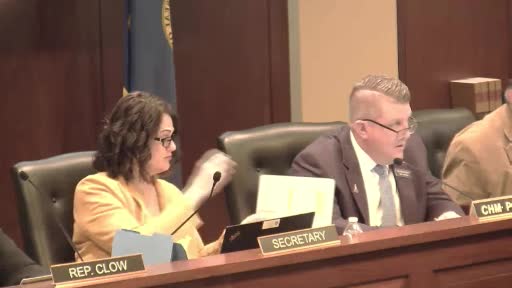
After discussion the committee took a roll‑call vote to report the bill to the floor. The secretary recorded the votes: Chairman Pickett — yes; Representative Hawkins — yes; Clow — yes; Mendyff — yes; Ehart — yes; Vishnevski — yes; Garner — no; Nelson — no; Sauter — no; Harris — yes; Marmon — yes; Tanner — yes; Matthias — no; Church — no. The chair later confirmed a vote tallies correction for earlier items; the outcome to report the bill did not change.
The bill's text, as presented, would (1) limit use of exclusive free‑speech zones on public campuses, (2) allow content‑neutral time‑place‑manner restrictions to preserve educational missions, (3) ban security fees tied to a speaker's viewpoint, and (4) require universities to publish policies and reporting procedures. Exclusions were included for commercial speech and for employment‑related harassment claims; FERPA was noted as unaffected by the bill. Sponsors said Boise State University had been involved in drafting discussions; staff from other institutions were not present for this hearing.
The bill advances to the House floor for further consideration.