Get Full Government Meeting Transcripts, Videos, & Alerts Forever!
Get email alerts on the School Insurance topic
No spam. Unsubscribe anytime.
School districts flag rising property/liability costs after concealed-carry changes
Summary
Witnesses and district officials told the Select Committee on School Finance that liability and property-insurance costs are rising, that some carriers are adding riders tied to firearms policies, and that pooling options carry trade-offs for districts weighing risk-sharing, cost and control.
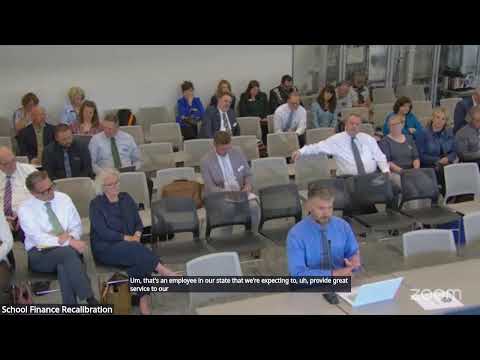
CASPER, Wyo. — School district officials and the Wyoming School Boards Association told the Select Committee on School Finance on June 18 that districts face growing and sometimes unpredictable property and liability insurance costs, and that the removal of so-called gun-free zones has prompted some insurers to add riders or to seek higher premiums for school liability coverage.
Brian Farmer, executive director of the Wyoming School Boards Association (WSBA), said during a committee hearing that districts procure insurance for two separate needs: employee benefits (health, life, workers’ compensation) and property/casualty coverage that protects district assets and pays liability claims. He described the school risk retention program known as SERP (the joint powers board often contracted to administer pooled property/casualty coverage) and said it currently has about 31 members.
Why it matters: Insurance is a regular line item in district budgets; sudden cost increases, new riders or litigation that tests governmental immunity can shift local spending away from instruction or other priorities. School boards must decide whether to buy coverage individually, join a pool or change risk-management approaches — all of which have trade-offs for cost, local control and exposure to other entities’ decisions.
What officials told the committee
- Farmer said property coverage is externally priced by underwriters that re-insure catastrophic risk; those markets are global and can drive local premium spikes. He said wind and hail frequently are a separate rider. He described the liability side as driven by actuarial assessments of risk, and said recent legal and policy changes have prompted carriers to reassess exposures.
- Because Wyoming removed gun-free zones, Farmer said some commercial carriers now view firearm-related risk as a new exposure and are asking districts to purchase separate riders. He said SERP has taken the position that the change has not altered its coverage, but that other carriers are treating it differently.
- Committee members and district officials described concrete premium impacts. A Teton County rider was cited in testimony as roughly $35,000, and district officials described other districts adding tens of thousands of dollars to their policies to cover firearm-related exposures or other new riders. John Williams, chief financial officer for Uinta County School District No. 1, said his district’s concealed-carry-related rider has cost about $16,000 in the past and that a new policy this year would add roughly $32,000 more for additional coverage.
- Farmer said pooled insurance (the SERP joint powers entity) can reduce cost through scale, but pools also carry risk: a single catastrophic loss in a district with many buildings can “turn the pool upside down,” he said, and districts that act differently on safety or facilities may be unwilling to share that risk.
- WSBA structure: Farmer explained WSBA is a 501(c)(3) that provides member services; the association’s insurance activities are run through a separately incorporated administrator, Wyoming School Support Services. Farmer said enterprise revenue from insurance administration has ranged from about $500,000 to $1,000,000 in recent years; he also said WSBA membership dues vary by district and can reach roughly $22,500 for large districts.
Legal, claim and litigation context
- Farmer explained that Wyoming’s Governmental Claims Act (1979) creates a route to immunity for governmental actors in some cases and that insurers and pooled programs may assert that immunity as a defense in litigation. He warned the committee, however, that immunity is litigated at the courthouse level: courts must decide whether an incident falls within the statutory coverage (for example, whether a staff member acted within the scope of employment and without negligence) and whether an exception—such as negligent operation or maintenance of a public building—applies.
- He also cautioned policy makers that federal claims (for example Section 1983 civil-rights suits or federal tort claims) are not resolved by the Wyoming statute and can expose districts to liability regardless of state immunity protections.
How districts are responding
- Districts use a variety of strategies, Farmer said: competitive procurements under state purchasing rules, joining or leaving a pool, or negotiating specific riders with carriers. Many districts treat the procurement decision as a local budget-and-risk trade-off that reflects building stock, local hazard exposures (wind, hail), and the district’s tolerance for shared risk.
- Farmer and other witnesses urged that if the Legislature or state administration proposes centralized insurance for districts, lawmakers should first consider legal ownership of facilities (a question that can be unsettled for newer projects), who controls risk decisions and whether centralized pooling would remove local discretion.
What’s next
Committee members asked staff and consultants to gather more comparative information on state-level or pooled insurance programs and to return examples from other states. Several legislators suggested the committee should weigh options for aggregating purchasing power while protecting district autonomy.
Ending
Speakers urged caution: pooled coverage can reduce premiums but shifts the distribution of risk and requires governance decisions. Several witnesses told the committee additional data from insurers and examples from comparable states would help policymakers weigh centralized versus local approaches to district insurance.