Get Full Government Meeting Transcripts, Videos, & Alerts Forever!
Get email alerts on the Housing Zoning topic
No spam. Unsubscribe anytime.
Planning staff outline zoning code changes to allow more ‘middle housing,’ DADUs and an attainable-housing incentive
Summary
Metro planning staff presented four zoning-code bills that would add two new base districts (RN and RL), change height and accessory-dwelling rules, allow certain duplexes by right and create a voluntary attainable-housing incentive for rental multifamily projects. No votes were taken at the presentation.
Metro Planning Department staff on Wednesday outlined four proposed zoning-code bills intended to increase “middle housing” options, limit unexpectedly large infill homes and offer an incentive for income-restricted rental units.
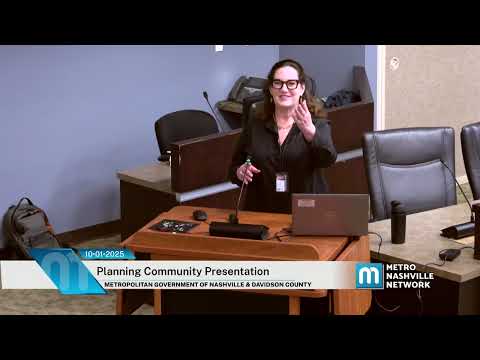
Greg (Planning Department presenter) told attendees the four bills under consideration are numbered 1005 through 1008 and are changes to the zoning code, not the zoning map: “These are changes within the zoning code. They are not changes to the zoning map.” The presentation included an overview of detached accessory dwelling unit (DADU) rules, new base districts called Residential Neighborhood (RN) and Residential Limited (RL), proposed height limits in single-family zones, and a voluntary attainable-housing incentive proposed for multifamily rental developments.
The Planning Department framed the bills as part of a broader housing and infrastructure study that began with Nashville Next and continued through subsequent city efforts including a council resolution (Resolution 2024-288) that asked Metro agencies to assess whether regulations affect housing supply, affordability and infrastructure capacity. Staff said the bills are intended to create more predictable, house-scale infill and expand options for homeowners and renters while protecting historic character.
Key proposals explained at the meeting: - Height limits in R and RS (one- and two-family residential) zones: staff proposed reducing the maximum from three stories to two-and-a-half stories and adding a formal definition of “half story.” The draft uses both eave/parapet and roof-ridge measurements (examples cited: 24-foot eave/parapet and 35-foot roof ridge) to clarify allowable massing. - Two-family (duplex) clarification: the proposals would allow duplexes “by right” in zoning districts that already permit one- or two-family use, provided lots meet size requirements. Staff said duplexes would remain prohibited in RS single-family-only districts. - Detached accessory dwelling units (DADUs): staff proposed expanding where DADUs are allowed, removing a 700-square-foot living space cap for new DADUs in some districts and instead limiting them by footprint, height and proportionality to the primary structure. Staff also proposed allowing one owner-occupied short-term rental (STR) per single-family home in the Urban Services District (USD), preserving existing allowances for owner-occupied STRs. - Two new base districts (RN and RL): RN is described as a “house-scale” district permitting single-family houses, duplexes, townhouses, small multiplexes and courtyard housing. RL is a slightly more permissive district that can allow low-rise flats, courtyard flats and larger multiplexes while retaining controls on massing, frontage and open space. Each district would have suburban and urban “flavors” (e.g., RN-1 suburban, RN-2 urban) with different height and form limits. - Voluntary attainable-housing incentive (Bill 2025-1008): staff outlined a state-authorized incentive limited to rental multifamily projects of five or more units. The incentive could allow up to two additional stories (within form limits), remove parking requirements for income-qualified units, and offer flexibility on unit counts so long as other form standards are met. In return, developers would provide an affordability set-aside. Staff presented two set-aside options: 10% of units at 80% of area median income (AMI), or 5% of units at 60% AMI. Greg said these terms “translate state law very directly.”
Planning staff repeatedly emphasized that adding RN and RL to the code would not rezone any property automatically. Greg said the bills merely add options to the code; applying a new base district to property would require a zone-change application or a council-initiated rezoning with full public notice, Planning Commission review and three readings at council with public hearings.
Robin Ziegler of historic zoning staff explained the limits of historic overlays and the historic zoning commission’s role. Ziegler said historic design review covers exterior changes such as demolition, new construction, and additions, and that the commission applies the Secretary of the Interior’s standards as a guideline. She said historic overlays do not regulate interior alterations, ownership, density (how many units are allowed), or subdivisions, and that an overlay remains in effect even if base zoning later changes.
Dustin (Planning Department staff) said the proposals aim to “right-size infill” so new housing better matches neighborhood scale and to simplify regulations that now require costly, case-by-case specific plans. He said the DADU footprint limits were informed by peer-city comparisons and that limiting height and proportionality is intended to keep accessory units smaller than the principal structure.
Staff said the Planning Department is completing an infrastructure assessment to identify areas consistent with the city’s growth-and-preservation map from Nashville Next where these district standards would most appropriately be applied. The department plans further community engagement and said the current bills only add the option to the code; any application of RN or RL to specific properties would follow standard rezoning procedures.
No council votes or formal actions on the bills occurred at the presentation. Staff provided handouts and said the materials and further information are available at engage.nashville.gov/housinginfrastructure. Attendees were told virtual office hours and follow-up meetings will be scheduled for more detailed Q&A.