Get Full Government Meeting Transcripts, Videos, & Alerts Forever!
Get email alerts on the Transportation Bay Ave topic
No spam. Unsubscribe anytime.
Capitola council restores pre‑quick‑build traffic pattern at Bay Avenue and Hill Street
Summary
After months of public debate and a summer quick‑build trial, Capitola City Council voted to restore the prior traffic configuration at the Bay Avenue/Hill Street intersection (Option 2). The council also directed staff to pursue an associated senior crossing flag program and continue corridor planning for long‑term improvements.
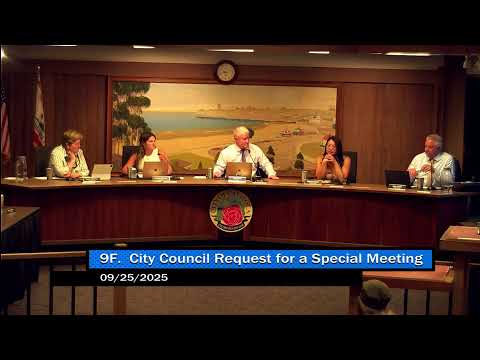
The Capitola City Council voted Thursday to return the Bay Avenue and Hill Street intersection to its previous lane configuration after a yearlong trial of a “quick‑build” road‑diet layout aimed at improving pedestrian safety.
Council members approved the restoration (Option 2) by roll call; Council members Orbach, Westman, Vice Mayor Morgan and Mayor Clark voted in favor, and Council member Johnson was recused from the item. The motion also included direction to fund a senior crossing flag program through the city’s community grants process if needed.
Council staff framed the vote as a choice between maintaining a short‑term “quick‑build” configuration installed in July 2024 and reverting to the earlier four‑lane geometry while the city’s Bay Avenue corridor study advances toward a permanent design. “By council request, we're bringing this item to you this evening and an update on the Bay Avenue and Hill Street intersection,” City staff said during the presentation.
Why it matters: the intersection has drawn repeated complaints from residents and businesses about congestion and safety. Staff and consultants presented traffic and crash data showing a mix of concerns: the Bay/Hill intersection carries roughly 2,000 vehicles per hour at the evening peak, while a nearby segment of 40 First Avenue carries more traffic (about 5,000 vehicles per hour total, reported as roughly 3,700 northbound and 1,450 southbound). Crash records cited in the presentation showed 32 collisions on Bay Avenue in the study period (10 involving pedestrians, nine involving bicycles) and 122 crashes on the 40 First corridor (nine involving pedestrians, 23 involving bicycles).
What council debated: staff and consultant Frederick (Kinley Horn) laid out three options: keep the existing quick‑build road diet; restore the prior four‑lane configuration with some enhanced bike striping; or restore the prior configuration and add a raised mid‑block crossing near the senior center. “The 3 options that is in front of you tonight is number 1 is just to do no change and keep the road diet as a demonstration project,” Frederick told the council, summarizing the choices.
The restoration alone was estimated at roughly $50,000 to $70,000; adding a raised mid‑block crossing would bring the cost to about $150,000 to $200,000, staff said. Those price estimates did not include additional lighting; staff said they are talking with PG&E about pole lighting but that PG&E has been “not very amenable” to adding lighting on existing poles. Staff is also investigating solar lighting options.
Many speakers during public comment urged keeping the quick‑build for pedestrian safety; others — including nearby business owners and drivers — said the road diet made congestion and unsafe driving behavior worse. “I just wanted to put in a vote for Option 1 to keep things the way they are,” resident and cyclist Liz McDade said at the meeting; by contrast a nearby business owner said sales dropped about 20% after the change and urged reverting to the prior lane layout.
Council members acknowledged the safety objectives behind the quick‑build but said interim and regional traffic changes tied to Caltrans work and the Capitola overcrossing closures have altered traffic patterns and worsened backups. Several members argued it would be irresponsible to shift budgeted funds away from an already approved 40 First Avenue multimodal repaving project; one council member called the deferral of that project to pay for a mid‑block crossing “unacceptable.”
Council directions and next steps: the council voted to restore the prior configuration (Option 2) while continuing the Bay Avenue corridor study that is evaluating a permanent design (the corridor study had previously identified roundabout control as an option for this and a nearby intersection). Council also asked staff to: - Maintain momentum on the corridor study and return with follow‑up analysis and schedule for long‑term improvements. - Continue coordination with PG&E and evaluate solar lighting options for the intersection; staff said additional lighting costs were not included in the restoration estimates. - Support a community‑led senior crossing flag program and, if necessary, use community grant funds to ensure the program is implemented.
What was not decided: council rejected diverting funds from the 40 First Avenue repaving project to pay for a larger restoration plus mid‑block crossing (Option 3). Staff had suggested the larger Option 3 could be funded by narrowing the scope of the 40 First Avenue project; several council members said the pavement work on 40 First Avenue — which staff said has a pavement condition index in the low 30s (“poor”) between Clare Street and Gross Road — is a high priority for safety and the city’s revenue base and should not be cut.
Details cited at the meeting: staff used verified crash data from the state reporting system (reported through the city’s police department) and noted that the quick‑build had reduced pedestrian crossing distance but increased queueing under current, regionally altered traffic conditions. Staff also described the proposed raised mid‑block crossing near the senior center as a “raised table” with bulb‑outs and a refuge area designed to shorten crossing exposure and slow vehicles.
Public sentiment at the meeting was divided: dozens of residents testified, with many older residents and parents praising the quick‑build’s safety benefits and many business owners and commuters arguing the configuration increased congestion and risky driving behaviors in adjacent streets and parking lots.
The council’s vote restores the pre‑quick‑build lane pattern while staff pursues the long‑range corridor study and immediate safety measures (flag program, lighting options). The city will return subsequent corridor studies and design alternatives to council as staff coordinates with Caltrans on right‑of‑way issues and with PG&E on lighting.