Get Full Government Meeting Transcripts, Videos, & Alerts Forever!
Get email alerts on the Reserve Accounts topic
No spam. Unsubscribe anytime.
LSO staff walk committee through reserve-account history, online spending-policy visuals
Summary
Legislative Service Office staff demonstrated new online data visualizations and reviewed the history, guarantees and recent activity for four permanent-fund reserve accounts used to smooth annual spending.
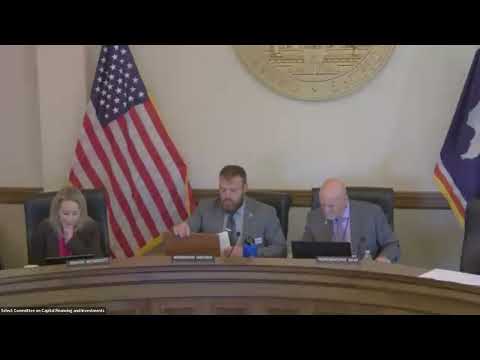
Polly Scott and Catherine Camarotti of the Legislative Service Office on Tuesday told the Select Committee on Capital Financing & Investments that an online set of data visualizations and a memorandum provide a history and primer on the reserve accounts supporting the state's four permanent funds, and explained how guarantees have been added over time to smooth spending.
The presentation highlighted how the spending-policy model uses a five-year rolling average market value and a percentage spending policy to determine an annual spending amount. "This is what you could consider a picture of our spending policy model since inception," Scott said, pointing to charts that show volatile investment earnings (dark blue) and a separate, smoothed spending line computed from the rolling average and the policy percentage.
Scott told the committee the Permanent Mineral Trust Fund (PMTF) is the only fund whose investment earnings are distributed to more than one recipient; historically the first 2.5 percentage points have gone to the general fund while amounts above that were split between the Legislative Stabilization Reserve Account (LSRA) and the now-repealed CIPA or were guaranteed by the reserve account. She noted the guarantee to the general fund began in fiscal 2017 and a 1.25 percentage-point guarantee for CIPA was added in 2020.
The memorandum and visuals summarize three types of reserve-account inflows the committee asked about: excess investment earnings that were retained in reserve accounts, corpus tips that returned excess distributions to principal, and direct appropriations into reserve accounts (for example, House Bill 89 in 2023, which appropriated funds intended to move balances toward statutory maximums). Scott said the PMTF had roughly $6 billion in investment earnings over the period shown, with more than $1 billion of that ending up in reserve accounts after spending.
Scott also described differences among the funds. The Common School Permanent Land Fund's spending policy has tended to track its spending line closely because a constitutional restriction limits use of its investment earnings for K-12 education; when earnings exceed the spending policy, statute requires swaps with federal mineral royalties rather than placing those dollars in the reserve account. The Hathaway scholarship fund does not use a percent-based spending rule; its spending equals scholarship need and the reserve has guaranteed scholarship payments in three years when investment earnings fell short. The Excellence in Higher Education Endowment had a statutory guarantee reduced in 2017 so the reserve account guaranteed roughly half of prior-year shortfalls and the institutions covered the remainder.
Scott walked members through an interactive slide that sums reserve-account history by type (investment earnings retained, spending supported from reserve accounts, corpus tips and direct appropriations). She pointed out a large direct appropriation in fiscal 2024 resulting from the committee's prior work on statutory "5x" and "7x" reserve targets.
On projections for fiscal 2025, LSO estimated strong investment returns would put the PMTF reserve account at the 5x statutory target but not the 7x; the Common School reserve account was projected to be slightly below 5x because federal mineral royalty swaps might lag; the Hathaway reserve account was expected to receive a corpus tip and reach its statutory maximum; and the Excellence in Higher Education fund was expected to be at 5x but not 7x.
Scott closed by noting a question in the memorandum (question 9) on how much the rolling five-year average would have to increase to offset a spending-policy reduction. LSO calculated a 5.26% increase in the five-year rolling average would be required to offset a 0.25 percentage-point reduction (from 5.00% to 4.75%); a 0.50 percentage-point cut would require an 11.11% increase in that five-year average, or a one-time corpus infusion five times that difference to immediately offset the reduction. LSO also estimated that under historical growth rates it would take roughly two years of market growth to "catch up" to prior spending levels after a one-quarter-percent cut, but cautioned that the five-year averaging mechanics make a permanent reduction effectively a multi-year setback in spending timing.
The committee asked clarifying questions about recent years of low investment earnings (notably 2016) and about how guarantees and swaps with federal mineral royalties work in practice. Scott recommended members use the online visual tools on the WyoLege site (State Finances -> Data Visualizations -> Spending Policies) for year-by-year amounts and flowcharts. The presentation concluded before the committee moved on to draft legislation and later votes.
Ending: LSO staff said the visuals and memorandum will be updated with finalized fiscal-year-2025 numbers in October and are intended as an ongoing resource for appropriators and the committee; members asked staff to continue to include flowcharts and detailed notes on guarantees and swaps so policymakers can trace which accounts and statutory provisions constrain use of earnings.