Palos Park reviews major zoning-code changes; council adopts several limits on new uses and installations
Loading...
Summary
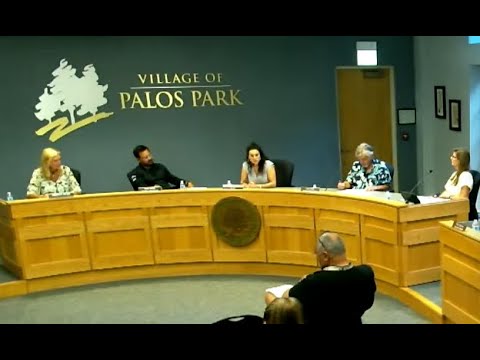
Palos Park’s joint Village Council and Plan Commission reviewed a draft rewrite of the village zoning code that would formalize how older undersized residential parcels are treated, set a 500-square-foot minimum for certain rebuilds, and add rules for accessory structures, beehives, wind turbines and solar panels.
Palos Park’s joint Village Council and Plan Commission reviewed a draft rewrite of the village zoning code that would formalize how older, undersized residential parcels are treated, set a 500-square-foot minimum for some rebuilds, and add rules for accessory structures, beehives, wind turbines and solar panels.
The draft, presented by staff, defines “legacy lots” as existing parcels between 20,000 square feet and less than one acre and treats smaller existing lots as legally nonconforming; it would allow building on those legal lots provided they meet other standards or obtain variance relief. The draft also sets a 500-square-foot minimum dwelling size for legacy lots after a committee vote.
Why it matters: the revisions aim to clarify what can be built on older small lots that exist inside Palos Park and to add standards for new technologies and uses (solar, small wind turbines, beehives) that were not previously addressed in the zoning code. The proposals prompted debate at the meeting and comments from residents who said the low minimum could change neighborhood character.
Key decisions and direction - Minimum dwelling-unit size on legacy lots: The committee voted to add a 500-square-foot minimum unit size for legacy lots. Some commissioners said the limit was a compromise after debate; several residents urged a higher minimum or removal of the provision. Resident Paul Sahaki said, “500 square feet is not Palos Park. This is absolutely ridiculous.” Resident Ralph Jones said the number was “out of place” in the village. - Legacy-lot definition and buildability: Staff clarified legacy lots are those from 20,000 square feet up to just under an acre; lots below 20,000 square feet will be treated as legally nonconforming. Staff cited a GIS analysis showing that out of 1,812 residentially zoned parcels, 1,164 are less than one acre, though that figure does not account for multiple parcels held as a single zoning lot. - Accessory structures and materials: The draft would limit accessory structures finished in exterior metal panels to 144 square feet, revise setbacks (10 feet interior side, 15 feet other lot lines), and limit accessory-structure coverage through district standards. Freestanding ground-mounted solar arrays would be limited to the rear yard and a maximum 8-foot height in earlier drafts; after discussion the body agreed to cap any rooftop or ground-mounted elevated solar panel pitch or elevation at a maximum of 4 feet above the roofline or ground (a staff follow-up was assigned to verify typical panel sizes and angles). - Wind turbines and institutional uses: The commission discussed permitting small wind turbines only in institutional districts. Commissioners voted to allow wind turbines for all institutional uses (village hall, schools, library, fire district buildings and similar civic properties), subject to the draft’s height and siting limits (roof- or ground-mounted, and rear-yard placement for ground-mounted devices). - Dog-exercise-area fencing: A proposal to remove a requirement that outdoor exercise areas at commercial animal boarding/daycare facilities have a solid 6-to-8-foot fence or wall was put to a show-of-hands and failed; the requirement therefore remains in the draft. - Apiaries (beehives): After discussion and two rounds of votes, the body decided to limit beehives to rear yards only (with a 20-foot setback from lot lines), reversing a prior draft change that would have allowed apiaries in front yards and side yards under specified setbacks. - Guardhouses: Staff proposed guidance for small guardhouse structures on very large properties (example minimum lot sizes discussed were roughly 10 acres, stacking distance 20–40 feet, structure sizes 120–250 square feet). Commissioners voted not to add a new permit path for residential guardhouses in the zoning draft; the group noted owners may still seek relief through variance processes.
Public comment and community reaction Public commenters voiced strong objections to the 500-square-foot minimum. Paul Sahaki, a resident, said the 500-square-foot minimum would lower property values and attract buyers outside the village’s existing demographic. Ralph Jones said he lives in smaller vintage cottages within the village but that 500 square feet was far smaller than most existing homes and would be “out of place.” Other residents urged clearer definitions for WGA (Western Growth Area) housing types and stronger landscaping standards to screen nonresidential uses.
Staff follow-ups and next steps Staff said they will: verify solar-panel angle and height limitations against industry panel sizes and the 2024 energy code; provide additional definitions requested for patio/cottage/row-home building types in the WGA table; prepare required public-notice materials for map rezones that require notice (for example, converting limited M-1 mapped parcels to B-1 or institutional where appropriate); and return the draft with the committee’s direction for a formal public hearing before the Plan Commission and subsequent village-council action.
Ending: The joint meeting concluded with staff noting several public-notice and mapping steps remain before the draft becomes final, and the plan to bring the revised text and mapping to a formal public hearing where the village will accept additional comment and possible edits.