
Novi district highlights gains on state tests, flags math curriculum review and 11th-grade science anomaly
Get AI-powered insights, summaries, and transcripts
Subscribe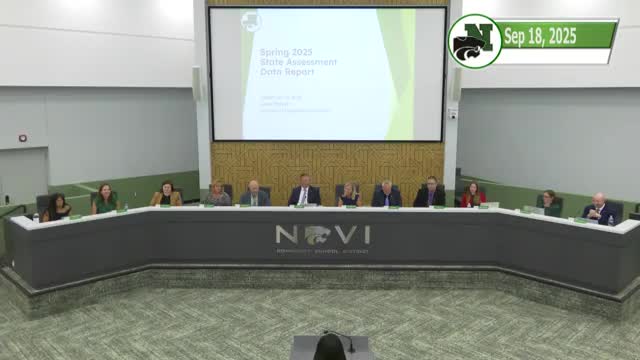
Summary
Laura Bidlak, the district’s director of elementary education, presented the Novi Community School District’s spring 2025 state assessment results on Sept. 18, noting county‑leading SAT scores in ELA and math alongside uneven math trends and an anomalous drop in 11th‑grade science tied to state test technical problems.
Laura Bidlak, the district’s director of elementary education, presented the Novi Community School District’s spring 2025 state assessment results to the board on Sept. 18, saying the district recorded top SAT scores in Oakland County for both English language arts and math while also identifying uneven performance across grades and subgroups.
Bidlak told trustees that “Novi students earned the top SAT scores in all of Oakland County for ELA and math.” She also highlighted specific subgroup gains, including increases for Black and African American students in several grades and a large gain for Hispanic students in 11th‑grade math. At the same time, she and district leaders said they have “wonderings” about math trends and noted an anomalous drop in 11th‑grade science that appears linked to test‑day technical problems.
The district says the findings matter because state assessments provide a broad, system‑level view of student outcomes and can prompt curriculum and instructional changes. Bidlak urged trustees that the results be used as a starting point for targeted follow‑up rather than as a day‑to‑day classroom diagnostic.
Key findings and next steps
- County‑leading SAT: Bidlak reported that Novi ranked first in Oakland County on SAT results for ELA and math for the tested grades. - Subgroup gains: Examples cited in the presentation include an increase for Black and African American students in eighth‑grade math (from 11% to 21% proficient on the PSAT‑8 comparison cited by the presenter) and an eleventh‑grade Hispanic math gain (from 22% to 52% in the presenter’s slide notes). The district also reported gains on M‑STEP for some subgroups in elementary and middle grades. - Math inconsistencies and curriculum review: District staff said math results were inconsistent across grades and assessment types, with a negative trend on PSAT‑8 math that mirrored countywide patterns. Bidlak and administrators told the board they will begin a K–12 math curriculum cycle to evaluate resources and alignment, and they signaled additional classroom‑level intervention work (tier‑2 supports) to address gaps. - 11th‑grade science anomaly: The presentation flagged a notable dip in 11th‑grade M‑STEP science proficiency that did not match the district’s local benchmark data. Staff reported state testing technology problems on the test day (students starting and losing sessions, requiring retesting) and said the high‑school team will survey and convene focus groups with affected students to probe whether the testing environment, scheduling or other factors explain the drop. - Social studies: The district noted the state revised social studies standards and the test this year; because of that change, direct year‑to‑year comparisons for social studies proficiency are not valid. - Data quality caveat for economically disadvantaged students: Trustees and staff discussed that counts of “economically disadvantaged” depend on families submitting free‑and‑reduced‑price‑meal applications, and that local take‑up has fallen since universal‑free meal policies were in place. The district said that lower application rates can skew subgroup reporting and recommended continued outreach so funding tied to those applications (Title and at‑risk state dollars) is not lost.
Trustees asked for more subgroup cohort tracking and for analyses tied to the district’s strategic goals. Several board members asked the administration to surface groups that do not meet three‑year growth targets so the board can focus follow‑up and resource decisions.
What the district will do next
District staff said they will: begin a K–12 math curriculum review; continue K–4 literacy implementation and scale intervention supports for students who need them; pilot and monitor 5–12 ELA programs; convene student focus groups and surveys to investigate the 11th‑grade science anomaly; and share more subgroup cohort analyses with the board in future reports.
The presentation included references to the PSAT/SAT (College Board assessments), M‑STEP (Michigan Student Test of Educational Progress) and local benchmark tools such as iReady. No formal board action was taken on the assessment report; trustees directed staff to return with targeted follow‑up materials and cohort analyses.
Ending
Trustees praised staff for the depth of the analysis and asked that future reports call out subgroup cohorts that are not meeting the district’s multi‑year goals so the board can better align resources and oversight.