Get Full Government Meeting Transcripts, Videos, & Alerts Forever!
Get email alerts on the Enforcement Consent topic
No spam. Unsubscribe anytime.
FPPC reviews and approves consent calendar; staff details Hanford mailer and Treisman lending case
Summary
The commission approved consent calendar items after staff described a Hanford utility-billing mailer that lacked required disclosures and a Treisman matter involving an undisclosed loan source; staff also introduced the new chief of enforcement.
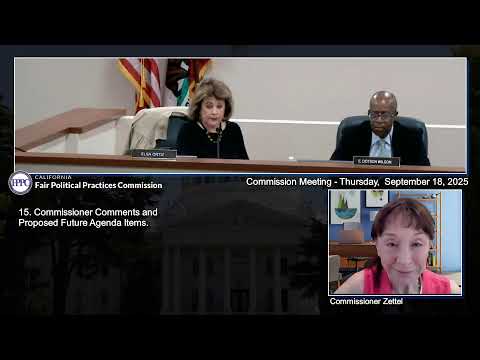
The California Fair Political Practices Commission approved its consent calendar Sept. 18 after staff briefed commissioners on two enforcement matters on the calendar and introduced the commission's new enforcement chief.
Chair Robert Silver introduced Kendall Bonebrake as the commission's new chief of enforcement and said the role is one of the commission's most important. Bonebrake thanked the commission and acknowledged assistant chiefs Angela Brereton and Christopher Burton, who led the enforcement division while the chief position was vacant.
Staff then summarized two matters on the consent calendar. The first involved a Treisman committee matter: staff said Treisman, who ran for Fresno County judge, received a $30,000 loan from his father that was deposited into Treisman's personal account and later transferred to the campaign committee; staff said the campaign statements identified the loan as coming from Treisman rather than his father and therefore did not disclose the true source.
The second summary concerned the city of Hanford. Staff said a mailer was distributed by utility billing to about 18,150 residents roughly 12 days before a sales-tax ballot measure (Measure F). Staff said that the mailer cost about $2,000.1958 39 (as reported in the stipulation) and did not include required advertisement disclosures (for example, "ad paid for by" and the committee name). Staff also said the independent-expenditure or 24-hour reports required in the period before the election were not filed. Commissioners discussed how to distinguish factual informational materials from advocacy, repeatedly citing the regulation factors of style, tenor and timing. Commissioner Brandt summarized the approach for staff and counsel: if the communication focuses on verifiable facts it may be permissible; bold advocacy language or clear voting instructions is a different inquiry.
Staff corrected a typographical error in the Garden Grove matter cited in the executive staff report (one figure listed as 11,000 was corrected to $1,500). Staff also reported that one item originally on the calendar (item 6) had been removed at the respondent's request to pursue settlement and would be returned to a future calendar if not settled.
After discussion, Chair Silver moved and the commission approved the consent calendar (items 3—5 as revised). Commissioners Brandt, Ortiz, Wilson, Zettel and Chair Silver voted in the affirmative.
Ending: The commission approved the consent calendar and welcomed the new chief of enforcement; staff will return unresolved matters to a future agenda and continue to provide advice and materials to local governments on election communications.