Get Full Government Meeting Transcripts, Videos, & Alerts Forever!
Get email alerts on the Municipal Finance topic
No spam. Unsubscribe anytime.
Covington reports steady revenues through second quarter; property taxes, REET and business tax collections meet or exceed expectations
Summary
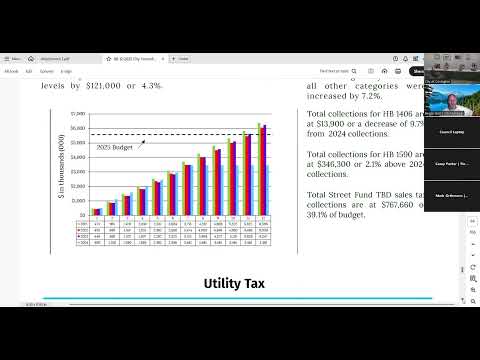
City staff told the City Council on Aug. 12 that through the second quarter the city has collected about $1.7 million in property taxes (52% of levy), $557,000 in real-estate excise taxes (69% of budget) and nearly $1.2 million in business-and-occupation collections, putting the general fund on track for 2025.
The Covington City Council heard a second-quarter financial report Aug. 12 showing revenues generally tracking budget and several individual categories outperforming 2024. Finance staff said collections through the end of June included about $1,700,000 in property-tax receipts (52% of the city’s $3.3 million levy) and roughly $557,000 in real-estate excise tax collections, or about 69% of budget for that category.
City finance staff presented the report during the council’s Aug. 12 meeting and noted the city’s mix of revenues is producing stable results despite some softening in retail sales. “Through second quarter, we’ve received about $1,700,000… It’s 52% of our levy, and our levy this year is $3,300,000,” finance staff said.
The presentation emphasized several specifics that shape the revenue picture. Real-estate excise tax (REET) collections reflected 27 new-home sales, 128 existing-home sales and six lot sales in the quarter; average existing-home price reported was $644,525 and average new-home price $836,840. Finance staff said new-home prices were down about 18% from the same period last year and existing-home prices down about 4.8% year over year.
Business and occupation (B&O) tax receipts have been stronger than initially estimated. Finance staff reported roughly $1.2 million in second-quarter B&O payments to date, representing about 95% of the adopted budget estimate so far — a significant increase over earlier, more conservative estimates while the city gauges the new revenue stream.
Other highlights in the report included: - Sales-tax-related collections (the city’s portion of general sales tax and special local taxes) were about 52.6% of budget, with construction and food-service categories growing year over year even as retail was slightly down (about 1.7%). - Utility-tax receipts were up about $192,000 compared with the same quarter in 2024 and totaled roughly 55% of budget. - Street-fund revenues trailed the 50% mark in part because January–February cash flows are accrued back into the year at fiscal-year-end; staff said timing explains the apparent shortfall and that the fund will look stronger after accruals. - The city’s cash and investments totaled about $46,000,000, with approximately $36.4 million in a local government investment pool earning about 4.4% and nearly $9.5 million invested outside the pool at a higher weighted average yield.
Staff also reviewed capital and impact fee balances: street impact fees were reported at just over $2,000,000 and park impact fees at just over $621,000, with staff noting those pots are largely earmarked for specific projects already approved by the council.
Council members asked clarifying questions about new-home price trends and the data available to compute price per square foot; staff said their standard data feed does not include square footage, only sale price and permit counts. Council members also pressed on the size and timing of projected B&O revenue, and staff reiterated that estimates would be refined as additional quarterly reports arrive.
Votes at a glance: during the Aug. 12 meeting council members approved the meeting agenda and later approved the consent agenda. Both procedural motions were moved and seconded on the floor; the mayor called for the ayes and the motions were approved as announced on the record.