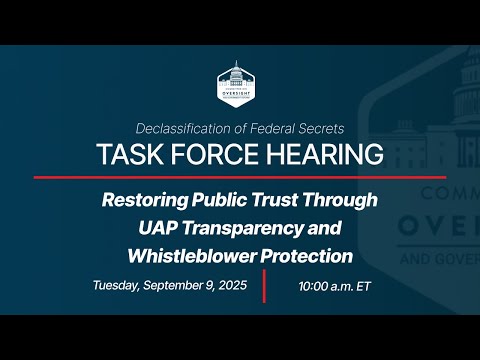
House task force hears military witness accounts of UAP encounters and presses for declassification, whistleblower protections
Get AI-powered insights, summaries, and transcripts
SubscribeSummary
A House Oversight task force convened a hearing where current and former service members described UAP incidents at Vandenberg Air Force Base, aboard USS Jackson and at Langley; witnesses and watchdogs urged greater transparency, stronger protections for whistleblowers and access to classified records.
Chairwoman Luna opened a House Oversight and Reform task force hearing on unidentified anomalous phenomena, saying: "This is about national security, government accountability, and the American people's right to the truth." The panel heard testimony from multiple current and former service members, a career investigative reporter and government watchdogs who described encounters, alleged retaliation against whistleblowers, and obstacles to congressional oversight.
Former Air Force security police officer Jeffrey Nusatelli testified that multiple incidents occurred at Vandenberg Air Force Base between 2003 and 2005, including an episode he and others now call the "Vandenberg Red Square," and another in 2005 in which he said a 30-foot-diameter sphere of light hovered above his backyard before accelerating away. "The truth remains hidden, classified and silenced by fear, retaliation, stigma and confusion," Nusatelli told the task force, and said base records requested under FOIA show routine destruction of police logs on a three‑year schedule.
Active-duty U.S. Navy Senior Chief Alexandra Wiggins described a Feb. 15, 2023 encounter in the Whiskey 291 warning area off Southern California while aboard USS Jackson. She said sensors and visual observations recorded a self-luminous "Tic Tac"‑shaped object that paired with three similar objects and then left with "no sonic boom and no conventional propulsion signatures." Wiggins urged standardized, stigma‑free reporting, preservation of sensor metadata and stronger protections for sailors who report encounters.
Former Air Force intelligence analyst Dylan Borland described a 2012 incident at Langley when he said an approximately 100‑foot equilateral triangular object hovered roughly 100 feet above him, caused his phone to fail, and then climbed rapidly to commercial flight level. Borland said a later process of reporting and pursuing inspector‑general complaints led to career retaliation and interference with his security‑clearance records; he told the task force the aftermath demonstrates a chilling effect on potential whistleblowers.
Veteran investigative reporter George Knapp, who testified as a private citizen, outlined a paper trail he said supports long‑running government interest in UAPs, including programs he described as having studied or attempted to obtain unusual materials. Knapp said documents he obtained from Russian sources describe Soviet collection and analysis programs and that private contractors including Lockheed and companies tied to Robert Bigelow have been involved in handling related materials. He urged the committee to pursue money trails and contractor files.
Joe Spielberger of the Project On Government Oversight framed the testimony in standard whistleblower terms: "Whistleblowers are the first line of defense to root out waste, fraud, abuse of power, and corruption in our government," he testified, and urged Congress to shore up independent protections, appeals and remedies for national security whistleblowers.
Members pressed witnesses on whether U.S. agencies had followed up on specific incidents, the availability of original recordings and whether the All‑Domain Anomaly Resolution Office (AARO, the Defense Department office that coordinates UAP reporting) and related entities had been forthcoming. Witnesses and several members criticized earlier public AARO reporting as incomplete; Nusatelli and others said some records are now in the possession of AARO and the FBI while other base records are unavailable because of routine retention policies.
The task force discussed legislative and oversight next steps. Multiple members referenced proposed measures or past attempts to expand protections and disclosure, including Representative Tim Burchett's UAP whistleblower protection proposal and language labeled the "UAP Disclosure Act" that some members said had been blocked in earlier plateaus of the congressional process. Members indicated plans to seek additional documents, to pursue secure classified briefings in a Sensitive Compartmented Information Facility (SCIF), and to introduce a motion to request immunity for some witnesses so they can testify in a secure setting without risking espionage prosecution; the panel did not adopt any formal subpoena or immunity order during the hearing.
The task force did not take any formal votes during the hearing. Members closed by asking for additional written submissions and documents and announcing that, pursuant to committee procedure, members would have five legislative days to submit materials for the record. The panel signaled further oversight activity, possible SCIF sessions and follow‑up requests to the Department of Defense, AARO, the Intelligence Community Inspector General and other agencies.
The hearing combined firsthand witness accounts of specific incidents, reporting on archival documents and program history, and policy recommendations from a watchdog group. Members of both parties repeatedly urged stronger declassification routines where national security permits, better interagency sharing with civilian aviation authorities, and legal protections that would reduce the risk of retaliation for service members and intelligence personnel who report or corroborate sensor evidence. The task force said it would continue to gather classified and unclassified material and consider legislative options to preserve reporting channels and enable oversight.