Get Full Government Meeting Transcripts, Videos, & Alerts Forever!
Get email alerts on the Traffic And Transportation topic
No spam. Unsubscribe anytime.
Commission approves PCH speed enforcement pilot under state law; cameras to be sited at five regions
Summary
Under Senate Bill 1297, the commission authorized installation of up to five speed enforcement camera regions on Pacific Coast Highway; violations will be civil fines reviewed by the sheriff's office.
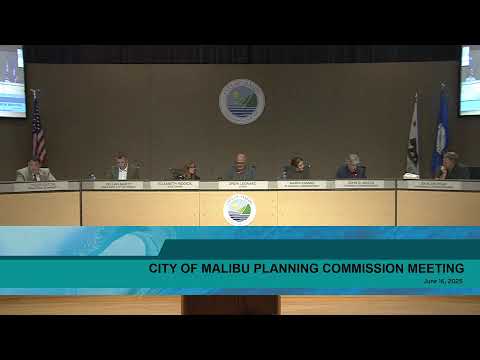
The Planning Commission on June 16 approved a coastal development permit to install speed feedback signs and speed enforcement cameras at five locations along Pacific Coast Highway under the authority of Senate Bill 1297.
Staff said the program authorizes five regions with camera capability and associated feedback signs; each region will allow northbound and southbound enforcement. The identified locations are Decker Canyon Road, Morning View Drive, Latigo Canyon Road, Carbon Canyon Road and Tuna Canyon Road. Equipment will sit on purpose‑built poles roughly 20 feet tall and use solar power and embedded cameras; staff said equipment will operate day and night.
Engineer Nadia (project manager from Public Works) and consultant representatives described the program's compliance steps. Under the state law and staff implementation plans, the camera system will capture potential violations, the Los Angeles County Sheriff's Department will review footage to confirm a violation, and a civil fine will be mailed to a vehicle's registered owner. The program is configured to capture speeds 11 mph or more over the limit; fines and graduated violation buckets are set by state guidelines. The revenue first covers program costs; any excess must be spent on local traffic‑calming measures.
Public comment recommended alternative camera placement (Big Rock was suggested as a higher‑risk intersection than Tuna Canyon). Commissioners asked whether additional camera regions could be added; staff replied the state law limits each participating jurisdiction to five regions and that locations were chosen based on engineering data, safety analysis and sheriff input. The commission adopted staff's recommended resolution by unanimous roll call.
Staff said they expect construction and Caltrans encroachment permitting this fall and a roughly 90‑day construction period once permits are obtained; the program also requires a council‑adopted implementation policy before citations are issued.