Get Full Government Meeting Transcripts, Videos, & Alerts Forever!
Get email alerts on the Housing Rental Policy topic
No spam. Unsubscribe anytime.
Duluth council holds first reading on tenant ‘right to repair’ petition and alternative landlord-training ordinance
Summary
City council heard public comment and staff briefings June 27 on a petition ordinance (25-15) backed by Duluth Tenants Union and a council-drafted alternative (25-16). The clerk certified 3,752 petition signatures; councilors emphasized legal review, life-safety capacity and enforcement timelines ahead of a final vote at a special meeting July 1.
DULUTH, Minn. — The Duluth City Council on June 27 held the first reading of two competing measures that would change how landlords and tenants handle minor repairs: a petition ordinance (Ordinance 25-15) from the Duluth Tenants Union and Housing Justice Center and a council-drafted alternative (Ordinance 25-16).
The clerk reported that the petition was certified on June 23 with 3,752 verified signatures; state law and the Duluth charter require the council to act on the petition within statutory deadlines. If the council passes the petition ordinance unchanged it becomes law after 30 days; if the council does not pass it the petition goes on the November ballot. The council has also received an alternative ordinance and may vote on that alternative within a shorter charter window.
Why it matters: The petition would give tenants a formal “repair and deduct” pathway for small repairs, with a 14-day notice window before a tenant may arrange repairs. Supporters say it speeds fixes that otherwise grow worse; opponents argue the petition could expose tenants to legal or financial risk and could conflict with existing state anti-retaliation protections. Council discussion focused on legal implications, city enforcement capacity and how training, inspection and fee schedules would be handled if either ordinance advances.
Public comment and stakeholder views
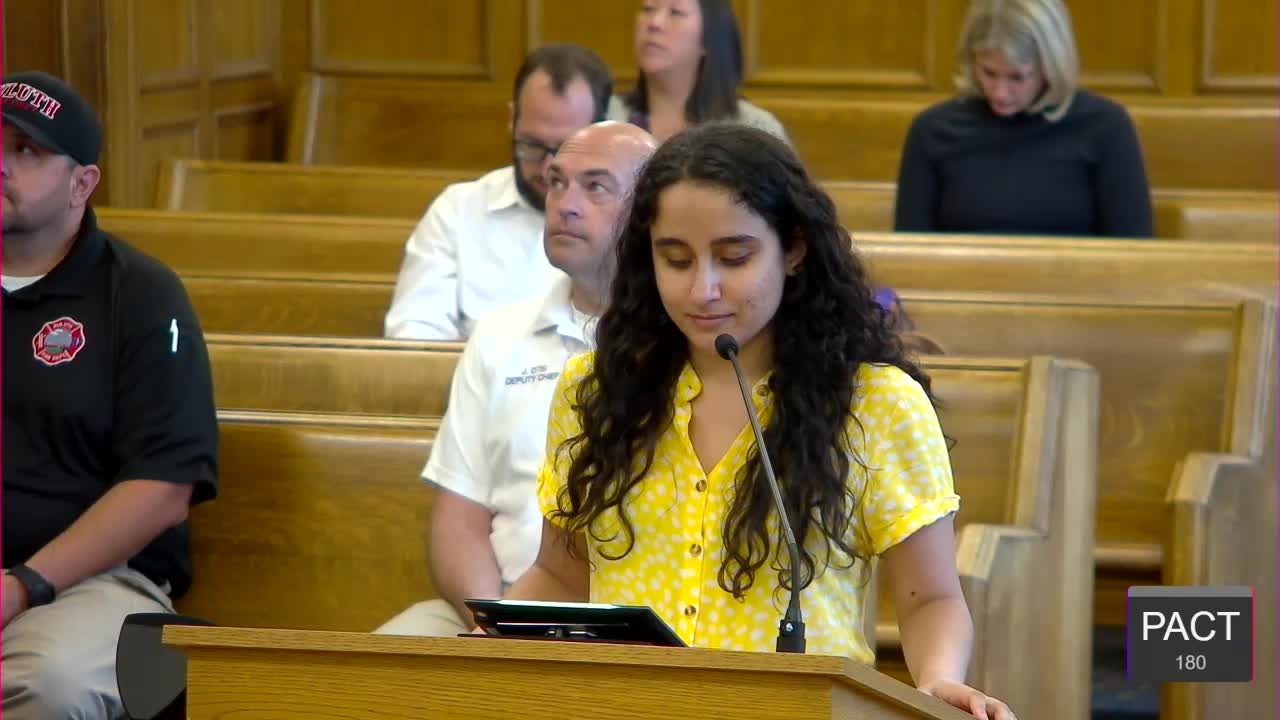
Three members of the public spoke during the meeting. Ginka Tarnowski, who identified herself as a resident of the Fifth District, said parts of the petition “frighten me” and warned a tenant-led repair option could produce landlord–tenant court disputes and potential tenant liability.
Riley Barnhart, government affairs director for the Lake Superior Realtors Association, told the council the association "respectfully oppose[s] the proposed ordinance 25-15 in its current form," arguing the petition creates operational uncertainty for small local housing providers by allowing tenants to deduct repair costs after 14 days without required third‑party verification or inspection.
David Shaffroth, a public commenter, described the time and cost of complying with development and permitting processes and called additional regulatory steps a potential disincentive for new apartment construction.
Council and staff briefings
Clerk Denham summarized the charter process for petitioned ordinances and the council’s scheduling obligations: the council must vote on the petition ordinance within 20 days of the clerk’s certificate (on or before July 14), and an alternative ordinance must be passed within 10 days of certification (on or before July 3) if the council wishes to pursue that route. The clerk also explained that if the council adopts an alternative ordinance petitioners have a 10-day window to withdraw names; if at least 50% of signers withdraw, the alternative becomes effective and the petition will not appear on the ballot.
Councilors asked for legal and administrative review before the final vote. City Attorney Laird said he had no prepared comments that evening; other city attorneys (Loehr was later referenced by speakers) and city staff committed to provide a cover memo and recommendation before the next meeting. Councilor Forsman explicitly requested a legal perspective and asked staff to provide it before the scheduled July 1 special meeting.
Life-safety capacity and enforcement
Deputy Chief John Otis and life-safety manager Greg Smith described how the city handles complaints and inspections. Otis said the department prioritizes landlord–tenant complaints: "We prioritized landlord-tenant complaints. So if a tenant complaints, it comes in, that goes to the top of the queue." He and Smith distinguished that the department’s backlog is on initial or renewal inspections rather than active complaint responses. Smith said anecdotally the department had received about 20 complaints since the beginning of the year and currently had “not more than 2 open.”
Staff explained which problems the city enforces under codes (building code, fire code and the International Property Maintenance Code) and which issues are typically referred to community partners such as One Roof HRA or JusticeNorth (for example, mold itself is not a codified enforceable item absent an identifiable code-based cause).
Training, licensing and penalties
Under the council’s alternative ordinance (25-16), landlord training that had previously been voluntary would be made a licensure requirement; landlords would submit proof of attendance as part of rental-license renewal. Greg Smith said training is already offered through life safety, One Roof and the HRA and that externally taught courses covering the city’s material would be acceptable.
On penalties, Otis said the city currently uses an administrative citation process with escalating fines of $200, $400, $800, $1,600 and $2,000 and that repeated or severe violations could lead to license revocation. Councilors discussed the possibility of adjusting fines if the alternative ordinance passes; several councilors said they want penalties set at levels that will encourage compliance.
Timing and next steps
Councilors scheduled a second special meeting for the second reading and final vote on Tuesday, July 1, at 6 p.m. Several councilors asked staff to deliver a legal memo, a life-safety capacity memo and a recommended fee-schedule adjustment before that vote. Councilor Nephew (one of the ordinance authors) and others said the alternative ordinance is intended to put the responsibility for repairs on property owners while preserving enforcement authority for the city.
No final council action on either ordinance was taken on June 27. The meeting concluded with a procedural motion to adjourn; the council recessed to reconvene for the July 1 special meeting to consider second readings and any final votes.
Ending
The council’s next consideration of these measures is set for a special meeting on Tuesday, July 1, at 6 p.m., when staff will present additional legal and administrative analysis and the council may take final votes or decide whether to place ordinances on the November ballot.