Get Full Government Meeting Transcripts, Videos, & Alerts Forever!
Get email alerts on the Education Achievement topic
No spam. Unsubscribe anytime.
Maury County schools report gains in proficiency but remain below state averages
Summary
District officials presented 2025 statewide test proficiency results showing year-to-year gains in most subjects while acknowledging the county remains below state proficiency levels in ELA, math and science. Staff described efforts underway to target transitional grades and teacher recruitment.
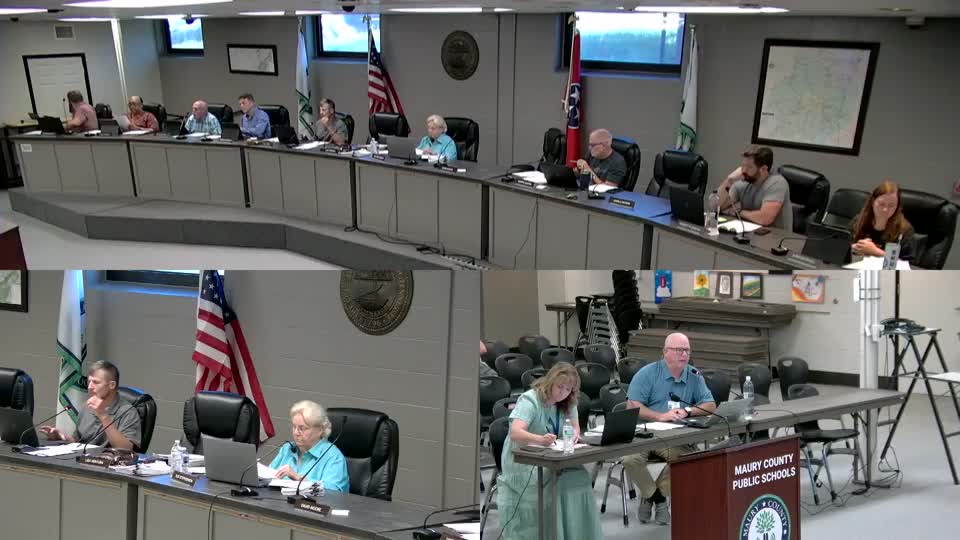
Maury County schools reported gains in student proficiency across multiple subjects for the 2024–25 school year, but officials stressed the district still trails statewide proficiency rates.
During a board meeting presentation, district staff laid out the district’s 2025 proficiency numbers and year-over-year changes for English/language arts, math, science and social studies. “For the third straight year, we have shown overall gains in these four subject areas,” said Mister Stacy, the district presenter. Stacy told the board that 34.1 percent of Maury County students scored proficient in overall ELA, compared with 40.9 percent statewide. In math the district recorded 30.2 percent proficiency; science was 38.6 percent; social studies 39.8 percent, with notable year-to-year gains reported in some middle-grade social studies measures.
Stacy and other presenters emphasized the difference between proficiency (a snapshot of performance on this year’s test) and growth measures that the state releases later. “Our TVOS data which will show growth has yet to be released,” Stacy said. He and other staff urged caution in interpreting single-year proficiency rates but highlighted multi-year gains: since 2021 the district has reported double-digit percentage-point increases in ELA (13.1 percent) and math (12.4 percent).
Board members and staff discussed specific gaps by grade. Stacy pointed to transitional years as a recurring challenge: students moving from elementary to middle school and from middle to high school tend to show dips in some measures, particularly in middle-grade math. He said principals had raised concerns about acclimation when students move to new schools and schedules.
Miss Ventura, who answered procedural and timeline questions from the board, said school- and cohort-level results remained under state embargo and would be released in coming weeks. Board members pressed for additional, actionable detail: Miss Stevenson asked what interventions target students who are “approaching” or “below” expectations and requested a public packet summarizing interventions, curriculum supplements such as the district’s 95% Phonics supplement, RTI screening/tiering and tutoring programs. Ventura said the district uses tiered interventions (RTI), targeted tutoring and supplemental materials and would provide a written list of district supports and the school improvement plan timeline.
Board members also noted staffing trends: Stacy reported human resources had reduced vacancy counts to 26 positions across the district (teachers and educational assistants) and said recruitment had improved in the past three years. The presenters said the district expects additional data releases that will include school-level proficiency and state growth (TVAS/TVOS) measures; the district intends to present that material at upcoming meetings.
The board did not vote on policy changes during the presentation; the item was informational and staff said more detailed, school-by-school data would be available when the state lifts its embargo.