Get Full Government Meeting Transcripts, Videos, & Alerts Forever!
Get email alerts on the Arts Licensure topic
No spam. Unsubscribe anytime.
Arts steering committee to seek statewide input on K–12 license changes; findings due to board in November
Summary
The board heard a follow-up from the Arts Steering Committee proposing consolidation and new licenses in K–12 arts licensure. The committee will survey arts educators and administrators and hold listening sessions, with a report to the board at the November meeting.
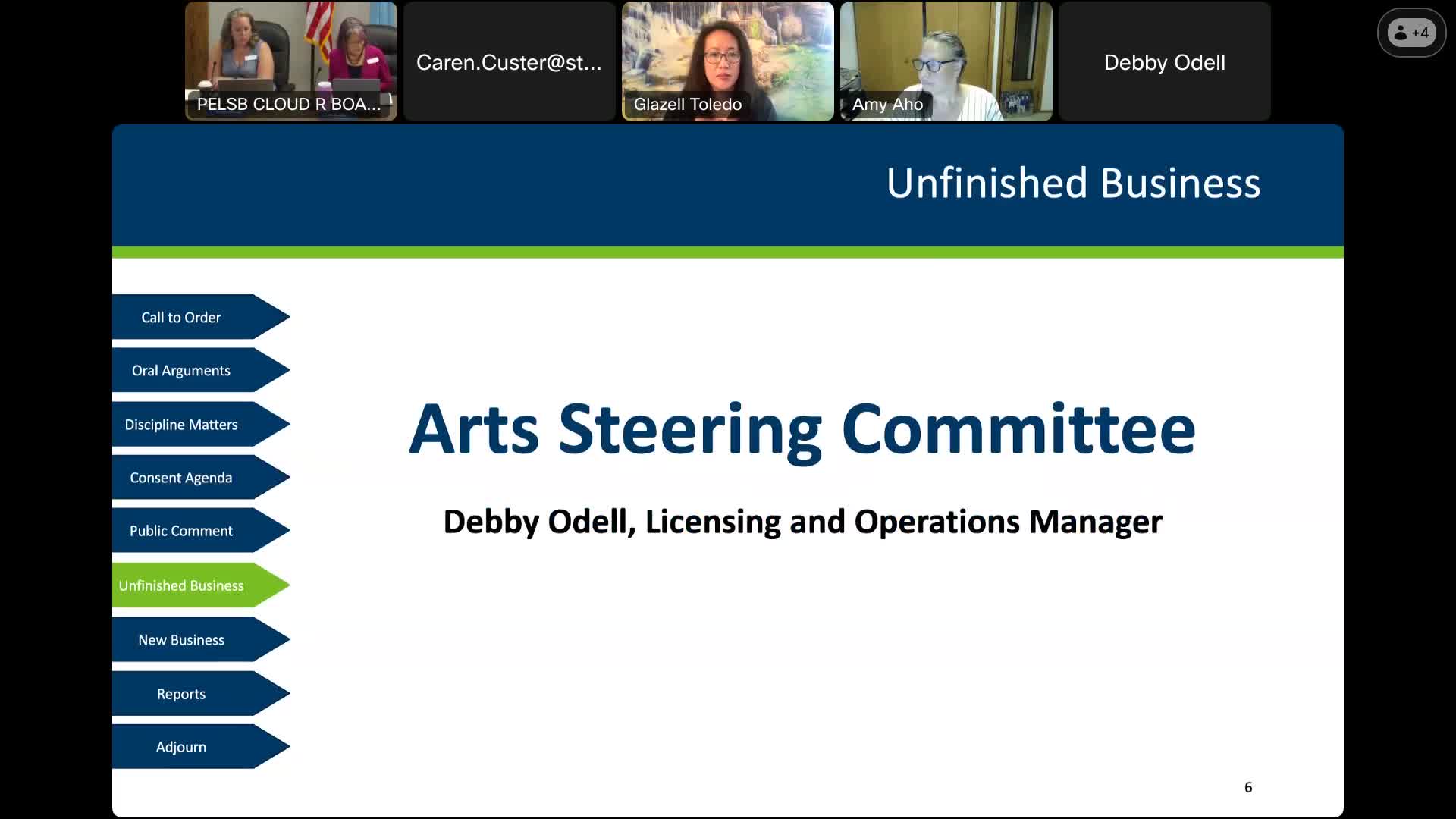
The Professional Educator Licensing and Standards Board received a follow-up report from the Arts Steering Committee on July 18 that recommended changes to K–12 arts licensure and outlined a plan to collect statewide input before the board considers formal action.
Debbie O’Dell, the board’s Licensing and Operations Manager, reported that the steering committee’s recommendations include discontinuing the existing K–12 classroom and K–12 instrumental/classroom licenses in favor of a single K–12 arts license, creating a separate K–12 media arts license, and retaining existing K–12 dance and theater licenses alongside separate dance and theater credentials. The committee framed the media-arts proposal around specific Minnesota Department of Education (MDE) standards for media arts; the committee said those standards prompted the consideration of a distinct license, though it also flagged concerns about whether there are enough assignments to support a full-time media-arts license versus an endorsement model.
O’Dell said the committee will solicit feedback from arts educators, administrators and higher-education partners through a survey and listening sessions organized with state arts-education organizations. The steering committee expects to report survey results and recommendations to the full board at the November board meeting. The July report was informational; no board action was required at the July meeting.
Board member responses and requested clarifications
Several board members urged targeted outreach to practicing music teachers and building administrators. Ms. Shoemaker asked whether K–12 vocal should instead be combined with theater and dance (given overlapping responsibilities such as school musicals); O’Dell said she would refer that suggestion back to the committee for consideration and possible inclusion in survey questions. Ms. Ajo (referred to in the transcript) urged that the voices of currently practicing music teachers be emphasized because including vocal instruction in different license combinations is the major change under discussion.
Dr. Payne (identified in the meeting transcript as an administrator who provided input to staff) asked that administrators be included in the survey outreach because they are responsible for course scheduling and can speak to student demand for new courses such as digital media. Several board members asked that the survey collect demographic and geographic response data so the board can see response counts by region and license area (elementary versus secondary, for example) before final action.
Media-arts question
O’Dell told the board the committee’s interest in a K–12 media arts license was prompted by MDE’s separate media-arts standards. The committee raised the practical question of whether there are enough media-arts assignments statewide to justify a full separate license; the steering committee is considering whether an endorsement model or a separate license is more appropriate and will use survey input and district assignment data to guide that decision.
Timing and next steps
- The committee will conduct surveys and listening sessions with arts educators and administrators and intends to present findings at the November board meeting. - Board members requested the November report include response counts, geographic breakdowns and demographic information to show which licensure areas and regions contributed input. - Staff said they will ensure administrators are included among survey recipients and will work to collect assignment-count data and other contextual information for the board’s review.
Why this matters
Any change to K–12 arts licensure affects how districts assign teachers, how educators are prepared and how schools schedule arts programming. The board signaled that it does not intend to rush to new licenses without statewide input and data on assignment volumes and regional needs.