Get Full Government Meeting Transcripts, Videos, & Alerts Forever!
Get email alerts on the Wastewater And Utilities topic
No spam. Unsubscribe anytime.
Spring Hill moves forward on wastewater upgrades, seeks early procurement amid TDEC grant conditions
Summary
City staff and the board discussed expanded designs for the wastewater treatment plant, TDEC ARP grant conditions, and authorized task orders; staff recommended pre-ordering eligible equipment to meet grant compliance and lead-time constraints.
The Spring Hill Board of Mayor and Aldermen heard detailed staff updates on wastewater-plant upgrades, federal-state grant conditions and procurement timing, and approved a task-order agreement for design work while staff sought authority to pre-order parts of the project’s equipment packages.
City staff described three parallel efforts: a reuse pilot, a reservoir feasibility study and an expanded design for a new centrifuge/dewatering building and related headworks and equalization basin work. The design work for the centrifuge building and related systems is estimated to be substantially larger than earlier projections, and staff told the board the full construction cost could be in the tens of millions.
“Now it’s estimated to be somewhere between 16 and 18,000,000,” a city staff presenter said of the expanded project estimate, explaining the original smaller retrofit approach was judged likely to require additional, costly corrections later.
The projects are supported in part by American Rescue Plan Act funds administered through the Tennessee Department of Environment and Conservation (TDEC). Staff reported two compliance concerns raised by TDEC administrators: first, pre-purchasing capital equipment that would not yet be installed could jeopardize audit compliance; second, lead times for advanced-treatment equipment risked missing grant spending deadlines.
To resolve the first concern, staff proposed identifying approximately $900,000 in eligible, supply-category items from a 30 percent design package for the centrifuge project and pre-ordering those items for on-site storage until installation. For the reuse pilot, staff recommended preserving roughly $1,450,000 in the TDEC award to preprocure small-scale advanced-purification components with long lead times.
Mayor Fitter and several aldermen expressed support for moving forward. “Go forward and order it,” Mayor Fitter said. Alderman Fuqua asked staff about sequencing and the status of the public-works/fleet site relocation that would free a pad for the project; staff said they are running multiple tracks in parallel and would prepare a construction-ready pad for the reuse pilot while the larger design process continues.
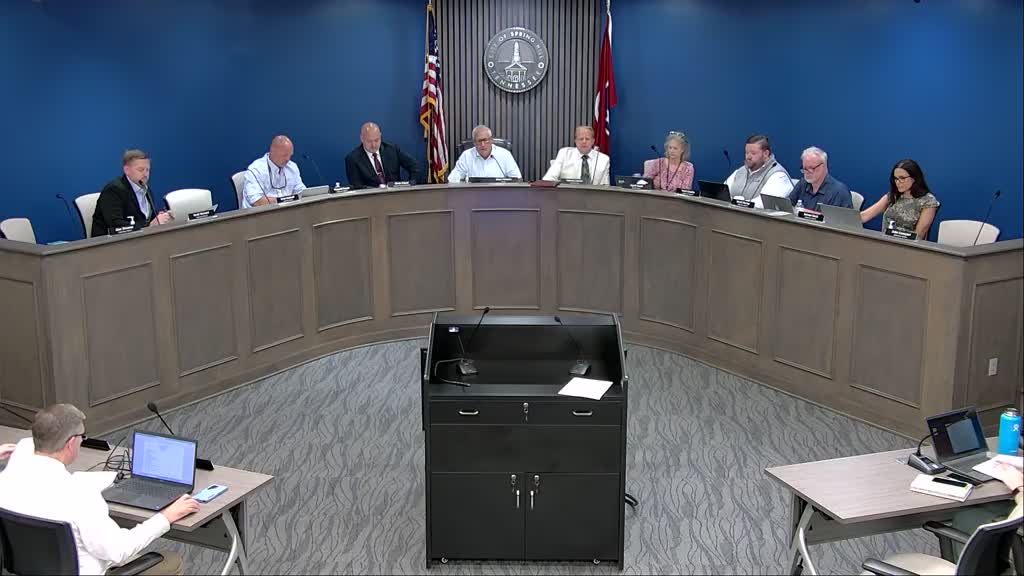
As part of the meeting’s voting agenda, the board approved resolution 25-166 authorizing water-and-sewer task-order agreements with Thomas & Hutton, the engineering firm referenced for feasibility and design work. The motion to approve was made by Vice Mayor Linville, seconded by Alderman Murray, and passed 6–0.
Staff also displayed a 30 percent design package for the centrifuge building that shows a multistory building with elevated centrifuge bays, internal conveyors for solids handling and redundant site access to accommodate high-storm events and truck movements. Staff said coordination with Duck River Electric for an additional redundant power feed is a critical dependency for the designs.
The board did not conduct a formal roll-call on the proposed early procurement of equipment; instead staff asked for board concurrence to proceed with pre-purchasing eligible supplies under the TDEC guidance and to pursue early procurement of reuse-pilot units to meet lead times. No alderman objected to the staff recommendation at the meeting. Staff said they would finalize eligible-item lists with consultants and communicate a procurement plan to TDEC and to the board.
Ending: The board approved design task orders and gave staff direction to proceed with plans to pre-order eligible equipment where the grant rules and audit advice allow; staff will return with finalized procurement lists and any contract documents required to execute purchases.