
Narima members press municipalities to review MOU for shared emergency truck after substation fire
Get AI-powered insights, summaries, and transcripts
Subscribe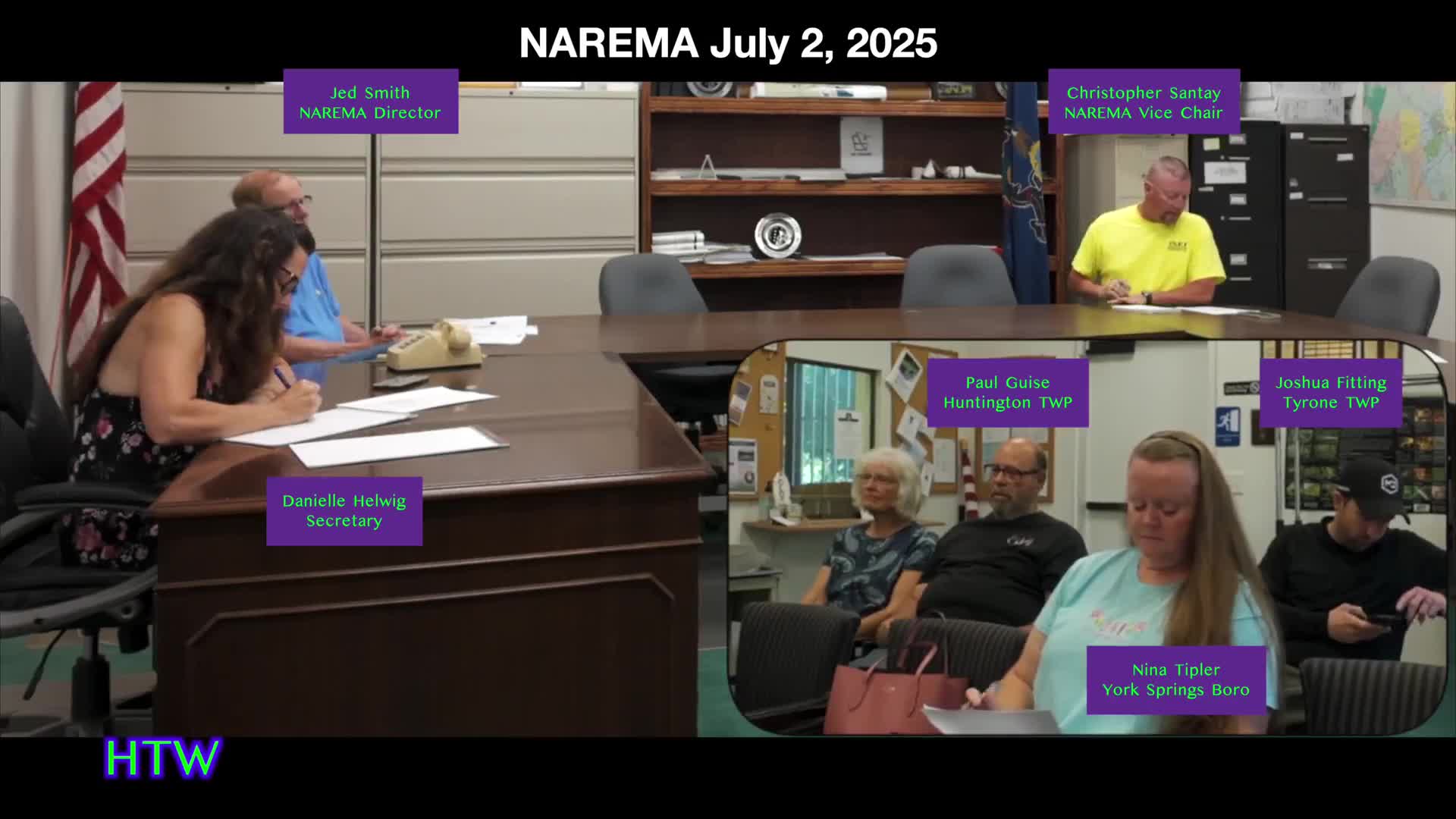
Summary
At the July 2025 Narima meeting, members discussed circulation of a memorandum of understanding for a shared emergency response truck, recent deployment to a substation transformer fire, hazmat and cleanup concerns, and directed municipalities to return comments by August.
Narima members at their July 2025 meeting urged all participating municipalities to review and return comments on a memorandum of understanding (MOU) governing a shared emergency response truck, after the vehicle was deployed to a substation transformer fire that raised cleanup and coordination questions.
The MOU was circulated to member municipalities for legal review, and Jed, a Narima staff member, asked townships to "vet that through your legal, and see if your board will take action on that" and to send any suggested additions or corrections back to him by August so Narima can consolidate comments and move the agreement forward.
The MOU and the truck’s readiness were discussed in the context of a recent deployment to a transformer fire that spilled mineral oil. Members said a cleanup contractor and state personnel were on scene; one attendee recalled seeing environmental crews removing oil at the site. Meeting participants flagged long-standing concerns about older transformers possibly containing PCBs and stressed the need to confirm whether any hazardous materials remain.
Why it matters: the MOU would govern use, maintenance and shared costs for a regional asset that Narima members said can provide power, lighting and cleanup support after local incidents. Participants said a clearer agreement and better equipment planning would speed follow-up support and help track costs for insurance or utility reimbursement.
What members discussed and decided - Circulation and review: Jed said the MOU has been sent to municipalities including York Springs, Huntington Township, Manallen and Butler and asked members to "reply all" and resubmit comments; he requested that comments be returned to him by August. Narima will consolidate municipal feedback and pass it to Bernie for review at the Narima level before re-circulating to municipalities. - Fuel wording edit: Members noted a wording issue in the draft that required fitness for diesel engines. One participant said the draft instructed users to "return it with a full tank of gas," and another proposed changing the language to "a full tank of fuel or a full tank of diesel," to avoid fueling errors. - Equipment and storage: Attendees said some FEMA-recommended gear — fire extinguishers and basic supplies — is already in the truck, but command-center equipment (radios, computers) has not been installed pending finalization of the MOU and a collective decision on required functionality. Tyrone Township has a three-sided covered area behind a salt shed where the truck is currently stored, which participants described as preferable to leaving it fully exposed. - Recent deployment and cleanup: The truck was deployed to support response at a substation transformer fire. Municipal and county staff reported the utility had environmental crews onsite and that mineral oil was being controlled with absorbents. Participants emphasized documenting any municipal costs (trucking, sand, staff overtime) because those expenses may be reimbursable from the utility’s insurance. One participant said the power company already faced heavy regulatory scrutiny and a large fine; others said that did not relieve municipalities from documenting costs. - Hazmat concerns: Members said older transformers are more likely to contain PCBs and noted the transformer inspected bore a nameplate dated 1965. They urged county and state follow-up to confirm whether hazardous materials remain and to verify the environmental cleanup. - IDs and personnel readiness: The group discussed issuing identification cards for deputies and other personnel while the county ID machine remains out of service. Members agreed to investigate local providers (for example, Staples) to produce IDs if state equipment remains unavailable. - Planning and contact lists: Staff said appendices and forms related to duties and responsibilities will be circulated after the July 4 holiday and that the full updated plan is expected within weeks to two months. Members also agreed to update and share cell phone contact lists; attendees noted confidentiality concerns and the need to limit distribution to necessary personnel. - Operational guidance for deployments: Members clarified the truck is a follow-up support vehicle, not a lights-and-sirens first-responder vehicle. Deployment protocol discussed: the deputy of the affected township would ordinarily retrieve and operate the truck, although local conditions could result in other nearby personnel assisting.
Formal actions recorded - Motion to approve minutes from the March 6, 2025 meeting: A motion was made and seconded; the minutes were approved by voice vote (outcome: approved; tally not specified in the record). - Motion to adjourn: Moved by Josh and seconded by Kenny; approved by voice vote (outcome: approved).
Next steps and timeline - Municipalities were asked to review the MOU and return comments to Jed by August so Narima staff can consolidate feedback and present a revised agreement at a subsequent meeting. - The group set a regular meeting for Nov. 5, 2025, with Paul volunteering to host; members also agreed to convene earlier if consolidated MOU comments warrant another meeting.
Context and background Narima members discussed the truck in light of a recent substation transformer incident that temporarily disrupted power and required coordination among local deputies, the utility, county and state responders. Participants said the event highlighted gaps in backup power, cell-tower and generator resilience, and the need for clearer mutual-aid procedures, equipment inventories and documentation practices for reimbursement. Several members recommended that townships evaluate their emergency power and cooling-station capacity, check on backup fuel and generator run-time, and confirm evacuation and assembly points for schools and day-care facilities.
Ending: Members emphasized that completing the MOU and inventorying command-center needs are priorities before investing in radios or computers. Jed asked municipalities to return written comments by August so Narima can finalize the agreement and begin outfitting the truck for follow-up deployments.