Get Full Government Meeting Transcripts, Videos, & Alerts Forever!
Get email alerts on the Surveillance Technology topic
No spam. Unsubscribe anytime.
Sheriff presents Flock license-plate readers; commissioners press for data safeguards and transparency
Summary
Ramsey County sheriff briefed the board on Flock stationary and vehicle-mounted license-plate reader (LPR) cameras. Commissioners asked about retention periods, data-sharing with federal agencies, auditing and costs; staff agreed to circulate a follow-up memo and FAQs and explore memoranda of understanding.
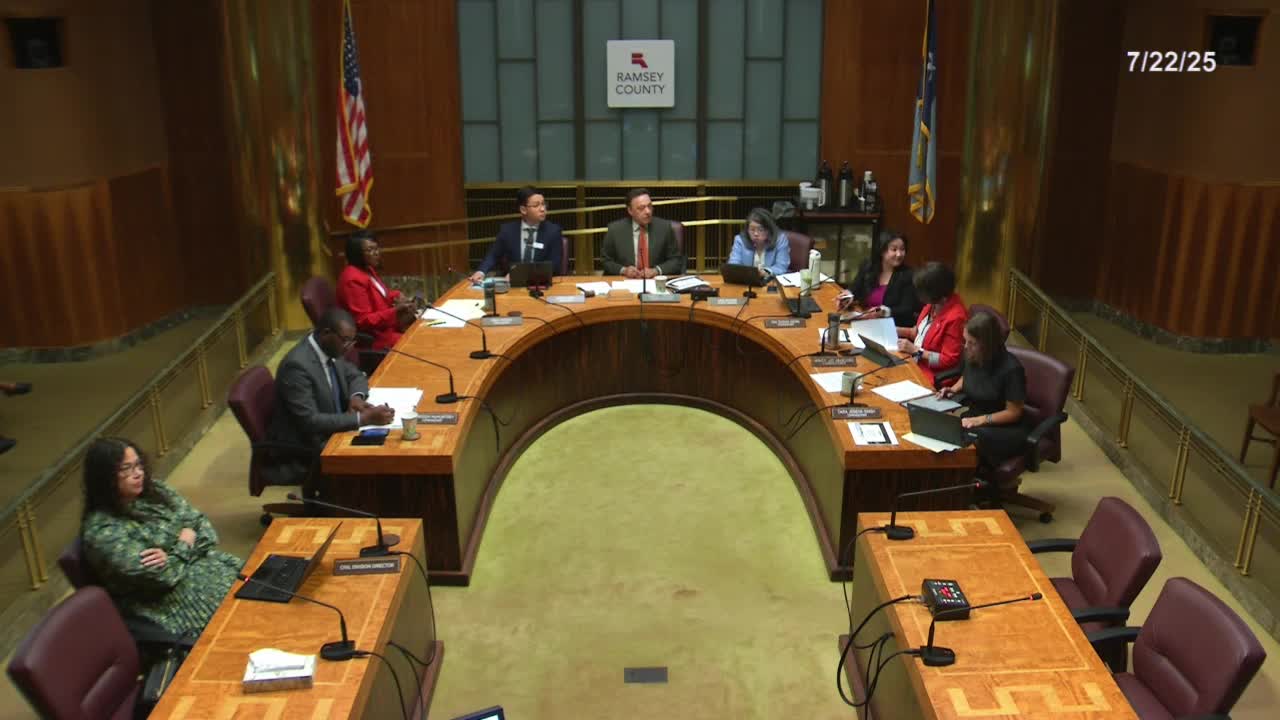
The Ramsey County sheriff's office presented on July 22, 2025, about the county's use of Flock license-plate reader (LPR) cameras and the broader network of cameras used by local contract cities and partner agencies. The briefing prompted sustained questions from commissioners about privacy safeguards, data retention and third‑party access.
Sheriff (Bob) described the system as a tool primarily aimed at identifying stolen vehicles and transmitting alerts to officers. "The whole concept here is to let officers on the street really know when a stolen car is driving through their jurisdiction. It's really about stolen cars," he said. He told commissioners that Flock photographs each car that drives by, reads license plates and checks state and NCIC databases for stolen plates or active "cops alerts."
Key details presented: the sheriff said Flock's policy deletes collected LPR data every 30 days (he contrasted that with state law, which he described as requiring deletion after 60 days and said agencies may delete earlier). He said the user cost is roughly $3,000 per camera per year for the service fee; Flock has sometimes subsidized installation costs. The sheriff also outlined where cameras are deployed under county contracts: examples cited included North Oaks (12 cameras), Shoreview (9), Little Canada (3), Vadnais Heights (4), White Bear Township (2) and five county "at-large" cameras placed at high-traffic entries to identify stolen vehicles coming from Minneapolis and other jurisdictions. He said the metro network includes roughly 32 agencies and about 250 cameras and noted St. Paul operates about 16 cameras of its own.
Commissioners raised privacy and governance questions. Multiple members asked what would happen if a federal agency sought access to the data. The sheriff said the county tracks access and maintains an audit trail of searches and users and that the sheriff's office audits use, but he acknowledged local governments have limited power to prevent federal warrants and that the county's best leverage is to limit access on the front end. "We have taken steps to not share our data with out state or agencies out of the state," he said, adding that the county was mindful of incidents in Colorado where data was accessed by federal agencies.
Commissioners asked for clearer written commitments. A county staff member told the board the county would provide a follow-up memo and a FAQ on the sheriff's office webpage and said staff would coordinate with the county attorney on possible memoranda of understanding with Flock regarding notifications and data seizure procedures.
Other points of discussion included: - Use cases: the sheriff described using LPR matches to find stolen cars that are often used in other crimes; he said about half the stopped stolen cars have firearms present. - Technology limits: the sheriff said the county currently uses still-image LPR captures rather than continuous video or AI-based facial recognition; he said any future adoption of facial recognition or new AI tools would be brought to the board for policy discussion. - Interagency sharing: the sheriff said most metro partners share data but some agencies opt not to; the county limits cross-state sharing. - Cost and funding: the sheriff said most cameras are paid for by the cities that host them; the county pays for five at-large cameras using grants (the Department of Commerce auto-theft prevention grant was cited as a source for some county-funded cameras).
Next steps: County staff committed to produce a follow-up memo, a FAQ for the sheriff's webpage, and to consult the county attorney's office about legal protections and notification requirements should an external party seek access to county-held LPR data. Commissioners requested written confirmation that Flock or any vendor would notify the county if there were a legal request seeking county data.
Ending: The presentation prompted broad questions but no formal board action. The board asked staff to return with written clarifications on retention, auditing, access controls and any contractual commitments regarding notification of legal demands.