Get Full Government Meeting Transcripts, Videos, & Alerts Forever!
Get email alerts on the Government Center Construction topic
No spam. Unsubscribe anytime.
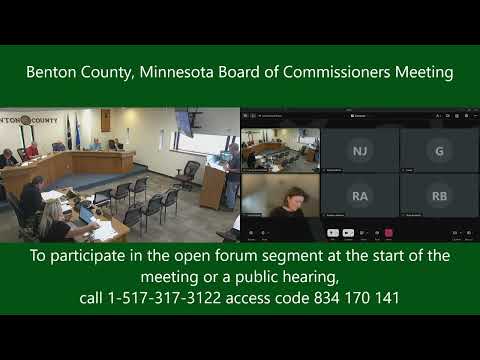
Benton County approves low bid and selected alternates for new government center, opts for 20-year HRA financing plan
Summary
The Benton County Board of Commissioners voted 4–1 to award the construction contract for a new government center with selected alternates and later approved pursuing HRA lease-revenue financing with a 20-year term. Commissioners kept natural stone in the base bid, deferred one finish decision and heard public criticism about process and safety.
Benton County commissioners voted on July 1 to accept the low construction bid for a new county government center with selected alternates, and later authorized financing on a 20-year schedule.
The board approved the bid award, as recommended by county staff and consultants, with selected contract alternates that include upgraded security glazing (Alternate A3), a concrete foundation option (Alternate A6 as bid), and a heated snow/ice-melt entrance system (Alternate H1). The board recorded a roll-call vote of four in favor and one opposed; Commissioner Popp voted no. The contract total reported at the meeting was $24,238,319.33.
The vote followed a multi-hour presentation by county construction advisors and the construction manager, who reviewed 10 alternates that would raise or lower the contract price. County consultant Pete Phillipi of Integrity Group and an associate identified the alternate prices and recommended a selection of alternates that staff said balanced durability, maintenance and cost. Northland Securities advisor Jessica Green briefed the board separately on bond timing and term options.
Why it matters: The decision commits county funds and a financed debt service stream to a multi‑million-dollar building and to specific construction choices that affect long‑term maintenance and safety. Several public speakers said the process should have included a countywide vote and urged different safety measures; commissioners said scheduling and earlier public discussions shaped their options now.
Board action and what was accepted
- The board moved and seconded a motion to accept the recommended low bid with the alternates described by staff; the motion carried on a 4–1 roll call (Benoit: aye; Heine: aye; Popp: no; Johnson: aye; Gapinski: aye). The stated contract total after the accepted alternates and other adjustments was $24,238,319.33.
- The group agreed not to accept Alternate A2 (the manufactured stone veneer) and to keep the natural stone in the base bid; commissioners and the construction team cited durability and long‑term maintenance as the rationale for retaining natural stone in the base design.
- The board did not finalize a choice for Alternate A1 (linear metal plank ceiling through portions of the entry and foyer) and directed staff to return with more specific pricing for the vestibule-only option before a final selection.
Key alternates and amounts discussed (figures presented by staff)
- Alternate A1 (linear metal plank ceiling): upgrade quoted at $49,425 (decision deferred for a vestibule-only price). - Alternate A2 (manufactured stone veneer in lieu of natural stone): presented as a $92,000 deduction if accepted; the board voted to remain with natural stone (not accept A2). - Alternate A3 (upgraded laminated/security glazing at public counters): add $10,500 (accepted). - Alternate A4 (pergola at south entrance): add $27,250 (deferred/optional for later installation). - Alternate A5 (framed vs. furniture partition at second-floor secure area): $13,550 (board favored furniture-wall flexibility to preserve future reconfiguration). - Alternate A6 (poured concrete foundation in lieu of CMU/deduction): credited at $47,926 (accepted as part of the contractor pricing approach shown). - Alternate P1 (not using PEX plumbing): add $17,260 to go to copper runs (board majority preferred retaining PEX where appropriate). - Alternate H1 (snow/ice-melt system for the main front entrance and east steps): add $107,400 (accepted; board cited pedestrian safety and potential MCIT implications). - Rooftop screening option (shown to affect contractor selection and add about $117,000 plus a $2,600 contract adjustment if chosen): the group generally deferred rooftop screening; staff noted screens can be added later and may affect maintenance access.
Financing path, timing and term choice
After the construction vote the board heard from Jessica Green of Northland Securities about financing options. Green described three approaches: HRA lease‑revenue bonds, EDA lease‑revenue bonds and certificates of participation (COPs). She summarized timing differences: COPs would be the quickest to deliver proceeds (sale in mid‑August with proceeds mid‑September), EDA lease bonds slightly later (early September sale, early October proceeds), and HRA lease‑revenue bonds the slowest because they require redevelopment‑plan steps and planning‑commission review (sale likely in late September with proceeds in late October if the procedural steps are met).
"So to recap, the quickest option is the certificates of participation. The longest option is those HRA lease revenue bonds," Jessica Green said during her presentation.
Several commissioners said they preferred the HRA route despite the longer schedule because the county has used that method in the past and because it aligns with representations previously made to residents. The board agreed to pursue the HRA lease‑revenue option and to schedule the necessary land‑use steps (planning commission and local municipal actions) as quickly as practical.
On bond term, the board voted to issue debt with a 20‑year repayment schedule. A motion for a 15‑year term failed for lack of a second; a subsequent motion for a 20‑year term passed unanimously on roll call. Green told the board each five‑year increase in term raises total interest cost by roughly $4 million in the modeling presented; the board discussed debt‑service impacts on county levies and heard staff estimates that a 20‑year structure would raise the first‑year levy roughly 8% compared with no bond issuance.
Public comment and next steps
Several residents spoke during public comment, criticizing the timetable and urging more public involvement. One resident said, "I can't find, I can't find 10 people that tell me we should build this," and urged the board to involve a citizens' advisory committee or to place a referendum before voters. Other commenters urged installation of physical security gates and stronger protective measures at public counters.
Staff and consultants said some elements (for example, rooftop screens and the metal plank ceiling through only the vestibule) can be added later in construction or during the shop‑drawing/material procurement phase. The board asked staff to return with a vestibule‑only price for Alternate A1 and to move forward with the next procedural steps for HRA financing, including attempting to schedule planning‑commission and municipal actions as soon as notice requirements permit.
The board's action on the bid award, alternates and the 20‑year financing term creates an approved contract scope and an identified financing path; further ministerial steps remain (final contract documents, contractor mobilization dates, planning‑commission findings related to HRA bonds and a formal bond sale timetable).