Get Full Government Meeting Transcripts, Videos, & Alerts Forever!
Get email alerts on the Tenant Right To Repair topic
No spam. Unsubscribe anytime.
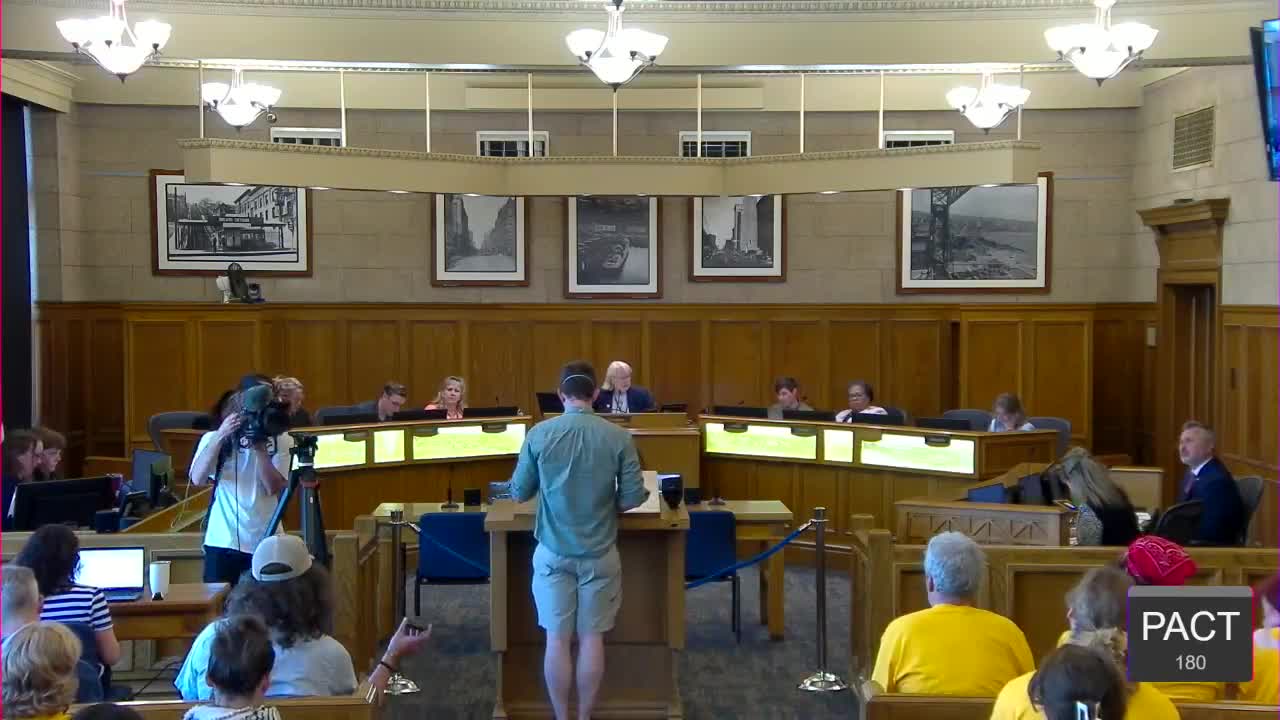
Duluth council rejects tenant-drafted "Right to Repair" petition ordinance after hours of testimony
Summary
A petition ordinance known as the "Duluth Right to Repair," submitted by Duluth Tenants Union and Housing Justice Center, failed in a roll call vote at a special meeting of the Duluth City Council.
A petition ordinance known as the "Duluth Right to Repair," submitted by Duluth Tenants Union and Housing Justice Center, failed in a roll call vote at a special meeting of the Duluth City Council. The council rejected the petition ordinance 2–6 after extensive public comment both for and against the measure.
Supporters told the council the petition responds to widespread delays in getting small but urgent repairs completed and empowers renters to make documented repairs and deduct costs when landlords do not act. “We know the systems don't work,” said Aaron Rose, a disabled combat veteran and renter, describing months-long delays he experienced getting a basement door and locks fixed. “This gives us a tool, not to punish landlords, but to protect ourselves.”
The petition ordinance was placed on the council agenda after Duluth Tenants Union gathered nearly 6,000 signatures, of which the clerk later reported approximately 3,762 valid signatures. Dozens of Duluth renters, many identifying themselves as members of Duluth Tenants or Duluth Tenants Union, spoke in favor at the meeting, describing delayed repairs that created health or safety risks, mold, or months without functioning appliances.
Opponents — including Realtors and the Duluth Area Chamber of Commerce representatives — argued the measure would create legal and financial risk for small housing providers and could reduce the rental housing supply. “This ordinance would disrupt that balance and create new challenges for the small local landlords who provide much of the Duluth rental housing,” said Gloria Allen, chair of government affairs for the Lake Superior Area Realtors. Riley Bernhardt, government affairs director for Lake Superior Area Realtors, told the council that the ordinance would allow tenants to deduct repair costs after 14 days without third-party verification and could encourage litigation and claims of retaliation.
Council debate focused on legal risk, enforceability, and the effect of approving a petition ordinance versus crafting policy through the council's regular amendment process. Several councilors expressed concern that the petition text had not received a formal written legal review from the city attorney because of constraints tied to campaign and petition timing. Councilor Forsman and others also cited example outcomes from other Minnesota cities where ballot measures had produced unintended consequences for housing markets.
The roll call on Ordinance 15 recorded two yes votes and six no votes. The clerk's roll call in the minutes lists the motion as moved by Owls and seconded by Derwachter; the council vote result was recorded as "The ordinance fails 2 to 6." The council discussion and the vote distinguish between public comment (many speakers urging the measure), direction to staff (questions to life safety and the city attorney), and formal action (the failed motion).
The council's rejection of the petition ordinance does not remove the measure from the November ballot at this stage; the petition process and clerk certification timeline remain part of the record and the petition will proceed to the ballot unless signatures are withdrawn or other procedural steps occur. Several councilors and staff described an administrative process that would allow signatories to remove their names from the petition ahead of the election if they choose.
The meeting also produced an alternative city ordinance (Ordinance 16) intended by council authors to shorten repair timelines and add landlord training and tenant notifications; that measure passed in a separate vote (see separate article).