Get Full Government Meeting Transcripts, Videos, & Alerts Forever!
Get email alerts on the Comprehensive Plan Musa topic
No spam. Unsubscribe anytime.
Lake Elmo begins Imagine 2050 planning; council split on expanding MUSA and on Tri Lakes sewer options
Summary
City planning staff kicked off Imagine 2050 discussions and asked council whether to study MUSA boundary expansions and sewer options for Tri Lakes shoreline neighborhoods with aging septic systems.
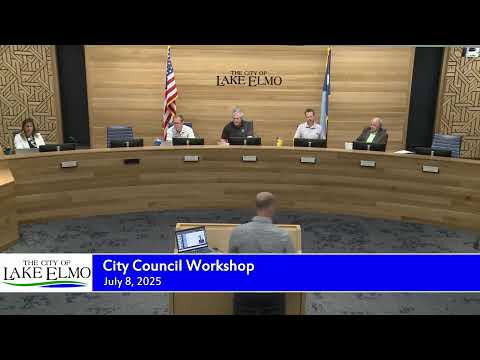
Lake Elmo staff opened the Imagine 2050 comprehensive‑plan planning process at the July 8 workshop and sought council feedback on whether to study expansions of the city’s MUSA boundary and whether to examine sewer options for the Tri Lakes area, where some shoreline lots have aging septic systems.
Jason (planning) reviewed the timeline for Imagine 2050: Met Council system statements were expected in fall and staff said the city must have a draft plan by June 2028 and a final adopted plan by December 2028 to meet regional review steps that include adjacent‑jurisdiction comment periods. He cautioned that Met Council guidance has tightened and that MUSA expansions could be harder to approve than in prior cycles.
The first policy question staff posed was whether parcels south of Stillwater Boulevard that are not currently inside the MUSA should be studied for possible inclusion. Council responses varied. Several council members — including the mayor, Council Member Hern and Council Member Holt — said they were cautious about broad MUSA expansion and preferred studying options only where infrastructure efficiency or demonstrated need exists. Council Member Holt suggested targeted outreach to external funding partners and congressional representatives to seek grants if major public‑safety or infrastructure projects are needed.
The Tri Lakes area prompted a separate technical discussion. Jack (engineering) showed maps and said portions of Olson Lake and Lake Jane shorelines include smaller lots originally platted in the 1960s and that the city has received periodic resident requests related to failing septic systems. Staff described multiple engineering options, including low‑pressure sewer or lift‑station solutions pumping to nearby municipal systems. Jack said those projects could be expensive and would require detailed inspections of existing systems and coordination with the county and Met Council.
Council members asked staff to include Tri Lakes in the Imagine 2050 scoping work so the city can evaluate feasibility, costs, grant potential and how any expansion affects density calculations required by Met Council. Several members emphasized the need for a factual basis — inspections, counts of failing tanks and a hydrologic/environmental assessment — before committing to sewer construction that could carry high costs for property owners and the city.
Staff will scope study areas, coordinate with Met Council and the county on requirements, and return with technical and fiscal analyses that show how MUSA options and Tri Lakes sewer scenarios would affect the city’s overall density obligations and infrastructure capacity.