Get Full Government Meeting Transcripts, Videos, & Alerts Forever!
Get email alerts on the County Budget Millage topic
No spam. Unsubscribe anytime.
Monroe County sets tentative FY2026 millage at 2.7327%, advances $678.6 million budget after staff cuts and reserve planning
Summary
Monroe County officials on July 15 advanced a proposed $678,600,000 fiscal 2026 budget and set a tentative countywide millage rate of 2.7327% to send on TRIM notices.
Monroe County officials on July 15 advanced a proposed $678,600,000 fiscal 2026 budget and set a tentative countywide millage rate of 2.7327% to send on the Truth in Millage (TRIM) notices. The board also approved a 2.9% across‑the‑board cost‑of‑living increase for county employees and constitutional officers, approved a package of cuts and vacant‑position eliminations to reduce operating costs, and directed an increase in reserves to bolster the county’s disaster readiness.
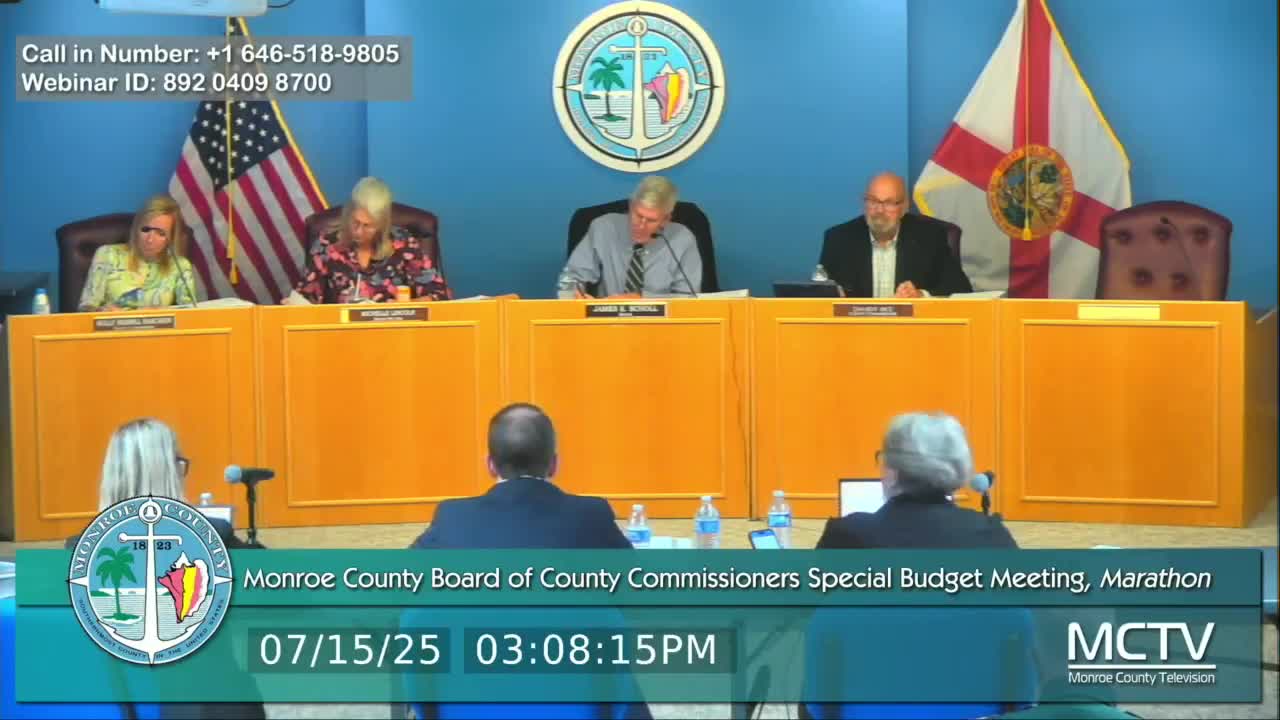
The budget presentation and votes came during a special budget meeting in Marathon where John Quinn, assistant budget director in the Office of Management and Budget, laid out the proposed FY2026 plan and the process for certification and two upcoming public hearings. Quinn told the board the proposed budget “includes cost of living adjustments for BOCC and constitutional officers employees” and reflected both unavoidable contract increases and a set of departmental reductions identified during budget roundtables.
Why it matters: County leaders said the changes respond to forecasted revenue declines — including a pause in some state resale revenues used by the Land Authority — and to emerging uncertainty about future federal disaster aid. County staff and the board said they want to increase cash reserves to limit the county’s exposure if federal reimbursement rules change. Lisa Tennyson, a county staff presenter on emergency and disaster funding risks, warned that “the direction seems to be overall that ... FEMA is moving towards a smaller footprint with more disaster responsibility and cost shifting to states and local governments,” and said the county should plan for a larger local share of disaster costs.
Key facts and decisions
- Budget total: Proposed FY2026 total appropriations $678,600,000 (FY2025 adopted: $715,700,000). Quinn said the year‑over‑year reduction of about $36.1 million primarily reflects lower capital spending and reduced one‑time pandemic surpluses.
- Ad valorem levy: The proposed total ad valorem property tax levy in the budget documents was about $168,800,000.
- Tentative millage: After discussion and a package of board decisions that freed roughly $1.9 million in savings, the board voted to raise the tentative countywide millage to 2.7327. County staff said that increase, combined with the identified cuts, would provide roughly $4 million of added capacity directed to emergency/disaster reserves.
- Employee pay: The board approved a 2.9% cost‑of‑living increase for BOCC employees and constitutional officers’ non‑bargaining staff. That action passed on a roll call (Commissioner Lincoln: yes; Commissioner Raschein: yes; Commissioner Rice: yes; Mayor Scholl: yes; Commissioner Cates absent). The budget still reflects larger, negotiated increases for some bargaining units where applicable.
- Staffing and cuts: County staff described three tiers of cuts. Level 1 and 2 reductions (already implemented in the proposed budget) totaled approximately $12.2 million for county departments and about $1.36 million for outside agencies, and accounted for roughly 36.3 FTE reductions. The board voted to eliminate a set of vacant positions from the Level 3 list (roll call: Lincoln, Raschein, Rice, Scholl — all yes); staff said the seven vacant positions were spread across facilities maintenance, libraries, building services and code compliance and represent a portion of the potential $4.3 million in Level 3 savings previously described by staff.
- Human services and outside agencies: The board left the Human Services Advisory Board (HSAB) allocation at the reduced level included in the proposed budget (a 50% reduction from prior funding levels had been included earlier in the development process). The board did vote to remove a remaining FY2026 allocation of $16,225 for the Historic Florida Keys Foundation (roll call yes) as identified in the Level 3 proposals.
- Transit and pilot programs: The board approved several transit‑related reductions: foregoing expansion of a pilot service into Islamorada and Key Largo and eliminating the county‑funded Freebee program on Stock Island/Key West. Those votes were recorded by roll call as the board worked through Level 3 options.
Discussion vs. formal action
Board members described the Level 3 list as a menu of potential additional cuts to increase reserves if the board chose not to raise millage. Several commissioners said they were reluctant to make deeper cuts to social services and to staff that deliver core public services; others pushed to raise tentative millage now to preserve flexibility through hurricane season and to bolster reserves in the face of uncertain federal policy. The board ultimately approved a motion directing staff to set a TRIM notice millage that would generate an additional $2 million (combined with the roughly $1.9 million of cuts) so that the county’s emergency/disaster reserves would grow by about $4 million compared with staff’s baseline projection.
Public comment and community concerns
Dozens of public speakers addressed the board in the meeting’s public comment period. Much of the public testimony appealed to the board to restore funding for local nonprofits, for the Monroe County Extension Service (UF/IFAS), and for addiction‑recovery and homelessness programs. Samuel’s House, Monroe County Extension, literacy and health service providers, and other nonprofits described the local services they provide and warned that cuts would reduce services for residents and weaken the county’s ability to meet needs after a storm. Multiple speakers emphasized that extension programs bring substantial external grant and university match funds for every county dollar invested.
What’s next
The board certified the tentative millage rates for TRIM notices and scheduled two public hearings: a first public hearing and tentative budget adoption on September 3, 2025 (Harvey Government Center, Key West) and a final hearing on September 10, 2025 (Murray Nelson Government Center, Key Largo). Staff will return with updated revenue estimates, any additional state or federal guidance, and revised budget numbers for the board to adopt the final FY2026 budget.
Ending note: The board framed its actions as an attempt to balance service priorities, employee pay and disaster preparedness while responding to revenue pressures. Commissioners repeatedly emphasized the uncertainty around federal disaster reimbursement and the desire to avoid being tied to a tentative millage too low to permit an adequate reserve increase should federal policy shifts materialize.