Get Full Government Meeting Transcripts, Videos, & Alerts Forever!
Get email alerts on the Infrastructure Boardwalk topic
No spam. Unsubscribe anytime.
Architects outline Navarre Beach boardwalk proposal; parking garage concept prompts cost and use questions
Summary
STOA Architects presented a multi‑component Navarre Beach boardwalk project — a coastal education and visitor center, retail buildings, a food‑truck plaza, pavilion and elevated boardwalk — and a civil‑engineer concept showed an optional multi‑level parking garage that would raise capacity but also add large costs and design tradeoffs.
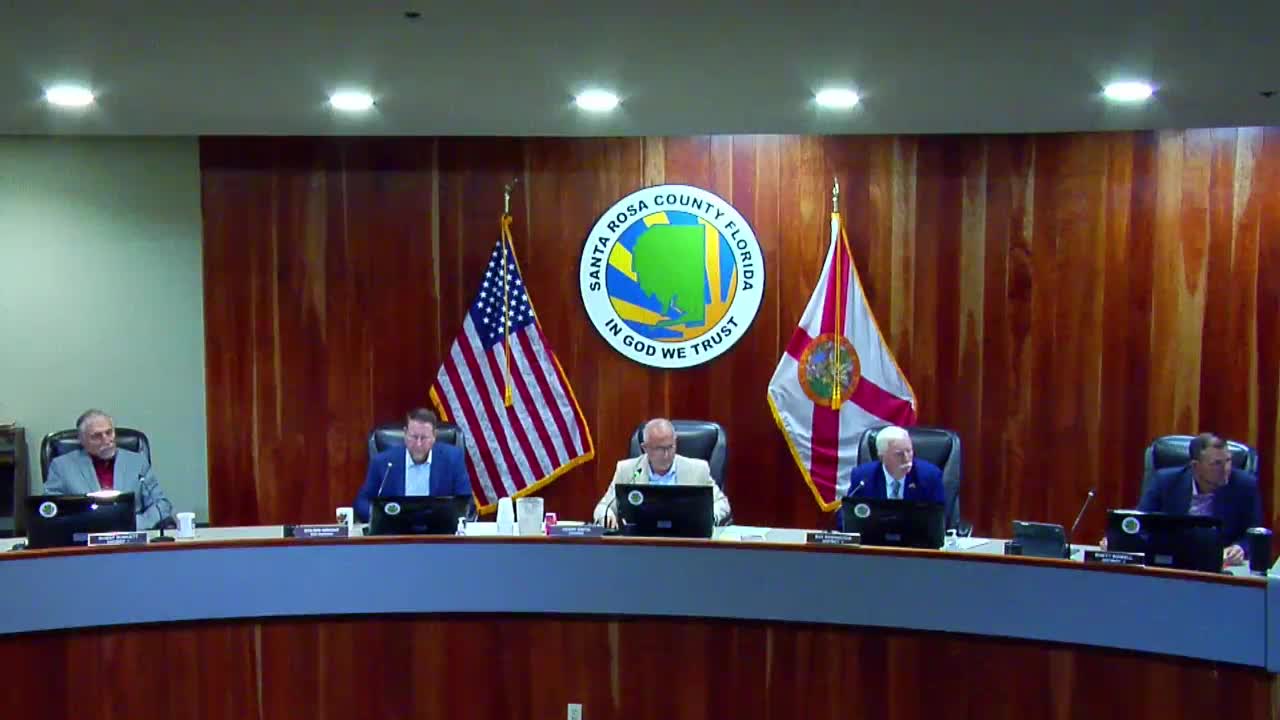
Architects and engineers from STOA Architects and Legacy Engineering presented a concept plan to the Santa Rosa County Board of County Commissioners on July 21 for a multi‑use boardwalk complex at Navarre Beach that would combine an education and visitor center, retail tenant buildings, a food‑truck plaza, an open‑air pavilion and an elevated boardwalk linking the components to the beach.
Cesar Reyes, a principal at STOA Architects, described five project components intended to create a ‘‘sense of place’’ for Navarre: an adaptable coastal education and visitor center with display and meeting areas, a dune walkover, four flexible retail buildings, a roughly 12,000‑square‑foot food‑truck plaza with utilities for vendors, and an open pavilion for gatherings. "This is all tied together with a boardwalk," Reyes said, adding that materials focus on durability and beach compatibility, for example cementitious siding and standing‑seam metal roofs.
A civil‑engineering concept presented by David Tiller of Legacy studied whether a three‑level parking garage could be built on the new surface lot north of the proposed complex. Tiller said a conceptual three‑story structure could add roughly 300–310 spaces to the proposed surface parking (a rough total estimate of about 578 spaces in the footprint shown) but would require more detailed study of foundations, ramps and structural systems. He estimated per‑space costs for structured parking in the region at roughly $30,000–$40,000 per space and called the garage idea ‘‘feasible’’ but subject to further study.
Why it matters: Commissioners said parking capacity, traffic flow, local retail opportunity and resilience to storms should drive design choices. A parking garage would significantly increase capacity but would also add substantial capital cost, change the look and function of the beach entrance, and require further design, permitting and funding decisions.
Commissioner reactions focused on use and resilience. Several commissioners cautioned against broadly designated RV and boat parking because of enforcement and overnight‑stay risks. "I'd be a little concerned about that," one commissioner said of day‑use RV spaces, noting the potential for overnight stays and abandoned trailers. Commissioners also urged sensitivity to hurricane wind loads and asked for building adjustments (for example, hip roofs rather than gables) if that reduces insurance or storm damage risks; the design team said roofs would be standing‑seam metal intended to meet wind‑load requirements.
The civil‑engineer concept included an option to retain RV and boat trailer spaces west of any future garage; the designers described removable bollards and utilities for food trucks (power, water, sewer). Staff and the architects agreed to meet with commissioners and stakeholders for more detailed follow‑ups. The board asked for further study and suggested individual commissioner briefings before returning with a recommended direction.
Clarifying details from the presentation: the visitor/education center is roughly a 5,400‑square‑foot conditioned footprint (designers said the existing building is about 4,600 square feet), retail buildings were proposed at about 3,000 total square feet broken into ~850‑square‑foot modules (dividable), the food‑truck plaza footprint was shown as roughly 12,000 square feet, and the designers indicated portions of the elevated complex would be about 19 feet above sea level—providing vantage and conforming to dune elevation needs.
Ending: STOA, the county engineering staff and commissioners agreed to schedule follow‑up meetings and internal staff work; designers will provide more refined cost scenarios, and staff will return the project to a future commission agenda after commissioner briefings and any additional scope direction.