Get Full Government Meeting Transcripts, Videos, & Alerts Forever!
Get email alerts on the Public Safety topic
No spam. Unsubscribe anytime.
Kissimmee delays final vote on revised noise rules, directs staff to present decibel options and business outreach
Summary
After staff detailed proposed changes to downtown noise measurements and enforcement, including a new "sound impact boundary" concept and higher downtown decibel thresholds until midnight, the commission deferred final action and asked staff to return with multiple decibel scenarios and an outreach/education plan for affected businesses.
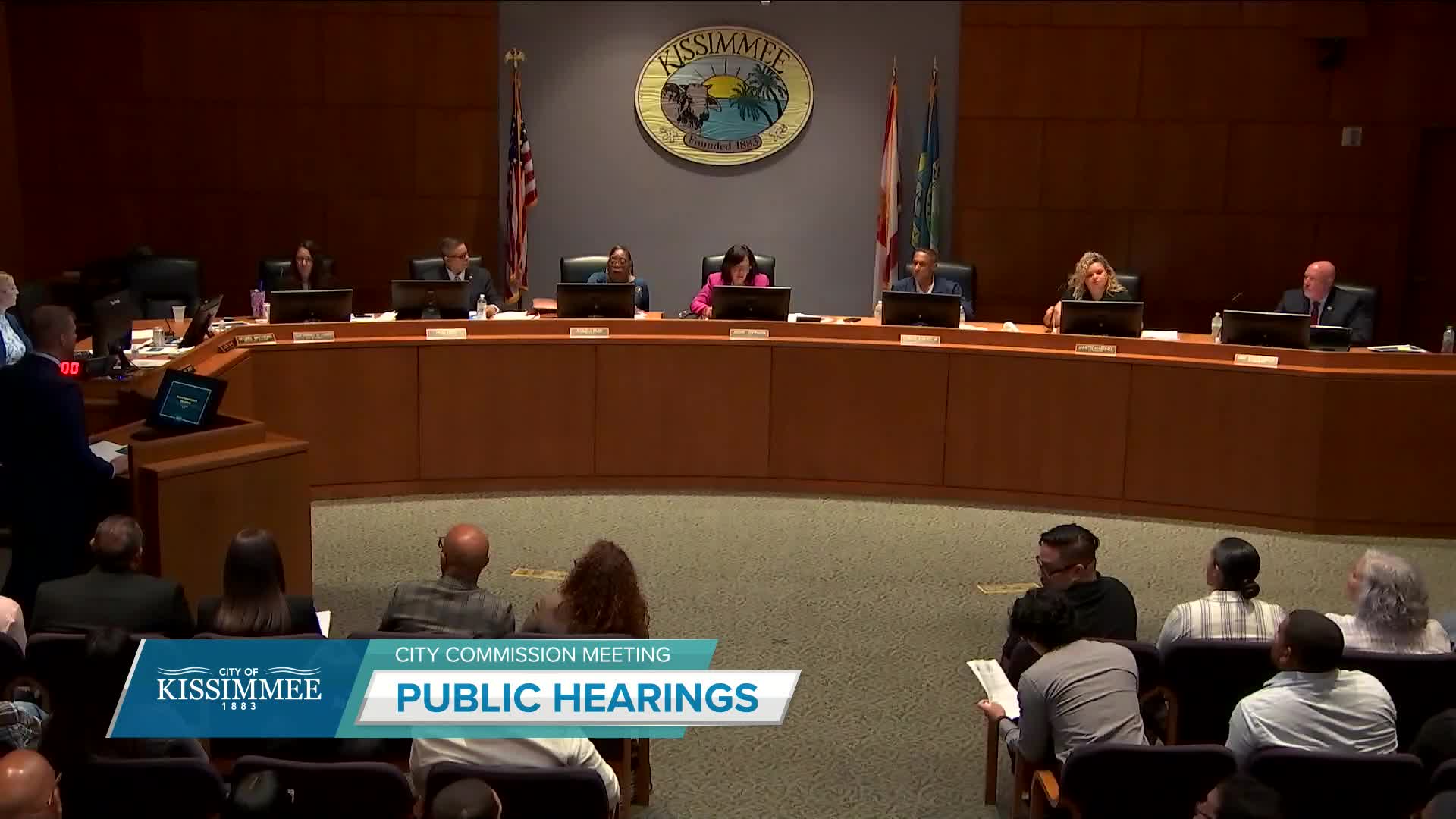
The Kissimmee City Commission paused a final vote on a proposed revision to the city’s noise ordinance Tuesday after a lengthy public hearing and asked staff to return with additional options and an outreach plan for downtown businesses.
Deputy City Manager Austin Blake and Assistant City Attorney Curtis McGehee walked commissioners through the proposed changes to how the city measures and enforces noise complaints, including a new “sound impact boundary” to establish where noise is measured and a change to downtown hours and decibel limits. Blake said the draft would permit higher levels in the downtown CRA — up to 85 A‑weighted decibels until midnight and a step‑down to 75 decibels after midnight — and would retain stricter measurement and enforcement outside the downtown.
Why it matters: The revised rules would change when and how amplified outdoor sound is allowed downtown and make enforcement more consistent citywide. Commissioners asked staff to return with clearer options to balance downtown economic activity and residents’ sleep and quality‑of‑life concerns.
What staff proposed (summary) - Measurement approach: Use a defined “sound impact boundary” (property line, permitted outdoor café footprint or roof/floor boundaries for multi‑story buildings) to determine whether noise exceeds the maximum allowed level. - Downtown CRA: proposed maximum of 85 decibels until midnight, then a reduction to 75 decibels after midnight. No “plainly audible” standard downtown; enforcement would rely on a meter. Citywide, the ordinance retains lower limits and a “plainly audible” enforcement rule outside the CRA after 10 p.m. - Speakers: outdoor speakers mounted to a building or used on sidewalks would still be prohibited after 10 p.m. citywide under current law; downtown meter rules would be clarified for permitted café areas. - Measurement specifics: proposed enforcement uses A‑weighted sound level meters that meet the ordinance’s technical specifications; staff said the measurement period is a 1‑minute sample and the rule treats any exceedance lasting up to 1 minute in a 15‑minute window as a violation. - Fines and enforcement: outside the downtown CRA, first violations would start at $50 with increases up to $500; inside the downtown CRA staff proposed a first citation of $250 and subsequent citations of $500. Repeated violations could be referred to code enforcement and magistrate fines up to $15,000 for irreversible acts; failure to pay citations would shift the matter to the clerk of court.
Public comment and concerns Residents and downtown property managers described being kept awake by late‑night amplified sound and by loud vehicles. Several business owners and operators warned that stricter downtown limits would harm restaurants and nightlife that rely on evening patronage; others said better enforcement of current rules would address most problems. Speakers repeatedly asked about the precise meter specifications and requested the city publish the acceptable meter models and measurement procedures.
Commission direction The commission did not adopt the ordinance on first reading. Instead it asked staff to: 1) present multiple decibel‑level options (different numeric thresholds and geographic footprints within the CRA), 2) prepare an educational outreach program and meetings with affected downtown businesses to explain how the rules would be measured and enforced, and 3) return with any proposed implementation timelines and clarifications about meter specifications and sample collection. The commission also asked staff to coordinate with DBPR/fire and building inspectors for capacity and licensing checks where applicable.
Implementation notes Staff said the ordinance text specifies technical meter requirements and that staff will post that guidance and hold business workshops. The draft also included a proposed 90‑day effective period following adoption, but that implementation schedule will be revisited after the additional outreach and options are prepared.
Evidence and provenance Staff presented the draft at the meeting and cited measurement intervals, the proposed “sound impact boundary” and enforcement thresholds. The commission’s request for outreach and alternative options was adopted in a motion to table the item and return with options.