Get Full Government Meeting Transcripts, Videos, & Alerts Forever!
Get email alerts on the Roofing And Building Envelope topic
No spam. Unsubscribe anytime.
Garland representative outlines multi-option roof repairs for Sebring buildings; restoration budgets range $180K–$600K
Summary
A Garland Roofing representative presented an assessment of multiple low-slope and concrete roofs, offered repair and replacement options with warranties, and advised scanning and competitive bidding; staff discussion included core samples and next steps for quotes.
A Garland Roofing representative presented a building-envelope and roof assessment at a Sebring meeting, detailing repair and replacement options, estimated budgets and warranty terms for several low-slope and concrete roof sections.
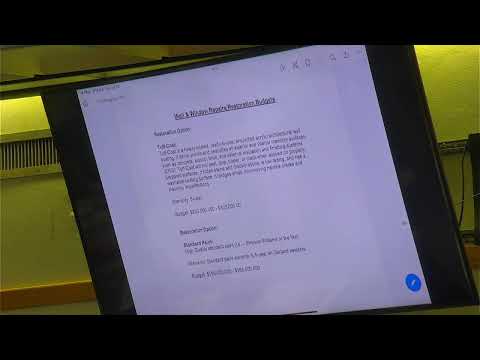
The consultant said restoration (clean, repair and coat with new rock) for the low-slope roofs would run about $180,000 to $250,000 with a 10-year warranty; a lower-cost single-ply membrane option would carry a 15–20 year warranty and a per-square-foot budget the presenter listed at about $3.10 to $3.65; and a multi-ply “modified” system with longer-term coverage was estimated at roughly $475,000 to $600,000 for the set of low-slope roofs, with 30–32 year manufacturer-backed coverage under Garland’s approach.
Why it matters: those budget ranges and warranty choices affect the city’s capital-planning and maintenance decisions for school and municipal buildings and the timing of future replacements.
The presentation described specific problems observed: ponding water at roof drains and drive-through canopy areas, blisters in flashings (which the consultant said indicate trapped moisture that can expand and separate plies), vegetation growing through concrete roof decks, failed sealant at frame-to-wall joints and interior leaks visible near entries and stairwells. The consultant recommended targeted repairs where feasible, larger replacements where moisture or slope issues are severe, and additional diagnostic steps before committing to a scope.
The presenter recommended a nuclear moisture scan and, where needed, core samples to confirm insulation wetness and to refine budgets. He told the meeting he would arrange the scan, consult with the city’s contact (Scott Price) and return results; he said the scan would show which sections are restorable and which require replacement.
On procurement and warranties the presenter described Garland’s single-source approach: material purchased directly from the manufacturer, invites to a small pool of local, Garland-certified contractors, and manufacturer involvement during installation to preserve long-term warranty liability. He said this approach differs from a commodity/specification model, in which a manufacturer could deny warranty claims if installation details were incorrect. He referenced an Omnia cooperative agreement as a commonly used nationally bid cooperative that public entities may use to streamline purchasing.
Participants asked about shorter-term maintenance options and cost escalation. The presenter estimated a maintenance program that addresses blisters, re-caulking and replacement of missing surfacing rock could cost roughly $50,000–$60,000 and might buy “3–4 years” of useful life for marginal roofs; he recommended bidding bundled work (so labor is cost-effective) rather than repeatedly “chasing leaks.”
The consultant also provided line-item examples for smaller concrete/drive-through roofs: a DuraWALK-style coating estimated at $17,000–$21,000 and a higher-cost Liquitec finish at about $25,000–$30,000 with an additional five years of warranty.
Quotes from the presenter included practical notes about service and warranty: “You always just call Garland by the way. It's kinda that's how we operate on this,” and, describing warranties and accountability, “With us, I'm working from you from the beginning, and I'm there the entire time. So at no point can I waive that liability.”
Next steps discussed at the meeting included the presenter arranging the nuclear scan, sending the scan cost and results to Scott Price, and the city considering core samples to refine budgets. The consultant offered to produce formal bid packages (scopes of work, drawings, details) and said he performs periodic site walks and project management when retained.
The meeting then moved on to other agenda items; a motion and second were recorded and a voice vote of “yes” was called to close the meeting (the transcript records the motion, a second and affirmative voice votes but does not supply the motion text or named roll-call tallies).