Get Full Government Meeting Transcripts, Videos, & Alerts Forever!
Get email alerts on the Budget topic
No spam. Unsubscribe anytime.
St. Petersburg mayor recommends $970M budget; council sets tentative millage and public hearing dates
Summary
Mayor Kenneth T. Welch presented a $970.4 million recommended FY26 budget that holds the millage flat at 6.4525 mills. Council voted unanimously to set the tentative millage and public hearings on Sept. 11 and Sept. 25.
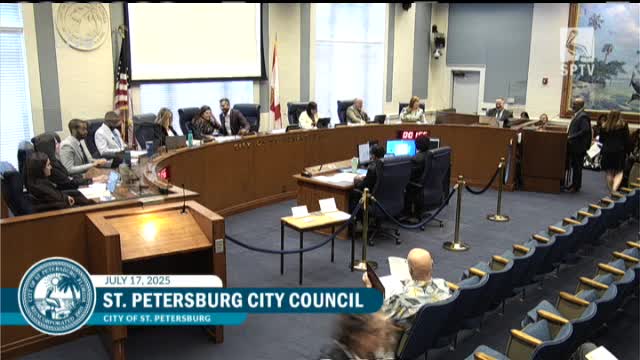
Mayor Kenneth T. Welch on Thursday presented his recommended fiscal year 2026 budget to the St. Petersburg City Council, proposing an operating plan that holds the millage rate flat at 6.4525 mills and sets a total recommended budget of about $970.4 million.
The recommended general fund operating budget is $411.763 million, Welch said, and the proposal preserves the current millage rather than cutting it after three years of reductions. "The proposed budget is a celebration as well," Welch said, adding the budget reflects work across five pillars: housing, environment/infrastructure/resilience, equitable economic development/arts/business, education/youth, and neighborhood health and safety.
The budget highlights Welch stressed include continued housing investments (including tenant eviction assistance, residential rehab and employee housing programs), a new Saint Pete Agile Resilience (SPAR) program to accelerate stormwater and water-system upgrades, $2.0 million in capital projects in FY26 with a five-year CIP totaling roughly $1.049 billion, and increased support for arts and cultural grants. Welch said the FY26 CIP includes transfers and new commitments for affordable housing and infrastructure; the mayor noted that SPAR will require additional funding sources such as bonds or grants to be fully implemented.
Liz Makovsky, the city—s director of budget and management, presented technical details. She said property values used for calculations were $36.949 billion (with 96% used for levy calculations), and the FY26 rollback rate — the millage that would generate the same tax dollars as the prior year after accounting for growth — is 6.2083 mills. Using the city—s proposed ad valorem need, the recommended rate is 6.4525 mills, 3.9% above the rollback rate. Makovsky said total recommended operating revenues are $970.4 million and that charges for service make up 43% of citywide revenue, with taxes at roughly 31.1%.
The recommended budget lists dozens of program allocations and grant amounts, including items cited by the mayor: social action grants at $700,000; rapid rehousing at $400,000; the childhood homeless project at $260,000; Pinellas Hope at $215,000; Pinellas Safe Harbor at $150,000; Saint Vincent de Paul at $149,000; Westcare Turning Point at $125,000; Meals on Wheels at $100,000; and funding for arts programs including $40,000 for SPIFFS (noted as a new arts allocation) and continued multi-year commitments for institutions such as the Palladium ($250,000 in year two of a four-year commitment).
On resilience and capital investments, the mayor and Makovsky emphasized the city—s need to accelerate water and stormwater projects after a severe 2024 storm season, and noted the CIP includes $42.9 million for water reclamation facility improvements and $7.5 million for street and road projects. Makovsky said the five-year CIP (FY26——6 to FY30) totals about $1.049 billion.
Council members asked for detail and context. Vice Chair Hanowitz and Council Member Gina Driscoll noted federally and state-funded program changes that affect local planning. Council Member Corey Givens pressed administrators on how federal cuts — including possible FEMA and other program changes — could affect local services; Welch said the administration is engaging with state and federal partners and industry associations to advocate for continued funding. Council Member Brandy Gabbard asked for scenario planning tied to possible state changes to property tax collection rules; administration said legal and bond counsel can provide scenarios to the PSNI committee.
Votes at a glance
- Agenda approval: motion to approve the meeting agenda passed unanimously (recorded as "passes unanimously" with Council Member Driscoll absent at that vote).
- Consent agenda: motion to approve the consent agenda passed unanimously.
- F2A (Resolution setting tentative millage rate of 6.4525 mills): passed unanimously (council vote recorded as approval of the proposed rate).
- F2B (Resolution setting public hearing dates on the FY26 budget for Sept. 11 and Sept. 25): passed unanimously.
Why this matters: The FY26 budget sets the city—s spending priorities, funds public safety and infrastructure projects, and frames tax collections for the coming year. The mayor and administration emphasized housing and resilience spending but warned that SPAR and other capital priorities will require additional resources beyond standard revenues.
What—s next: The city will mail TRIM notices based on the proposed millage and hold two public hearings at City Hall on Sept. 11 and Sept. 25 before adopting a final budget. Makovsky said the first public hearing is Sept. 11 and the final budget hearing will be Sept. 25.