Get Full Government Meeting Transcripts, Videos, & Alerts Forever!
Get email alerts on the Land Development topic
No spam. Unsubscribe anytime.
St. Petersburg council unanimously adopts broad land‑development code changes affecting ADUs, design bonuses and flood‑zone rules
Summary
The City Council approved a wide-ranging amendment to the city’s Land Development Regulations to clarify building envelopes, add incentives for porch elevation, solar and tree preservation, and codify how accessory dwelling units are measured.
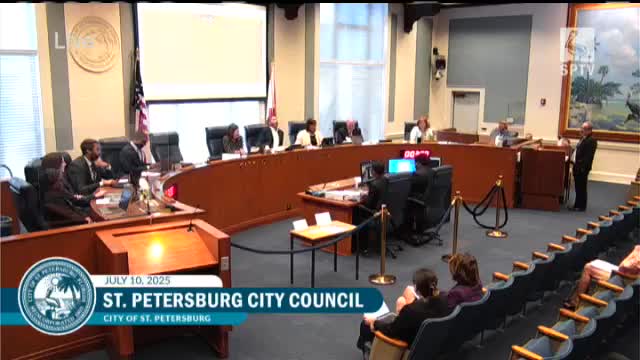
St. Petersburg City Council on July 15 unanimously approved Ordinance 611H, a comprehensive update to the city—s Land Development Regulations that changes development standards across several residential and mixed‑use zoning districts.
The ordinance sets new floor‑area‑ratio (FAR) bonuses and clarifies rules for accessory dwelling units (ADUs), building massing, fence and landscape standards, sidewalk payment‑in‑lieu, and how building heights are measured in flood‑prone areas.
Corey Milishka, a city planning presenter, told council the update responds to stakeholder feedback and to problems the code has produced in recent years, including tall, boxy single‑family homes and repeated variance requests. Scott Warrie of Development Review Services described specific changes: the draft removes a redundant 0.06 FAR bonus for minimal facade articulation; fixes a typo in a tree‑planting bonus (feet, not inches); narrows the solar‑ready bonus but creates a new bonus for installed solar (0.01 FAR per kilowatt up to 0.03); adds a 0.01 bonus for EV charging capability; and creates bonuses for preservation of large ("grand") trees and for elevated front porches.
The council approved a staff amendment codifying an administrative interpretation for ADU area calculations: 300 square feet per enclosed parking space will be excluded from ADU size calculations (the change memorializes the calculation staff has applied since 2022).
Other changes approved include: - A quality‑materials FAR bonus (0.05 for certain premium exterior materials; 0.03 for brick/stone veneer or hardyboard). - A bonus (0.03) for front porches elevated at least 18 inches (up from 12 inches) with accompanying limits on building height intended to keep new homes closer in scale with surrounding historic houses. - A massing bonus that rewards a minimum 20‑foot separation between principal and accessory structures or between second‑floor portions of the principal structure to "break the box." - A modest expansion of allowable blank wall width in rear halves of lots from 16 to 20 feet where the wall is not visible from the right of way. - A payment‑in‑lieu option for sidewalks so property owners can fund a city sidewalk fund instead of repeatedly seeking variances. - Revised noticing for dock side‑setback waiver requests so only waterfront property owners within 200 feet on the same side of the request are notified. - An allowance for an additional 2 feet in building height measurement for structures required by the Florida Building Code to elevate the lowest horizontal structural member above design flood elevation.
Council members praised the amount of stakeholder outreach and the length of the process. Council member Brandy Gabbard led a narrowly scoped amendment earlier in the meeting to set the ADU parking exclusion at 300 square feet; the council approved that amendment unanimously before the final vote. Council member Gina Driscoll said she supported the package and noted the changes expand ADU opportunities in more neighborhoods.
Staff said the ordinance was developed with multiple committee reviews, a Development Review Commission recommendation, and feedback from builders, neighborhood groups and preservation advocates. Milishka and Warrie said the revisions aim to reduce the number of design variances staff must process and to better align new construction with existing neighborhood character.
The ordinance passed unanimously. Implementation details, such as any required administrative forms or arborist reports tied to tree‑preservation bonuses, will be worked out by staff and appear in administrative procedures.
The changes reference the Florida Building Code and staff said they reviewed recent state legislation (Senate Bill 180) during drafting and removed any provisions that would conflict with newer state restrictions.
City legal and planning staff remained available to answer follow‑up questions and noted the code changes were intended to be consistent with the city—s Comprehensive Plan.
Council action on the ordinance closes a multi‑year review of the code that began with earlier rezonings and a 2017 code revision that originally established several of the development controls the new ordinance modifies.