Get Full Government Meeting Transcripts, Videos, & Alerts Forever!
Get email alerts on the Zoning Variance topic
No spam. Unsubscribe anytime.
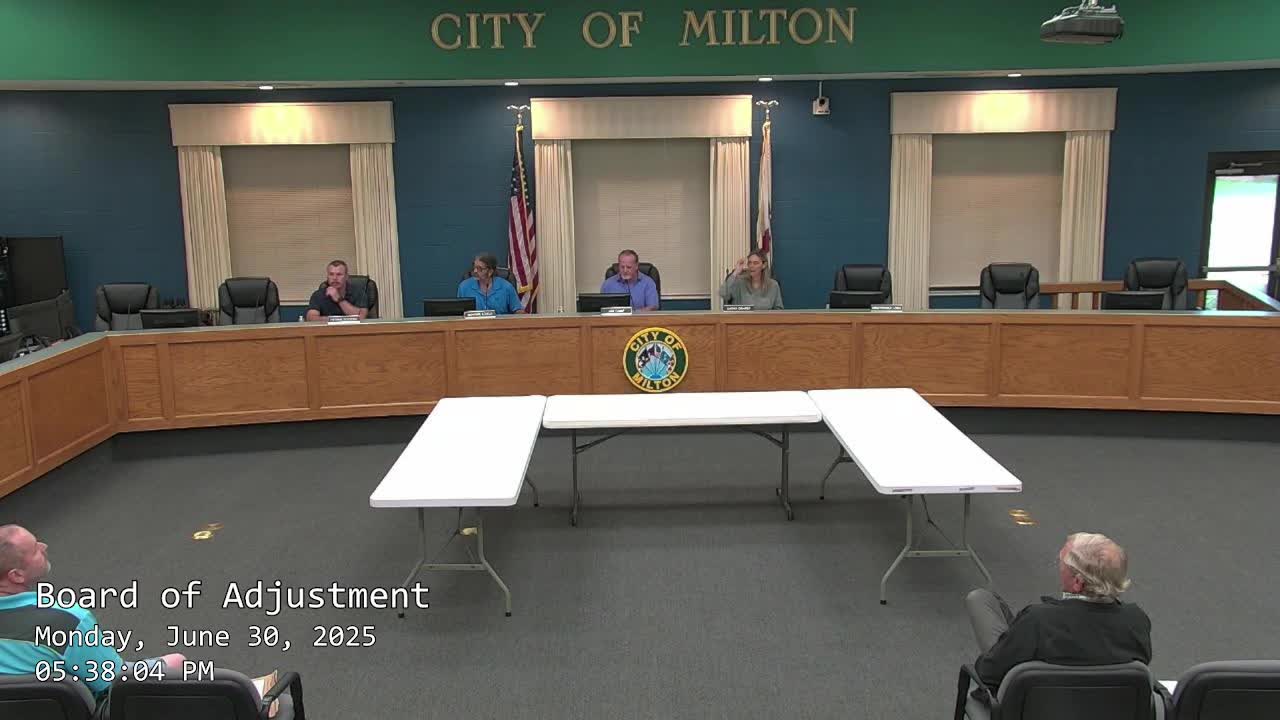
Board of Adjustments tables decision on 8-foot fence variance at 5500 Dogwood Drive
Summary
The Board of Adjustments postponed a decision on a variance request to allow an eight-foot privacy fence at 5500 Dogwood Drive after neighbors raised concerns about sightlines, maintenance and whether existing masonry and patio features create a lawful hardship under the Unified Development Code.
The Board of Adjustments on Monday tabled a decision on a variance request that would allow an eight-foot privacy fence at 5500 Dogwood Drive, leaving in place the city standard six-foot limit for side and rear yard fences until the board can review additional information and hear from more members.
City staff told the board the variance application, received May 16, 2025, seeks approval to retain an already-constructed eight-foot privacy fence along the parcel’s northern interior side yard and rear yard. Staff said the request relates to Article 9.3 of the city’s Unified Development Code, which limits fence height to six feet in side and rear yards, and that six certified notices were sent to nearby property owners (five delivered). The applicant submitted five letters of neighborhood support; two were from owners within the official notice area.
The applicant, co-owner Wayne Shreckengost, said the house and attached garage include masonry walls, raised patio sections and changes in grade that his dogs use to scale a six-foot barrier. “We just had some problems with the house... We just had to take care of him. But he's a climber,” Shreckengost said, describing one dog, Lucky, as able to climb standard fences. He told the board the family has already started fence work and that replacing or reducing the fence would be an unexpected expense.
Neighbors voiced mixed views. Jim Fort Worth, who identified himself as a nearby resident, said he had no strong objection but asked who would maintain the narrow strip of land between the two fences. An unnamed neighbor said she supported measures to keep animals safe and described prior problems with overgrown vegetation on the property before the current owners moved in.
Board members and staff discussed alternatives and legal limits. Staff noted that repairs or replacement that meet the 50% threshold require a permit and would be reviewed against current standards; a future repair could therefore trigger reversion to the six-foot standard. Staff also said the board previously approved an eight-foot fence in a September case where there was a one-to-two foot grade difference; board members debated whether the current situation—where the elevation difference results from man-made masonry and patio structures rather than natural grade—meets the same hardship threshold.
Members suggested lower-cost mitigation options the applicant could pursue without a variance, such as attaching inward-facing outriggers or other climbing deterrents to the interior side of the fence to reduce the dogs’ ability to scale it. Board members also discussed whether a variance could be limited to the property owner’s period of ownership as a condition; staff said enforcement of a condition tied to ownership could be difficult if the property changes hands.
A motion to approve the variance with two conditions—(1) limit the variance to the current owners’ period of ownership and (2) require the owners to maintain the narrow strip of land between fences—was made and seconded but did not carry (vote tally not specified in the meeting record). The board then voted to postpone final action to the next meeting to allow the applicant time to explore alternatives and to provide the board additional information; the board set the next meeting for July 28, 2025.
Votes at a glance: The board did not approve the owner-requested variance at this meeting. A motion to approve the variance with owner-limited conditions was moved (mover: Board member Howard), seconded (Jim), and failed (tally not specified in the transcript). A subsequent motion to postpone the item to the July 28 meeting passed (mover and second recorded in the transcript; voice vote — tally not specified).