Get Full Government Meeting Transcripts, Videos, & Alerts Forever!
Get email alerts on the Transmission Line Permit topic
No spam. Unsubscribe anytime.
Elbert County commissioners move to deny Xcel Energy’s permit applications for Colorado Power Pathway; set special meeting for final findings
Summary
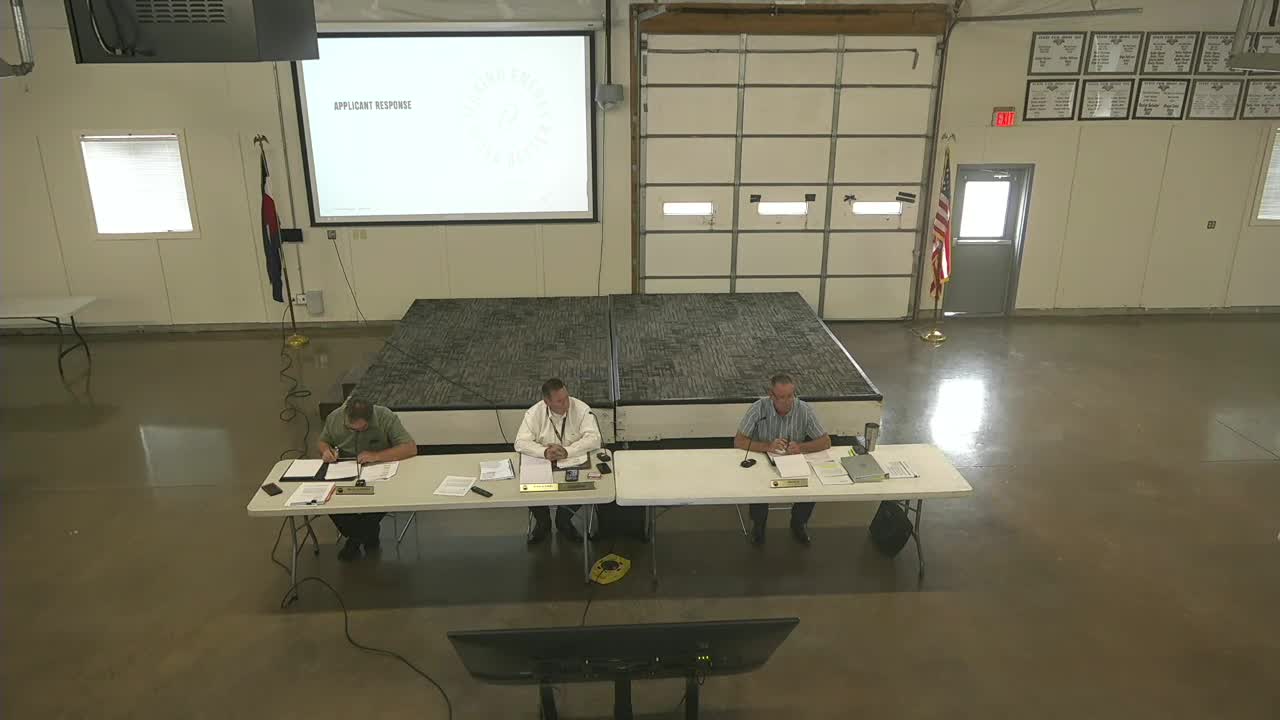
After hours of public comment and testimony from Xcel Energy and county staff, the Elbert County Board of County Commissioners voted to deny two permit applications for the Colorado Power Pathway transmission project and scheduled a special meeting July 2 to adopt written findings and finalize decisions.
The Elbert County Board of County Commissioners voted on motions to deny two permit applications from Xcel Energy for the Colorado Power Pathway transmission line after a multi‑hour hearing that included company presentations, staff recommendations, public comment and technical testimony.
Xcel Energy representatives described wildfire mitigation measures, continuous weather monitoring and routine inspection programs for transmission lines while county staff outlined recommended conditions of approval intended to address local concerns about construction, wildfire risk, wildlife, cultural resources, stormwater and coordination with fire districts. Commissioners expressed repeated concerns about eminent domain notices and the timing of land‑acquisition activity relative to local permitting.
Why it matters: The board’s motions to deny were approved and commissioners directed the county attorney to prepare resolutions with findings to be adopted at a special meeting set for July 2 at 1 p.m. Those resolutions will memorialize the board’s legal findings and finalize whether the county issues the requested land‑use approvals. The hearing also highlighted persistent local concerns about property values, proximity of poles to homes and the adequacy of fire‑district agreements, wetlands approvals and decommissioning assurances.
Xcel Energy testimony and technical details Xcel called multiple staff to explain the project and technical safeguards. Patrick Kuretisch, who identified himself as supporting transmission operations for wildfire at Xcel Energy, said the company has filed wildfire mitigation plans (an initial plan in 2020 and an updated filing for 2025–2027), uses a combination of roughly eight short‑ and long‑term weather models, and staffs an in‑house meteorological group (he said four meteorologists) that monitors conditions to inform operational decisions. He said Xcel provides 24/7 monitoring through redundant protection systems at substations, a control center that dispatches field crews, and situational‑awareness tools such as Pano AI cameras for smoke detection that the company is offering to local first responders.
Transmission engineering staff said the structures are designed to industry standards for the area, including the National Electrical Safety Code loading requirement of a 95‑mile‑per‑hour, 3‑second gust for that design class, and that photo simulations and pole heights were based on engineering inputs for each location. Company representatives said easements for the line were being acquired along a corridor process that included a 500‑foot option corridor (used during study) narrowed to a typical 150‑foot permanent easement; Xcel said it paid 25% of the option price when landowners accepted options.
County staff recommendations and suggested conditions County planning staff (presented by the county consultant) recommended using permit conditions to address outstanding items the project had not completed in the application record, including signed fire‑district forms, road‑use agreements, construction safety plans, preconstruction wildlife and nest surveys, cultural and bio monitors during construction, stormwater and SPCC controls, coordination on concrete batching and washout, decontamination procedures to avoid cross‑contamination of agricultural sites, and periodic construction schedule updates to fire districts and the county. Staff explained that conditions are commonly used when detailed construction information is not yet available at the land‑use review stage and that conditions provide the county enforcement leverage during construction and operations.
Eminent domain and land acquisition timing Multiple commissioners and public speakers criticized Xcel’s decision to file condemnation cases before county final actions. Xcel said its project schedule — constrained by the Colorado Public Utilities Commission (PUC) performance and in‑service deadlines — requires overlapping routing, permitting and land‑acquisition work; the company described a multi‑step negotiation process that includes offers, appraisals it pays for, final offer letters and, only after impasse, filings in district court. Xcel reported 48 total landowners in the Elbert County segment, with 25 easements acquired and 13 condemnation cases filed to date. Commissioners said those filings created a perception that the route was effectively fixed before the county completed its land‑use review.
Property values, siting and co‑location disputes Residents, commissioners and witnesses debated property value impacts and siting choices. The county’s hearing record included testimony from an appraiser, David Bethel (MAI), who said his analyses of acreage properties in multiple states show most measurable value impact is contained within the easement area and not beyond it; other hearing participants disputed that conclusion and raised concerns about marketability for smaller parcels and impacts to future county tax revenues and economic development parcels. Commissioners discussed board policy text in the county code limiting transmission lines near subdivisions unless co‑located, and requested clarifications about whether “co‑location” meant co‑location only with other transmission lines or with other linear infrastructure such as roads.
Outstanding application items cited by commissioners Commissioners identified items they considered incomplete or unresolved in the application record: signed fire‑district forms (Big Sandy and other districts), road‑use and development agreements, documentation addressing the Natural Resources Conservation Service (NRCS) Wetland Reserve Program easement, and the county’s interpretation of specific land‑use code sections about buffers and co‑location. Commissioners also asked for clearer documentation on decommissioning/financial assurance; Xcel said a decommissioning plan was included in the October application (Attachment S) and that financial assurance or PUC requirements would be addressed later, and said that decommissioning is rarely an outright removal without replacement for transmission lines.
Board action and next steps Commissioner motions recorded at the hearing: a motion to deny the major 10‑41 application and a motion to deny the special use review (SUR) application. Both motions were seconded, and the board voted in favor (motions carried). Commissioners directed the county attorney to prepare resolutions containing the board’s written findings for adoption at a special meeting on July 2 at 1 p.m. The board also voted to continue the hearings to the July 2 special meeting for final decision adoption, closed the public hearing and adjourned the session.
What remains open Key outstanding items for the July 2 special meeting will be the written findings prepared by county counsel and any additional evidence the board accepts into the record per legal advice. The record shows continuing disputes on eminent domain timing, whether required application materials (signed fire‑district forms, NRCS coordination, road‑use agreements) should be prerequisites to completeness, and how to interpret county co‑location buffer language for subdivisions. The July 2 resolutions will document the board’s legal rationale for denial and any findings about those procedural and substantive issues.