Get Full Government Meeting Transcripts, Videos, & Alerts Forever!
Get email alerts on the Affordable Housing topic
No spam. Unsubscribe anytime.
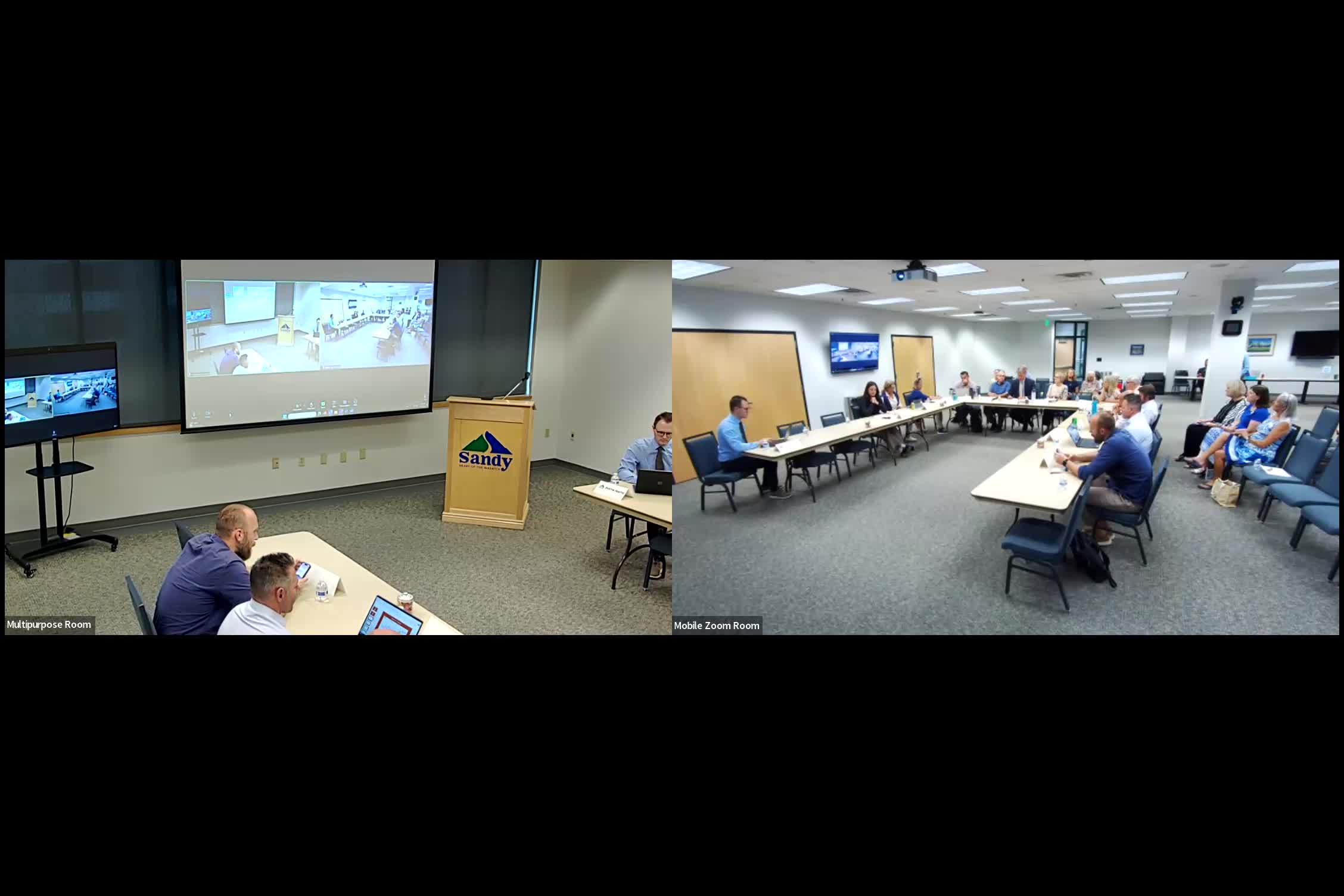
Sandy housing workshop reviews barriers, tax-credit tools and condo obstacles; staff to circulate priorities for Sept. 2 meeting
Summary
City officials and outside experts told Sandy council members on July 22 that rising interest rates, higher construction and land costs, and smaller tax‑credit equity pools are constraining affordable housing development — and that city incentives should be paired with enforceable affordability covenants.
SANDY, Utah — City officials and outside experts spent the bulk of a July 22 housing workshop outlining why producing affordable homes is difficult now and what local governments can do to improve the odds.
"My name's Lynn Pace. I'm the city attorney, and I know next to nothing about housing," Pace said as he opened the meeting and turned the floor over to three presenters: a multifamily developer, a regional planning official and a researcher from the Kem C. Gardner Policy Institute.
The presentations, and questions from council members, focused on four drivers that developers say make affordable housing projects hard to finance and build: higher interest rates, elevated construction costs, expensive land and persistent financing gaps for restricted‑rent projects.
Developer perspective: subsidies tied to enforceable restrictions
Lee, a multifamily developer with Calaway Partners, told the council high borrowing costs and rising construction prices have layered on top of land expenses to push projects beyond many household budgets. "Interest rates are high — it makes borrowing the money to do developments very costly," Lee said, and added that the cost of capital also raises investor return expectations.
Lee described how affordable rental deals commonly rely on Low‑Income Housing Tax Credits (LIHTC). In those projects the developer sells tax credits to banks as equity and records a deed restriction limiting rents and income eligibility, often for decades. "In that one, we've put a deed restriction on that property for 50 years," Lee said, describing a family project that will reserve units for households at a specified percent of area median income in exchange for tax credit equity and city subsidized loans.
He also noted the price banks pay for tax credits affects the financing gap: the market price for credits has fallen from highs above $1.00 per dollar of credit to roughly $0.90–$0.91, increasing the subsidy cities must provide to make deals work.
Regional planning and transportation links
Mike Hagen, community and economic development director at the Wasatch Front Regional Council, framed housing choices as part of a longer‑range land‑use and transportation vision called Wasatch Choice. Hagen said a network of walkable centers served by multiple travel options can lower household transportation costs and expand genuinely affordable choices when housing and jobs are better aligned.
"Access. You know, are you putting people where they can get to the things that they need, easily?" Hagen asked the council, urging officials to consider combined housing‑plus‑transportation costs (a common metric) when evaluating affordability and station‑area growth.
Gardner Institute: demographic pressure and the scale of need
Diane Eskridge, senior research fellow at the Kem C. Gardner Policy Institute, summarized recent demographic trends driving demand. Eskridge said Utah's population gains and the size of recent age cohorts mean the region will need many thousands of new homes in the coming decade.
Using the institute's projections, Eskridge said planners estimate roughly 270,000 new housing units statewide and about 81,000 units for Salt Lake County over a ten‑year horizon — a pace she summarized as roughly 25,000–30,000 homes per year statewide to meet projected demand.
Practical measures for local governments
Speakers outlined steps cities can take to reduce developer holding costs or to bridge financing gaps without simply shifting market profits to developers: - Offer subsidized loans, low‑interest loans or land contributions in exchange for enforceable deed restrictions that require long‑term affordability. Lee described deals that pair city loans and LIHTC equity with 50‑year deed restrictions. - Use zoning and entitlements selectively: increase allowable density or unit mixes only where developers agree to affordability terms; streamline permitting and prioritization for projects that secure affordability commitments. - Make city‑owned land or obsolete municipal properties available through land leases or discounted sales tied to affordability covenants.
"If you just said, no, we're going to reduce all those costs for every developer, it would not guarantee lower prices," Lee said. He recommended bargaining incentives for specific affordability commitments rather than across‑the‑board fee reductions.
Condominiums and 'missing middle' housing
Presenters and councilmembers also discussed barriers to condominiums and other "missing middle" housing types. Hagen and Lee described three recurring obstacles: higher insurance and litigation risk for condo projects, more demanding presale requirements for financing, and warranty/liability exposure that increases developer risk and cost.
"There's a condo stigma in the development community," Hagen said, noting insurance markets and lenders treat condos differently than rental apartments. Presenters urged the city to weigh policy options that reduce those barriers — for example, state or local programs to underwrite developer risk for targeted projects or adjustments to presale and financing practices — if council policy favors more for‑sale product types.
Public comments and next steps
In public comment, resident Patricia Jones urged the council to seek additional expert analysis and questioned escalating costs for the city's Alta Canyon facility project, citing figures she said had increased from about $11.3 million to an estimated $23.5 million. Jones asked for clearer funding accountability and whether taxpayer support would be required.
Housing analyst Mike Carey, who addressed the council during public comment, urged caution about relying on dated projections and encouraged officials to consider recent inventory and job‑growth assumptions when planning. "We need to be more nimble because right now, there's almost 15,000 homes on the market in Utah," Carey said.
Council and staff direction
Staff told council members they will assemble a list of policy options and priorities, circulate it to elected officials for edit, and then send a questionnaire asking members to rank priorities before the next workshop. Lynn Pace and staff said the goal is to use the Sept. 2 workshop for council policy direction; staff will then return with possible tactics and implementation steps based on council priorities.
What this means for Sandy
Speakers stressed that many cost drivers — national interest rates, commodity prices, insurance markets — are outside local control. But several tools are available to cities: targeted subsidies tied to enforceable deed restrictions, land‑use and zoning adjustments to allow higher yield where affordability is secured, expedited permitting to reduce holding costs, and coordinated use of local and county subsidized financing to fill LIHTC gaps. Presenters emphasized that incentives must be explicitly bargained and documented if the public is to receive long‑term, enforceable affordability in return.
The council scheduled the next housing workshop for Sept. 2; staff will circulate the issue list and a ranking questionnaire in advance of that meeting.