Get Full Government Meeting Transcripts, Videos, & Alerts Forever!
Get email alerts on the Public Works Standards topic
No spam. Unsubscribe anytime.
Council postpones change to construction standards after developers, staff debate slip‑form paving rule
Summary
League City council postponed action on revisions to the city’s design and construction standards manual — including a proposed minimum length for slip‑form (continuously reinforced) concrete paving — after developers raised cost and feasibility concerns and staff recommended allowing engineer discretion.
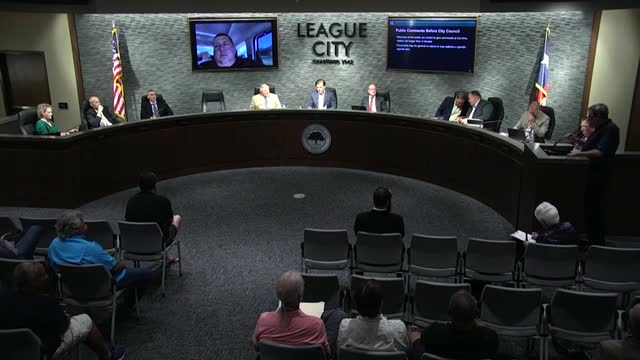
League City’s City Council on July 8 postponed consideration of revisions to the city’s general design and construction standards manual, including a debated requirement that slip‑form (continuously reinforced concrete) paving be used on roads with more than 10,000 average daily trips and a proposed minimum length for slip‑form sections.
Developer representative Steve Sheldon told the council that most residential paving is done in short developer‑constructed segments and that bringing in slip‑form equipment (machines he estimated at $2.5 million–$3 million) to pour a short 500–800 foot section is not cost‑effective; he recommended a minimum length such as 1,500 feet before slip‑form would be required. Sheldon said he otherwise supported many of the proposed standards changes.
City engineering staff said the slip‑form specification would produce a more uniform pavement with fewer “bird baths” over the long term, but acknowledged there are legitimate short‑distance construction scenarios where slip‑form is not feasible. Staff recommended flexibility by allowing the city engineer to grant exceptions rather than adopting a rigid minimum length. Staff also noted the standards document has not had a holistic update since 2011 and that the traffic chapter will be addressed next year.
Councilmembers debated whether adopting a 1,500‑foot minimum now would invite attempts to avoid the standard and discussed the need for a written policy. Several council members suggested postponing to allow staff to return with proposed policy language; Councilmember Chad Tressler moved to postpone for two weeks, the motion was seconded and passed 8–4.
The council did not adopt the proposed 1,500‑foot minimum at the July 8 meeting. Staff said they will draft clearer language and policy options and present them at a future meeting, along with the remaining traffic chapter updates.
No formal revision to the standards manual was adopted at this meeting.