Get Full Government Meeting Transcripts, Videos, & Alerts Forever!
Get email alerts on the Land Use Mud topic
No spam. Unsubscribe anytime.
Council gives conditional feedback on Pinnacle ETJ MUD proposal; financial terms remain sticking point
Summary
Developers presented a large 'Pinnacle' neighborhood concept and requested council direction on pursuing an ETJ municipal utility district. Council praised the plan but said master development fees, wastewater impact fees and costs for any limited city services must align with city policy or favor annexation.
City staff and the developer team presented the “Pinnacle” development proposal and requested council feedback on pursuing an ETJ municipal utility district (MUD) for a large tract partly in Georgetown’s extraterritorial jurisdiction (ETJ) and partly in Weir’s ETJ.
Nick (city planning staff) framed the request and asked council whether staff should pursue ETJ MUD negotiations. The nut graf: council members generally praised the land‑use and design concepts — including extensive greenbelts, a proposed Berry Creek regional trail connection and a walkable neighborhood design — but repeatedly identified financial terms as the key conditions for their support, specifically master development fees, wastewater impact fees and the cost structure for any limited services the city might provide under contract.
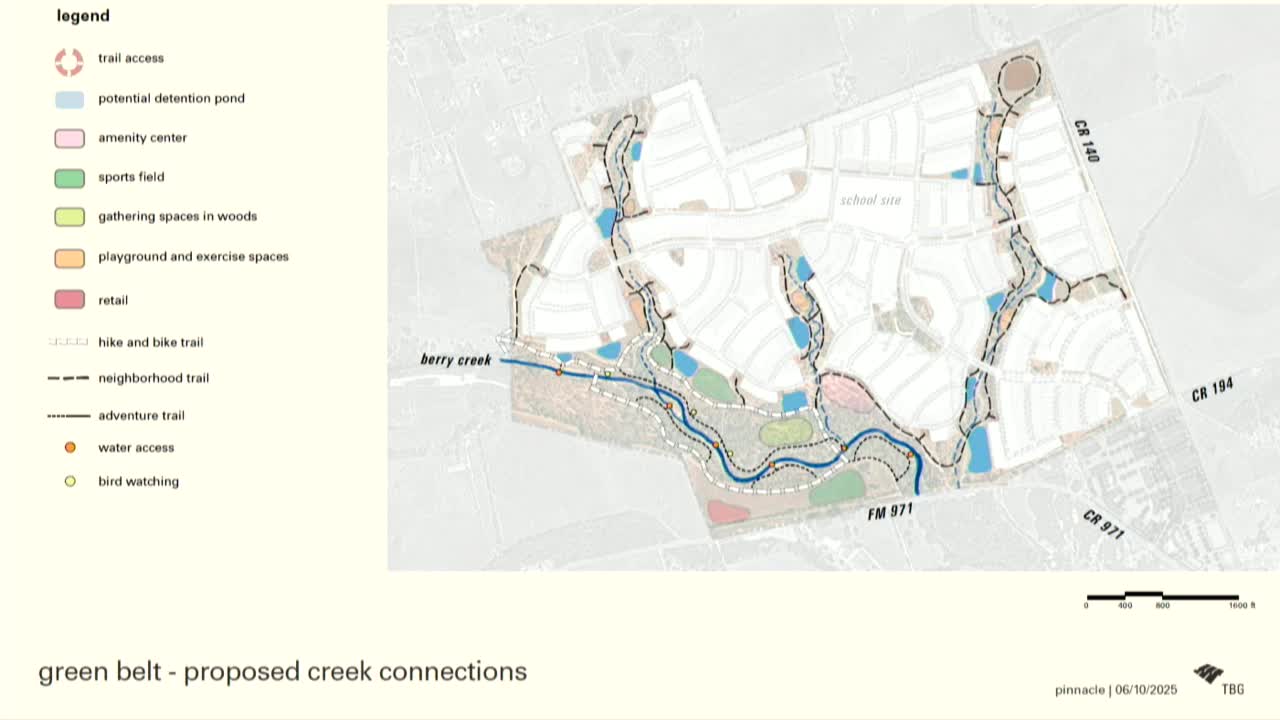
Developer representatives said the design emphasizes walkability, pocket parks and a large central amenity and that the team envisions product quality comparable to Wolf Ranch on Georgetown’s east side. Seth Merrick, identified as CEO of Grama Civil, and Ryan Blair of TBG Partners described a plan with multiple greenbelt “fingers,” an 11‑acre school site, about 340 acres planned for single‑family development, and regional trail connections to Berry Creek. Merrick said prior entitlements exist for portions of the tract in Weir’s ETJ and the team has discussed moving the tract into Georgetown’s ETJ under SB 2038 processes.
Infrastructure and service issues discussed:
- Utilities: The development currently lies in multiple utility service territories. Staff said Jonah would be the water provider for the tract; electric service would come from PEC/Encore. Wastewater could connect to the city’s future Three Forks wastewater treatment plant, which staff noted sits nearby on the Gibson tract. - Roads and access: The team described an improved access point to State Highway 971 through a reconfigured County Road 140 alignment; staff said the change would improve safety at an existing awkward intersection. - Parks and trails: The developer offered to construct a portion of the Berry Creek regional trail and said the plan includes a publicly accessible amenity center and retail frontage along 971.
Council’s primary concerns focused on finance and service provision. Several council members said they prefer annexation and payment of property taxes, but if the development remains in the ETJ they expect adherence to the city’s MUD policy, including payment of the master development fee and the city’s wastewater impact fees. Council members also asked for clarity on whether the developer would accept the city’s master development fee in addition to impact fees and whether any deviation is justified by significant regional infrastructure the developer would build.
The developer’s team asked whether council would consider contracting with the MUD for limited services such as police and street maintenance. Developer representatives and consultants discussed approximate costs: the developer’s consultant estimated street maintenance in the district could equate to roughly 3–5¢ of tax rate equivalent and suggested additional law‑enforcement coverage could be phased from a quarter officer to a full officer at build‑out; a consultant also said a commonly used Williamson County sheriff proxy is about $2.50 per deputy (quoted in the presentation). Council members said any city‑provided limited services must cover full, not partial, costs so existing taxpayers are not subsidizing service for an ETJ neighborhood.
Other items: staff noted the MUD policy’s 95¢ maximum tax rate for ETJ MUDs and a typical 10‑year bond issuance window; the developer asked for a 20‑year issuance exception. Staff and council also discussed fire station land needs, contributions to regional parkland, and the master development fee as mechanisms to address costs borne by city residents if the land remains outside city limits.
Ending: Council asked staff to continue negotiations with the developer but said support will hinge on agreement about master development and impact fees or annexation. Staff will return with more detailed terms if negotiations proceed.