Get Full Government Meeting Transcripts, Videos, & Alerts Forever!
Get email alerts on the Municipal Finance topic
No spam. Unsubscribe anytime.
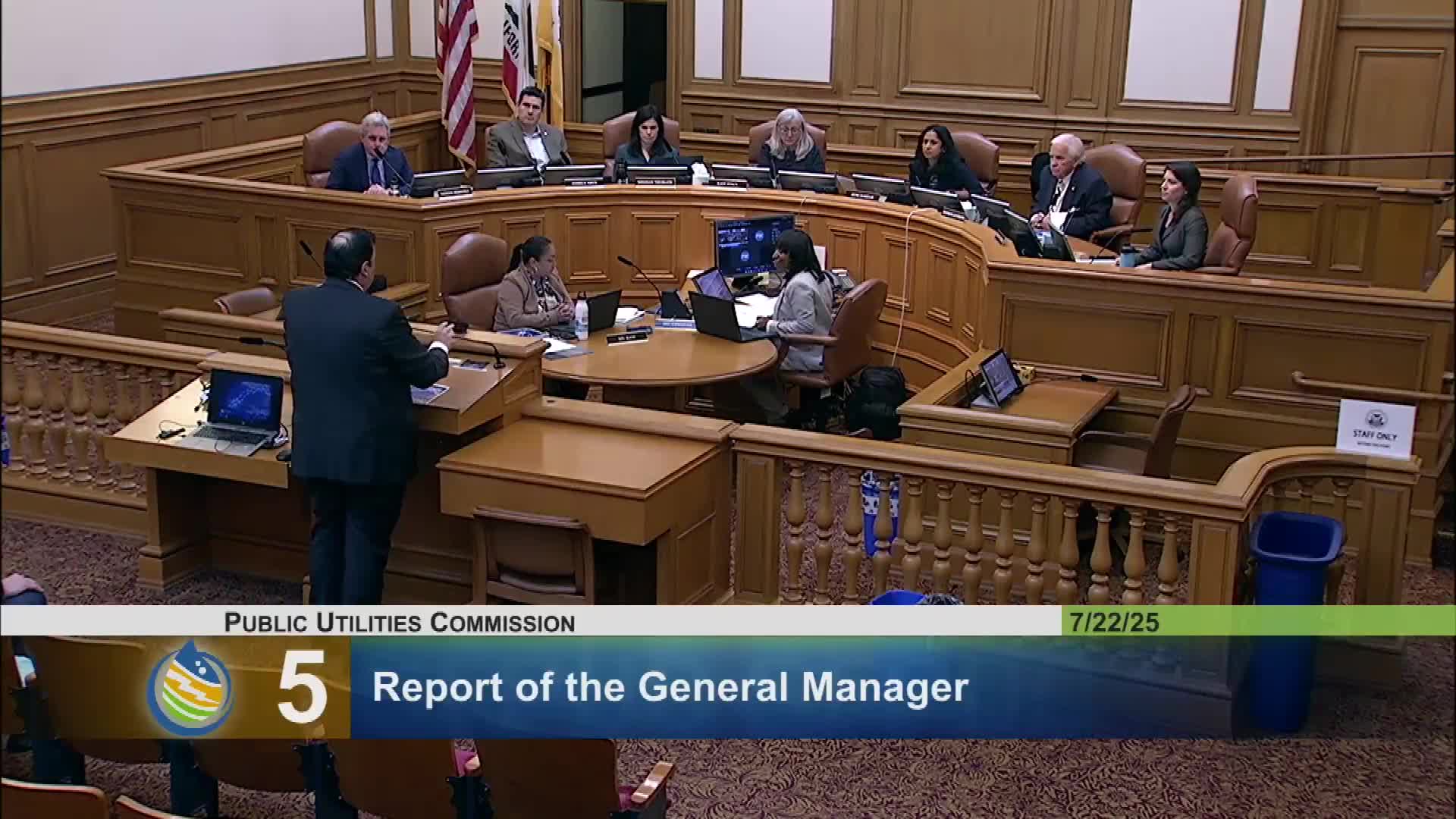
SFPUC staff outlines $10 billion 10-year capital borrowing plan, flags rating outlooks and WIFIA activity
Summary
SFPUC staff presented an informational annual capital financing plan that anticipates about $10–11 billion of capital work over the next 10 years and described near-term financing actions, rating outlooks and policy updates.
San Francisco Public Utilities Commission staff reviewed the agency's annual capital financing plan and previewed the financing actions planned for the coming year.
Nikolai Sklaroff, presenting the informational item, said the SFPUC has about $10.7 billion of borrowing outstanding and staff and commissioners discussed roughly $10–11 billion of capital projects planned over the next 10 years that would be financed incrementally. Sklaroff said the commission will see planning for one wastewater bond transaction in the spring and possible additional loans under a WIFIA master agreement. He told commissioners that the commission had authority from the Board of Supervisors to expand an interim funding program last year by $950 million and that staff may seek to expand wastewater interim funding this year to release controller reserves.
Sklaroff also flagged that two enterprise bond ratings (wastewater and power) with S&P were under negative outlook and that staff are in discussions with rating agencies to address concerns including wildfire risk and declining projected debt-service coverage. He said staff will return in the first quarter with an update to the debt policy and with amendments to municipal-advisor contracts and that staff will continue to pursue refundings and green-bond reporting.
Commissioners asked about the relationship between undrawn loan commitments (WIFIA, SRF) and outstanding debt, the potential effect of negative outlooks on borrowing capacity, and the role of green bonds given federal policy uncertainty. Sklaroff and staff clarified that undrawn loan amounts are reimbursement programs (they are additive to outstanding debt once drawn) and that stronger coverage projections in the 10-year plan are intended to address rating-agency concerns. There was no vote on the informational item.