Get Full Government Meeting Transcripts, Videos, & Alerts Forever!
Get email alerts on the Public Works Budget And Operations topic
No spam. Unsubscribe anytime.
Public Works: budget cuts shrink Pit Stop network to 17 locations; paving, curb-ramp targets met
Summary
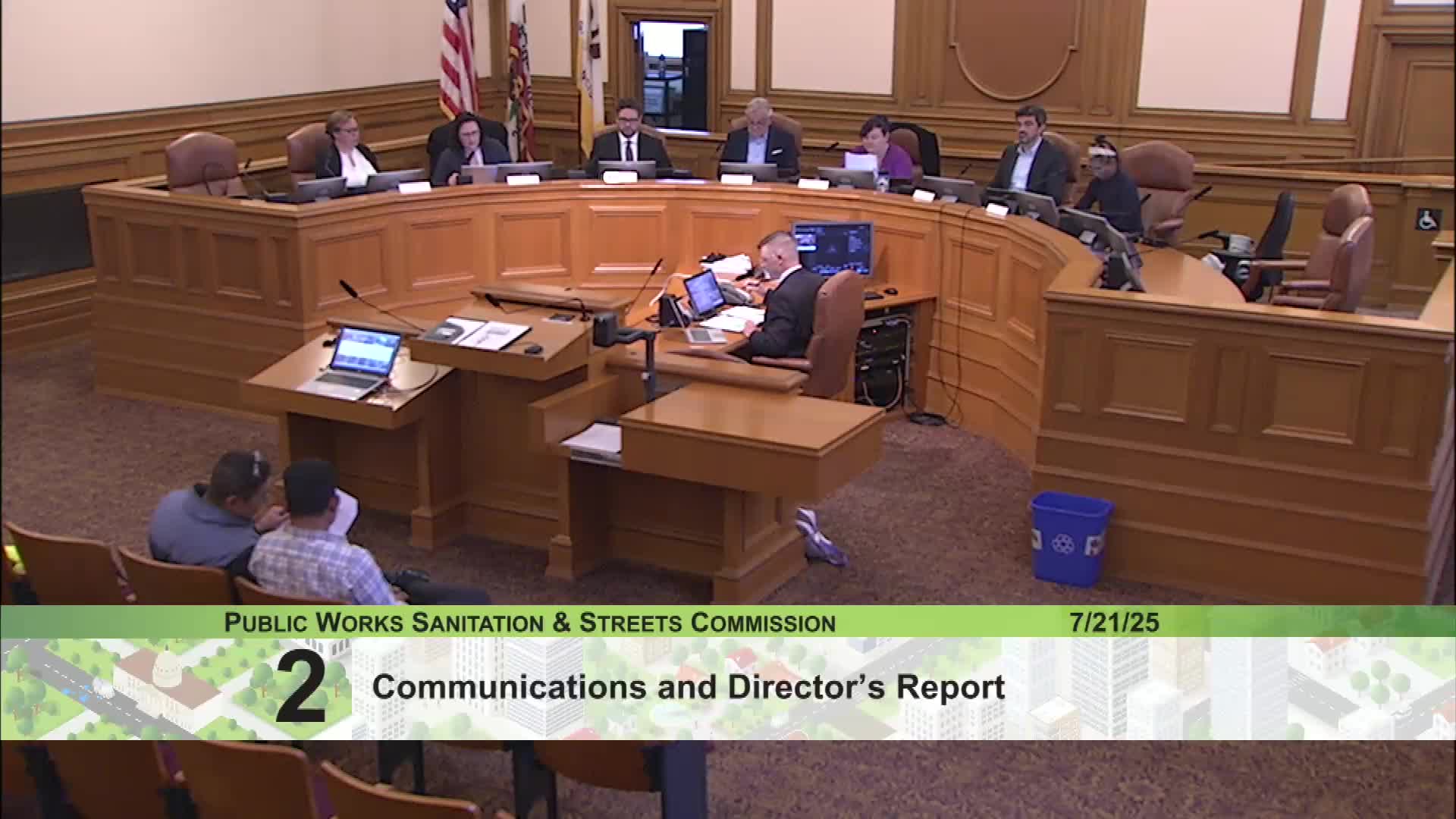
At an Aug. 20 Sanitation and Streets Commission meeting, Public Works Director Carla Short outlined budget impacts that reduce the Pit Stop public toilet program and described the department's paving, curb-ramp and block-design accomplishments for fiscal year 2024–25.
Carla Short, director of San Francisco Public Works, told the Sanitation and Streets Commission on Aug. 20 that the Board of Supervisors last month approved a two‑year budget plan that preserves some street‑maintenance funding but reduces the city's Pit Stop public toilet network from 30 locations to 17.
Short said the budget measure was approved 10–1 by the Board of Supervisors and “the mayor now has until Aug. 1 to sign it,” and that the department worked to retain key positions and vehicle replacement purchases recommended for cuts.
The changes to the Pit Stop program include a cut of about $4.4 million, producing a revised annual allocation of approximately $5.6 million; Short said the department expects to carry forward some additional funding from the prior year. The department also lost two positions included in the mayor's original budget and saw a net loss of 44 vacant positions citywide as part of deficit‑closing actions, she said.
Why it matters: Pit Stop toilets are high‑use public facilities; reducing the network increases pressure on street‑cleaning resources and public restroom access. Short told commissioners the department analyzed usage data and proximity to other toilets when selecting sites to close, but stressed that “there is no pit stop toilet that is unused, so these will have real impacts.”
Key budget and staffing details
- Public Works reported $1.3 million allocated for additional equipment and cleaning supplies. - A two‑year supplemental appropriation for street cleaning that expired June 30, 2025, previously supported 20 FTEs; Short said the department received 10 new positions for street cleanliness and eight restored positions, for a total of 18 FTEs to support neighborhood street teams. - Short said there were no reductions to frontline street‑cleaning positions or illegal‑vending enforcement staffing.
Paving, curb ramps and block design accomplishments
Short highlighted the department's resurfacing and accessibility work for fiscal year 2024–25. Among the figures she presented:
- 561 blocks resurfaced in FY 2024–25, exceeding a 500‑block target. - The city's pavement condition index (PCI) stood at 75, above the regional average of 67; Short said the city has invested about $979 million over the past 15 years in roadway maintenance and resurfacing. - 845 curb ramps constructed citywide in FY 2024–25; 224 of those were built by the curb‑ramp program (the program's goal was 145). - 526 blocks were designed in FY 2024–25, exceeding a 500‑block design target.
Short framed the resurfacing strategy as preventive maintenance: “The driving philosophy of the San Francisco street resurfacing program is to treat the right road with the right treatment at the right time for the right price,” she said, noting that reconstructing a severely deteriorated block is far more expensive than preserving a block in good condition.
Operations and events
Short also reported that crews responded to a series of large events this year and removed 17.5 tons of debris between July 4 and July 5. She said the department's crews and contractors completed work across neighborhoods including Clement Street, Fillmore Street, Laguna Street, Junipero Serra Boulevard and Geneva Avenue.
Neighborhood programs
Short described the neighborhood street teams funded with the 18 FTEs as five neighborhood teams plus one citywide team that will coordinate closely with street outreach teams to focus on areas with high congregations or encampments. She announced that Mission Hiring Hall received the contract for the reduced Pit Stop service network and that neighborhood beautification events will continue; Short invited commissioners and members of the public to participate in the department's August 9 beautification event at John O'Connell Technical High School.
What commissioners asked and noted
Commissioners asked how the department expects the Pit Stop reductions to affect street‑cleaning workload. Short said internal analysis suggests some locations could see a 20–30% increase in requests for steam cleaning and other services; the new neighborhood street teams are intended to absorb some of that increased demand.
Commissioners also praised the paving and curb‑ramp results. Vice Chair Thomas Harrison and Chair Kimberly Hartwig Schulman both expressed appreciation for staff work to reach the paving and PCI goals.
Sources and evidence
This article is based on the director's communications and report presented at the Sanitation and Streets Commission meeting on Aug. 20, 2025.