Get Full Government Meeting Transcripts, Videos, & Alerts Forever!
Get email alerts on the Budget Finance topic
No spam. Unsubscribe anytime.
Leesburg reports $3.4 million from data‑center equipment taxes; council urged to adopt a strategic, in‑arrears plan
Summary
Town finance staff told the Leesburg Town Council on July 21 that the town has received $3.4 million in data‑center computer equipment tax revenue and presented options for handling near‑term and long‑term receipts.
Town finance staff told the Leesburg Town Council on July 21 that the town has received $3.4 million in data‑center computer equipment tax revenue and presented options for handling near‑term and long‑term receipts.
Tamara Kiesucker, the town’s management and budget officer, said the $3.4 million is already in the town’s accounts and that staff is forecasting between $90 million and $115 million in cumulative revenue over roughly ten years under current assumptions. Because the revenue stream carries several risks—timing unpredictability, equipment replacement rates, and the possibility of tax‑exempt or non‑taxed tenants such as banks—the staff recommendation to council emphasized a strategic approach that spends revenue “in arrears” rather than committing to recurring operating expenses now.
Why it matters: the size and uncertainty of the revenue make it capable of materially affecting Leesburg’s capital program, reserves and operating budget. Staff briefed the council on options including cash‑funding CIP projects, paying down debt, replenishing reserves, dedicating funds to stormwater obligations and one‑time investments such as paving.
Finance staff laid out tradeoffs: using the money for recurring needs (for example, stormwater operations or tax relief) increases exposure if the revenue declines; using it for non‑recurring capital items reduces that risk. Kiesucker and Assistant Town Manager/CFO Owen Snyder walked the council through example allocations and an illustrative 10‑year split that showed multi‑million‑dollar impacts for paving, capital asset replacement and debt reduction if the higher end of forecasts materializes.
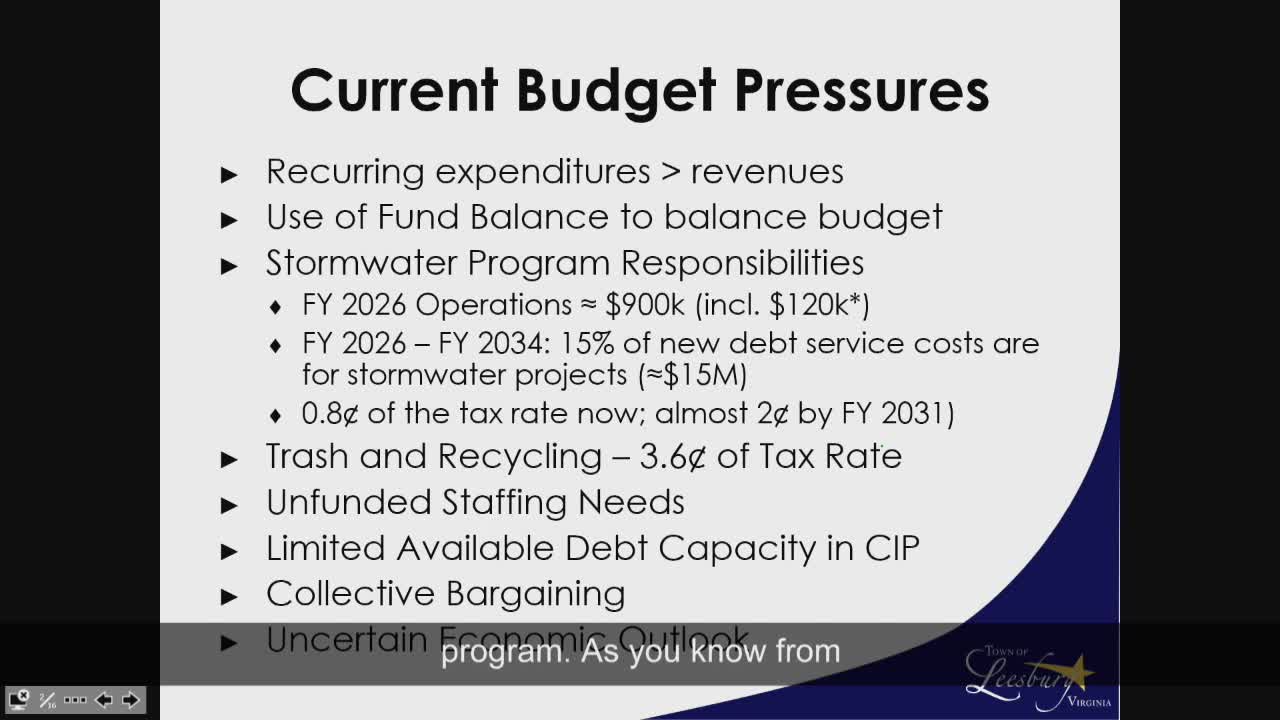
Staff highlighted specific near‑term budget pressures: FY‑26 included $900,000 in recurring stormwater costs; council had previously removed roughly $120,000 from stormwater in the budget process. Several council members expressed support for restoring the $120,000; council directed staff to return with a resolution to appropriate that amount for stormwater (staff said they could prepare it for an August or September meeting). Council also discussed directing a portion of the current receipts to paving; staff indicated an illustrative $300,000 for paving would be feasible and asked for council guidance on priorities.
Kiesucker noted a key modeling assumption: the town used a $0.75 per $100 assessment rate for the initial five years (the statutory minimum for certain data‑center assessments) with a later increase to $1.00 in modeling, and cautioned that timing of equipment installation affects when those values are realized. She described the Manassas example where an expected revenue windfall did not materialize because the data center’s largest tenant was a bank and personal property tax treatment differed.
Council asked staff to return with a recommended policy framework—potentially a resolution—that would document how data‑center funds are tracked and used in future budgets and maintain a reserve approach. Several council members said they support prioritizing stormwater commitments and addressing paving and capital replacements as staff develops more detailed recommendations.
Staff recommended returning to council with refined options ahead of the September budget work session; council signaled support for further analysis and a staged, in‑arrears approach to spending the revenue.