Consultant-led work session flags ranked-choice voting, campaign-finance transparency and public financing as options for Rockville
Loading...
Summary
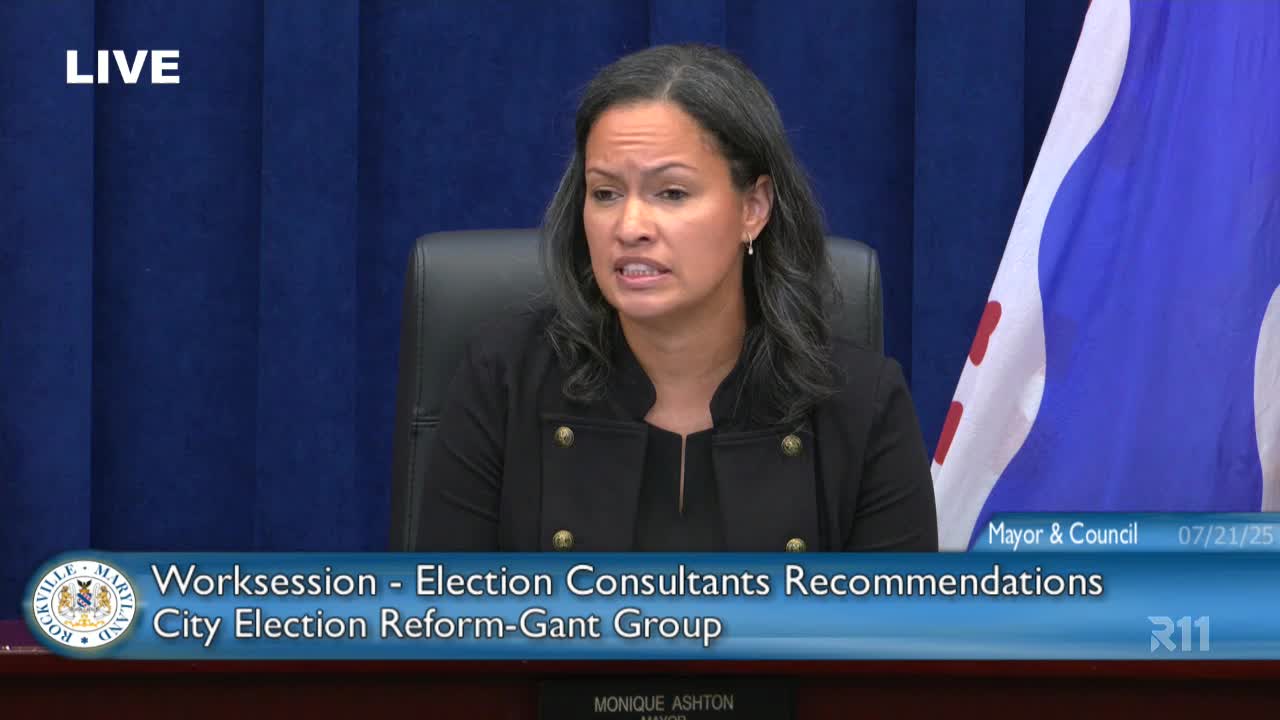
City staff and a consultant led a July 21 work session on election reform. The discussion covered campaign finance reporting, the role of the city’s Board of Supervisors of Elections, enforcement options and ranked-choice voting; a final consultant report is expected in September.
City staff and consultant Jason Gantt led a July 21 work session with the Rockville Mayor and Council to review options for revisions to the city’s election code. The session focused on campaign-finance transparency, possible public financing models, enforcement mechanisms for campaign violations, the role of the Board of Supervisors of Elections (BSC), and ranked-choice voting (RCV).
Why it matters: Councilmembers expressed interest in clearer campaign-finance reporting, better disclosure of independent expenditures and PAC activity, and a defined enforcement pathway for election-code violations. The consultant recommended a code rewrite to consolidate campaign rules, suggested considering public financing options (voucher or small-donor matching systems), and described implementation steps and timelines for ranked-choice voting.
Main takeaways - Campaign-finance transparency: The consultant urged rewriting the campaign-finance chapter as a standalone code section, tightening reporting for PACs and independent expenditures, and clarifying definitions (slates, independent expenditures, contributors). A consistent filing standard would make outside spending easier to track for the BSC and the public. - Enforcement and adjudication: The consultant and city attorney discussed multiple models for enforcement, including an administrative-hearing officer available during election periods to adjudicate campaign-finance complaints and a fallback municipal-infraction or prosecutorial path. Councilmembers favored independent adjudication to reduce conflicts for volunteer board members. - Public financing: The consultant laid out public-financing options (voucher systems like Seattle’s; small-donor matching like New York’s) and estimated modest annual budgets for a small city program (order-of-magnitude: low-to-mid hundreds of thousands over an election cycle depending on design and participation). Council members expressed interest but flagged budget and implementation timing concerns. - Ranked-choice voting (RCV): Speakers and councilmembers expressed broad interest in RCV. The consultant noted it is technically feasible for Rockville and recommended a phased approach: public education and pilot planning before full implementation. Advocates (Ranked Choice Voting Maryland and the Ranked Choice Voting Resource Center) described software (open-source RCTab) and local examples (Arlington VA, Cambridge MA, Portland OR).
Public and expert input included - Senator Cheryl Kagan (Maryland Senate) urged better election transparency and noted related state law changes that require livestreaming and public posting of election-board materials. - Ranked-choice voting advocates — Michelle Whitaker of Ranked Choice Voting Maryland and Chris Hughes of the Ranked Choice Voting Resource Center — briefed the council on available software and on experiences in other jurisdictions; Hughes said RCTab can be added to existing ballot-scanning workflows to produce round-by-round results.
Questions raised by the council Councilmembers asked staff and the consultant to provide: (1) consolidated examples of campaign-finance code language used by peer cities; (2) a cost estimate for a public-financing pilot and an implementation timetable; (3) a clear enforcement proposal with legal and procedural options; (4) a public-engagement plan for ranked-choice voting, including sample education materials and a proposed timeline for possible adoption. Staff said the consultant’s final report will include recommendations and an implementation timetable and is due in September.
Next steps The consultant will deliver a final report in September with recommended code language, cost estimates, and implementation pathways. Staff and the consultant proposed phased approaches for both public financing and ranked-choice voting to allow for community education and administrative preparation. Councilmembers asked staff to prepare model ordinance language and a communication plan that includes engagement with schools, community groups and the city’s youth commission.
Closing note Councilmembers said they supported greater transparency and clearer rules for campaign finance and enforcement; they signaled interest in exploring ranked-choice voting and public financing, but several members emphasized that any new program should be carefully designed and timed to avoid administrative or fiscal disruptions.