Get Full Government Meeting Transcripts, Videos, & Alerts Forever!
Get email alerts on the Rent Stabilization topic
No spam. Unsubscribe anytime.
Rockville council declines to pursue citywide rent-control policy after daylong public comment
Summary
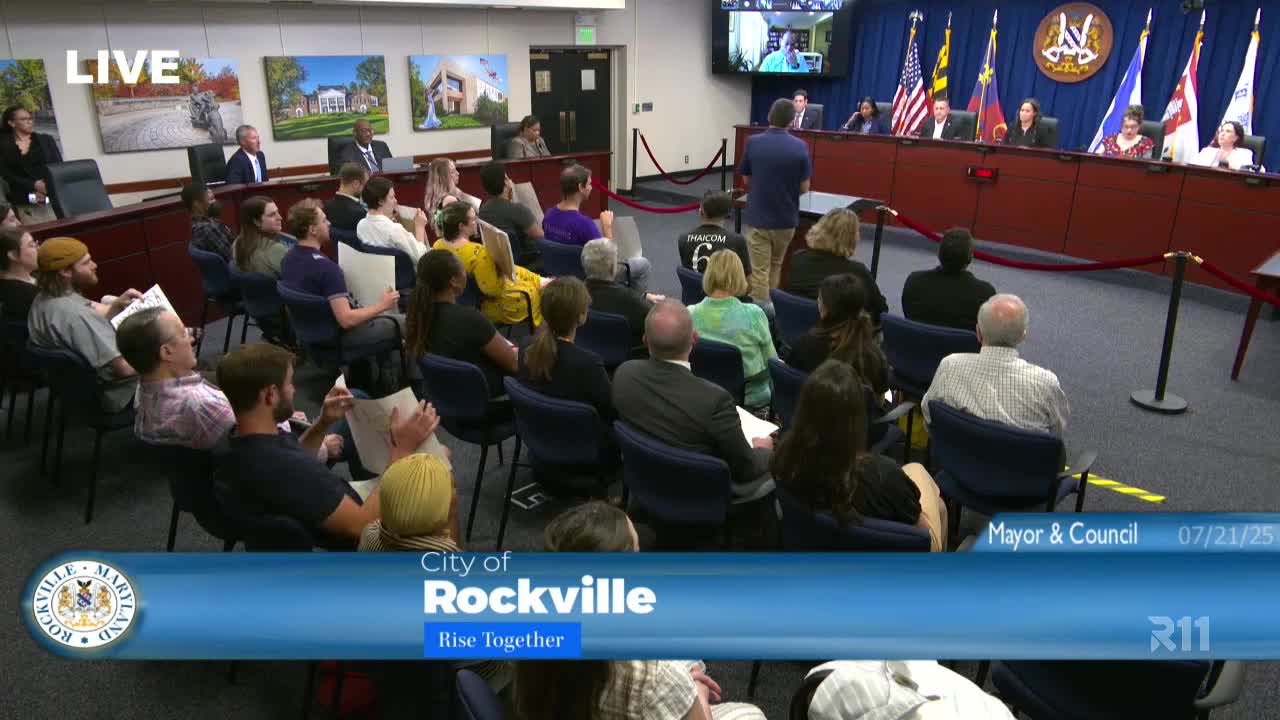
After more than three hours of public testimony, the Rockville Mayor and Council voted to decline further pursuit of rental renewal hard caps. Dozens of residents, landlords and developers spoke for and against rent stabilization during a July 21 work session and public forum.
The Rockville Mayor and Council voted July 21 to direct city staff that the council will not implement a rent-control policy or rental-renewal hard caps and will not consider such a policy again for the remainder of the council’s term. The motion, made by Councilmember Adam Van Grack and seconded during the meeting, passed after an extended public comment period in which residents, landlord representatives and housing developers urged competing approaches.
The vote came at the end of a work session devoted to a staff briefing on rent stabilization and a long public comment period in which more than 80 people spoke. Supporters of rent limits urged protections for long-term tenants faced with double-digit lease increases; opponents warned that hard caps would choke multifamily development and erode property upkeep. “Rent control is a flawed solution that will ultimately hurt many of the very people it aims to help,” said Ryan Murphy, a Rockville resident who testified against hard caps, urging supply-side and targeted subsidy approaches instead. Multiple landlords and developers described rising operating costs and said strict caps would make buildings financially unsustainable.
Why it matters: The decision keeps Rockville aligned with the council majority that has argued rent caps risk reducing new development and future city revenues. Supporters of caps said a local limit—similar to the Montgomery County ordinance adopted in 2024—would protect renters from sharp annual increases while longer-term supply-side measures proceed. Opponents said those county-level results already show a decline in multifamily permitting and warned of reduced reinvestment in existing housing.
Most important facts - After a day of public comment and a staff presentation, the council approved a motion stating it will not implement rental renewal hard caps in Rockville and will not place rent-control measures on its agendas for the remainder of the current council term. The motion was made by Councilmember Adam Van Grack and passed by majority vote (vote tally not specified in the meeting transcript). - Earlier in the meeting Councilmember Zola Shaw moved that the council enact a rent stabilization program modeled on Montgomery County’s ordinance (a 6% cap or Consumer Price Index + 3%, whichever is lower). That motion was moved on the record and subsequently was not adopted by the council (motion moved; final council outcome: not adopted; vote tally not specified in transcript). - The consent agenda (including final design approval for a Twinbrook Community Recreation Center annex mural and authorization of a memorandum of agreement with the Maryland Transportation Authority Police) was approved unanimously earlier in the meeting; mover: Councilmember Valeri; second: Councilmember Jackson.
Public testimony and council discussion Dozens of speakers filled the council chamber and overflow spaces. Many of those speaking in favor of rent limits tied their testimony to the everyday effects of rising rents: eviction risk, longer commutes after displacement, and lost community ties. Several tenant organizers and renters told personal stories about steep lease increases and urged the council to adopt local protections sooner rather than later. “We are asking you to stand with the people who live here, who you represent, not those who profit from our hardship,” said Katie Madore, a Rockville resident and teacher.
Speakers representing multifamily owners, managers and industry groups warned of unintended consequences. Several presenters cited Montgomery County’s experience after passage of its rent ordinance: a sharp decline in multifamily permits in the quarters after adoption. “When regulations reduce the ability of investment capital to make a return, that capital is deployed elsewhere,” said Todd Pearson of B & Soul Company. Developers pointed to rising operating costs — insurance, utilities, labor, materials — and said strict caps would constrain reinvestment and could accelerate conversions out of rental housing.
Council members emphasized different policy priorities. Some argued the council has already pursued several housing and tenant-protection measures — increased rental assistance funding, zoning changes, improvements to the city’s moderately priced dwelling unit (MPDU) program and steps to strengthen tenant protections — and that those actions take time to affect supply and affordability. Others said those measures do not address immediate harms facing renters and pressed for a local cap on renewal increases. The majority ultimately favored delaying a rent-cap policy because of concerns about local economic impacts and uncertainty about regional investment shifts.
What the motion does and does not do - The council motion does not change existing renter-assistance or tenant-protection programs. City staff will continue existing programs and planned policy work: transparency measures, fee disclosures, code updates, MPDU implementation, and the city’s rental-assistance programs. - The motion bars the council from placing any rent-control (rental renewal hard caps) proposal on its agendas for the remainder of the current council term; it does not prohibit future councils from reconsidering the issue after the current term ends.
Council direction and next steps Councilmembers asked staff to continue monitoring local rent and building-permit data, report back on neighborhoods and properties showing unusually large increases, and continue other housing actions already underway — including enforcement of habitability laws, MPDU implementation, and landlord-tenant code updates. Staff told the council it would continue to collect and publish rent trends and to provide the council with information that could identify “outliers” where unusually large increases or poor maintenance appear together.
Voices at the meeting Speakers included renters, tenant organizers, business and landlord representatives, developers and nonprofit advocates. High-profile participants included Senator Cheryl Kagan, who spoke about election issues earlier in the meeting, Margie Graff, president and CEO of the Greater Rockville Chamber of Commerce, and representatives of the Apartment and Office Building Association (AOBA). Many speakers urged the council to pursue non-cap options (vouchers, MPDUs, zoning incentives) while others said those steps would not protect current tenants.
Ending note The vote preserves the council’s stated preference for supply and subsidy measures and for strengthening tenant protections through enforcement and transparency rather than enacting a citywide cap on renewal increases. Councilmembers and staff told the public they will continue to gather data and report back; tenants’ groups said they will continue advocating for limits that they call necessary to prevent displacement.
Votes at a glance - Consent agenda (Twinbrook mural final design; MOA with Maryland Transportation Authority Police): Motion to approve by Councilmember Valeri; second by Councilmember Jackson. Outcome: approved unanimously (per transcript; tally not specified). - Motion to enact rent stabilization modeled on Montgomery County (6% or CPI+3%, whichever is lower): mover, Councilmember Zola Shaw; second: Dr. David Miles (councilmember). Motion presented on the record; final council outcome: not adopted (vote tally not specified in transcript). - Motion to decide not to implement a city rent-control policy or rental-renewal hard caps for the remainder of the council’s term: mover, Councilmember Adam Van Grack. Outcome: motion approved by council (vote tally not specified in transcript).