Get Full Government Meeting Transcripts, Videos, & Alerts Forever!
Get email alerts on the Planning Procedures topic
No spam. Unsubscribe anytime.
Frederick Planning Commission opens review of rules of procedure as attendance, voting and member roles draw scrutiny
Summary
Commissioners and staff asked for clearer language on attendance standards, alternate members’ duties, audible voting and limits on independent research as the Planning Commission began a formal review of its rules of procedure at a July 21 workshop.
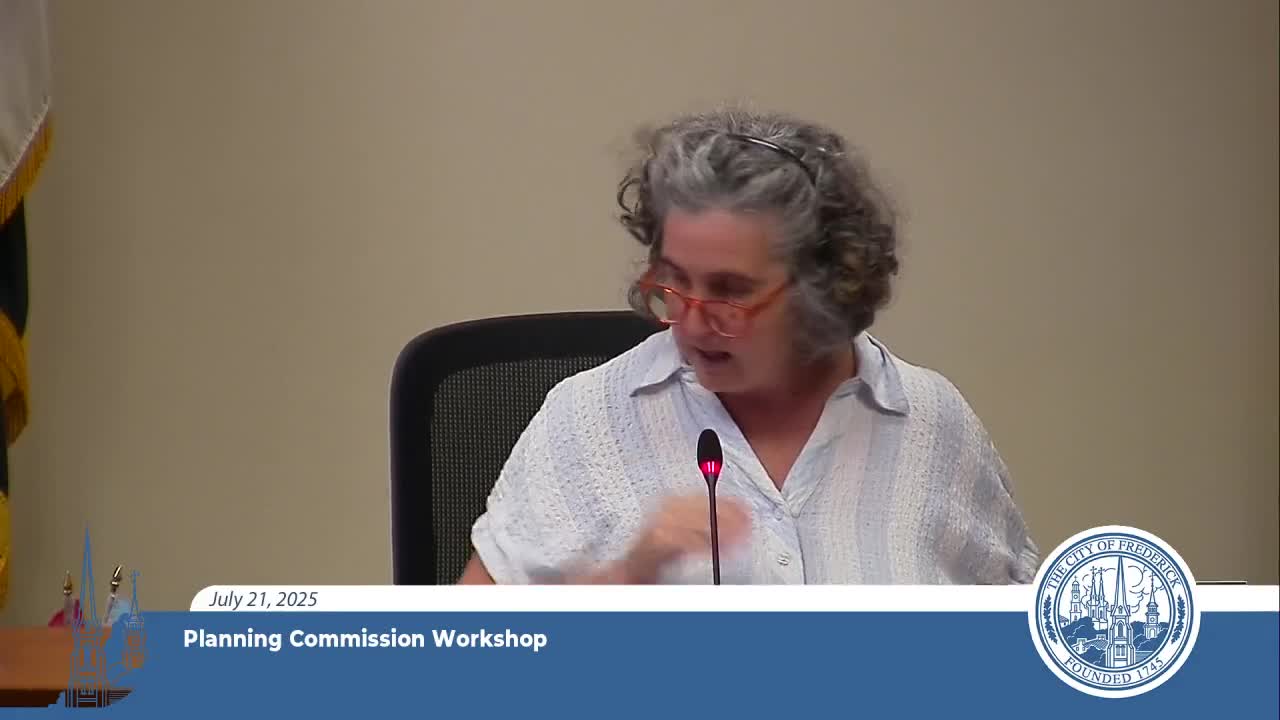
The Frederick City Planning Commission opened a multi-point review of its rules of procedure at a July 21 workshop, with commissioners and staff agreeing to return proposed draft language for further consideration.
Commissioner Dorothy Manelas, who requested the review, told colleagues the timing was apt because the commission is currently recruiting two new members and “this presents an opportune time to review the rules of procedure to ensure that the language regarding roles and responsibilities is clearly defined and well articulated.”
Commissioners said they want clearer, more usable language for routine governance questions — including attendance thresholds, the role and activation expectations for alternate members, how votes are counted when members do not vote audibly, and the limits on independent research by commissioners on pending applications.
Why it matters: The commission’s rules govern how it conducts public hearings and makes land-use recommendations; ambiguous language can create public confusion, limit transparency, and raise procedural grounds for appeals. Several commissioners said they want more concrete, user-friendly wording so new members and the public can understand expectations without parsing multiple documents.
Key discussion points and staff guidance - Attendance: Commissioners flagged confusion over how the attendance standard is enforced. Planning staff said the city code follows a state provision that considers a member to have resigned if they fail to attend at least 50 percent of meetings in any consecutive 12-month period. Staff said the commission does not itself have unilateral authority to impose a stricter attendance standard set in the city code and suggested the commission could recommend changes to the City Council if it wanted a different threshold. (Referenced statute: Annotated Code of Maryland §8-501.) - Alternate members: Commissioners pressed to add language explaining the alternate member’s role beyond the procedural statement that an alternate may vote. Manelas said alternates should be framed as “one of the most important people” because they may be called on to create a quorum and vote. Staff agreed that adding expectations and onboarding language would be reasonable. - Audible voting vs. show-of-hands: Commissioners questioned wording that appeared to count a non-audible response as an affirmative vote. Commissioners and staff agreed the provision should be clarified to reflect current practice — typically a show-of-hands tally recorded aloud — and to remove ambiguous language that could be misread as imputing a vote. - Independent research by commissioners: Several commissioners argued they sometimes need to obtain factual information (for example, market data or other non-staff analyses) when staff cannot provide it. Planning staff and the city attorney cautioned that unilateral research by a commissioner on matters that are “before the commission” can create transparency and fairness issues and, in some cases, could introduce materials that are out of scope for the land‑use criteria. Staff recommended clearer language distinguishing allowed background education and training (for example, membership and training through Maryland Planning Commissioners programs) from conducting independent factual investigations into a pending application; staff also recommended a public notification process for any topical Q&A sessions the commission holds as a body.
Next steps and decisions made at the workshop - The commission voted by voice to reorder the workshop agenda at the meeting’s start. Motion: “I move to have the items on the agenda for the workshop for 07/21/2025, to reorder the items to move number 8, rules of procedure to number 1, and then have project number 4 ... be moved to Number 2, and then follow the rest of the order of the agenda.” Mover: Commissioner Honellis; second: Commissioner Valencia. Outcome: approved by voice vote. (Recorded at the start of the meeting.) - Staff and commissioners agreed to draft specific proposed text revisions and circulate a redline for a future workshop. Staff recommended producing draft clauses and a short “SOP/checklist” to help onboard new commissioners.
What remains unsettled - Whether the commission should propose to City Council a change to the 50 percent attendance rule in the city code, and if so, the precise alternative threshold and appeal procedure. - Exact drafting for the “independent research” clause so it permits legitimate background information while guarding the formal record from extraneous or out-of‑scope materials.
Ending: Commissioners asked staff to prepare draft language (including proposed processes for alternate activation, attendance documentation and transparent Q&A sessions) for discussion at a later workshop; no formal rule changes were adopted at the July 21 meeting.