Get Full Government Meeting Transcripts, Videos, & Alerts Forever!
Get email alerts on the Health Insurance topic
No spam. Unsubscribe anytime.
Cooper City managers propose switching health plan, budget for 30% premium rise and a reserve to smooth future spikes
Summary
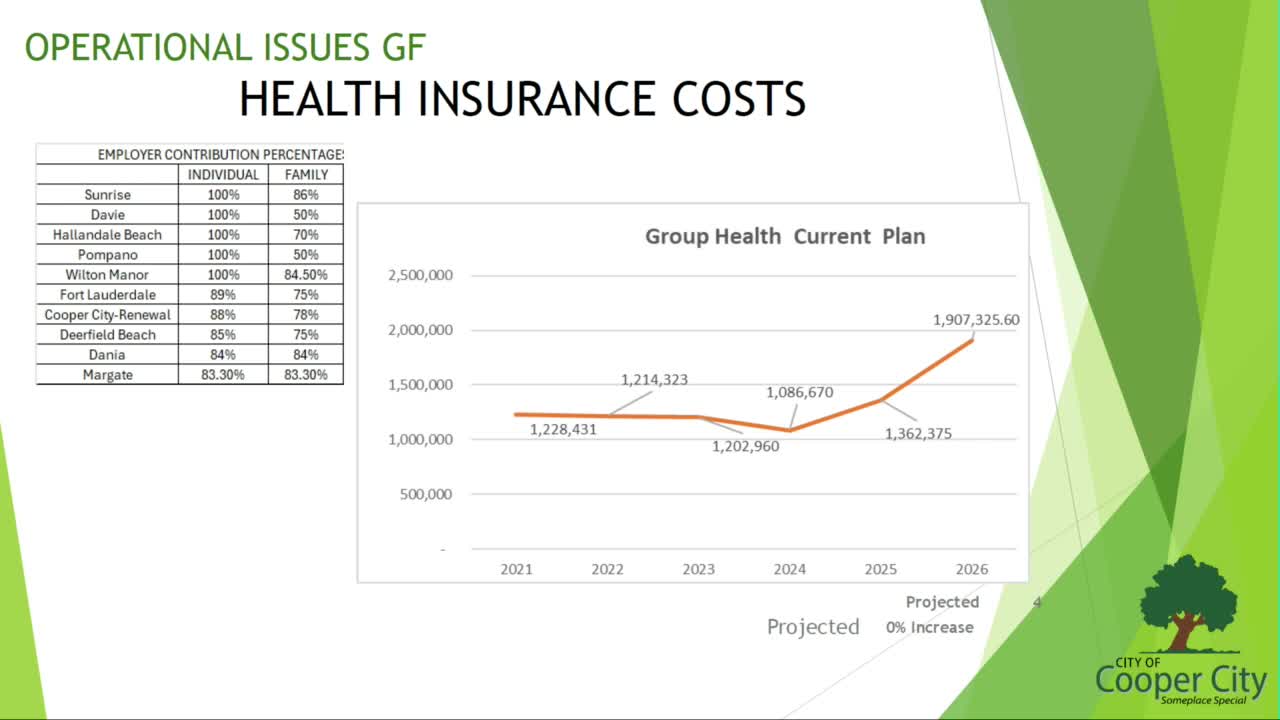
Cooper City officials told commissioners at a July budget workshop they are budgeting a roughly 30% increase in employee health insurance costs for the coming plan year and recommended switching carriers to limit that hit.
Cooper City officials told commissioners at a July budget workshop they are budgeting a roughly 30% increase in employee health insurance costs for the coming plan year and recommended switching carriers to limit that hit.
The City Manager said the city has “budgeted 30% increase in the health insurance plan” and that the current plan’s loss ratio is atypically high, driving premiums. Staff reported receiving market bids: Cigna declined, UnitedHealthcare offered coverage at a large increase, and Blue Cross Blue Shield (Florida Blue) provided a proposal staff said would reduce the city’s near‑term cost by about $104,000 compared with the renewal numbers and could free up as much as $600,000 compared with prior renewal assumptions.
Why it matters: the city’s health plan and its unusually high loss ratio are a major budget driver. Commissioners warned the council will face tradeoffs if the city asks employees to change providers; staff said some disruption is likely but that coverage for major conditions would continue.
City staff laid out both technical and practical elements. The presentation described the city’s current arrangement with FMIT (Florida Municipal Insurance Trust) and showed Cooper City’s loss ratio at about 152% — higher than comparable municipalities in the FMIT pool — which staff said is the main driver of the city’s higher rates. The City Manager told commissioners “if we didn't have those catastrophic cases, we wouldn't be nearly as bad” in premium comparisons.
Staff and the broker, identified in the workshop as Isis, said Blue Cross Blue Shield presented PPO plans similar to the city's current coverage and no HMO alternatives, and that a move to Blue Cross Blue Shield would likely reduce cost in the immediate renewal: “If you compare those number[s] the last row to the first row, first row is what we're paying today. I think those numbers are fairly comparable,” the broker said, adding the quoted Blue option could reduce the city's cost by roughly $104,000. Staff recommended negotiating with Florida Blue and returning to the commission with details for August.
Commissioners pressed staff for more analysis of who would be affected and how. Commissioner Schroeder and others asked staff to identify the employees and dependents who would lose specific providers under a carrier switch and to survey employees (anonymously, if needed) about provider reliance. Several commissioners recommended establishing a rate‑stabilization account to set aside initial savings so the city can blunt next year’s potential premium increases.
Staff also proposed non‑market changes intended to reduce long‑term costs, including using health advocates or case managers to help high‑cost members enroll in other appropriate public coverage (for example, Medicaid where eligible), pursuing better risk management and eligibility checks for retirees on the plan, and incentivizing healthier employees to move to lower‑cost plan options by offering contributions to HSAs or stipends. Staff said only three employees currently use an HSA and that a modest monthly employer contribution could encourage choice of a high‑deductible option.
What was not decided: commissioners did not vote on a carrier change. Staff said they will return with contractual documents and more detailed impact analysis at the August meeting and seek consensus to proceed toward a Blue Cross Blue Shield PPO for the FY26 renewal.
Commissioners requested the following follow‑up before final action: an anonymous or voluntary survey of employees and dependents about provider needs; a provider‑matching crosswalk showing which in‑network doctors would carry forward under Florida Blue versus UnitedHealthcare; the number and profile of high‑cost ongoing cases driving the loss ratio (HIPAA limits acknowledged so staff will provide aggregated data); cost/benefit analysis of an employer HSA contribution or other incentive design; and a plan for a rate‑stabilization fund if savings materialize.
Staff said the broker will present formal plan documents and that the August agenda will include a formal recommendation if the commission directs staff to proceed.
The workshop discussion emphasized distinguishing short‑term budget savings from the two‑year visibility carriers use when pricing a small plan’s experience; staff warned that a carrier change can lower near‑term premiums but will not erase the city’s high prior claims experience in carrier underwriting.
Commissioners who stressed protecting employees asked staff to analyze disruption — for example, whether an employee undergoing ongoing specialty care would need to change physicians — and wanted clear written communications to employees before any change.