Get Full Government Meeting Transcripts, Videos, & Alerts Forever!
Get email alerts on the Large Scale Plan Amendment topic
No spam. Unsubscribe anytime.
Board transmits Golden Ocala/World Equestrian Center comprehensive plan text and map amendments to state; public raises traffic, water and farmland preservation
Summary
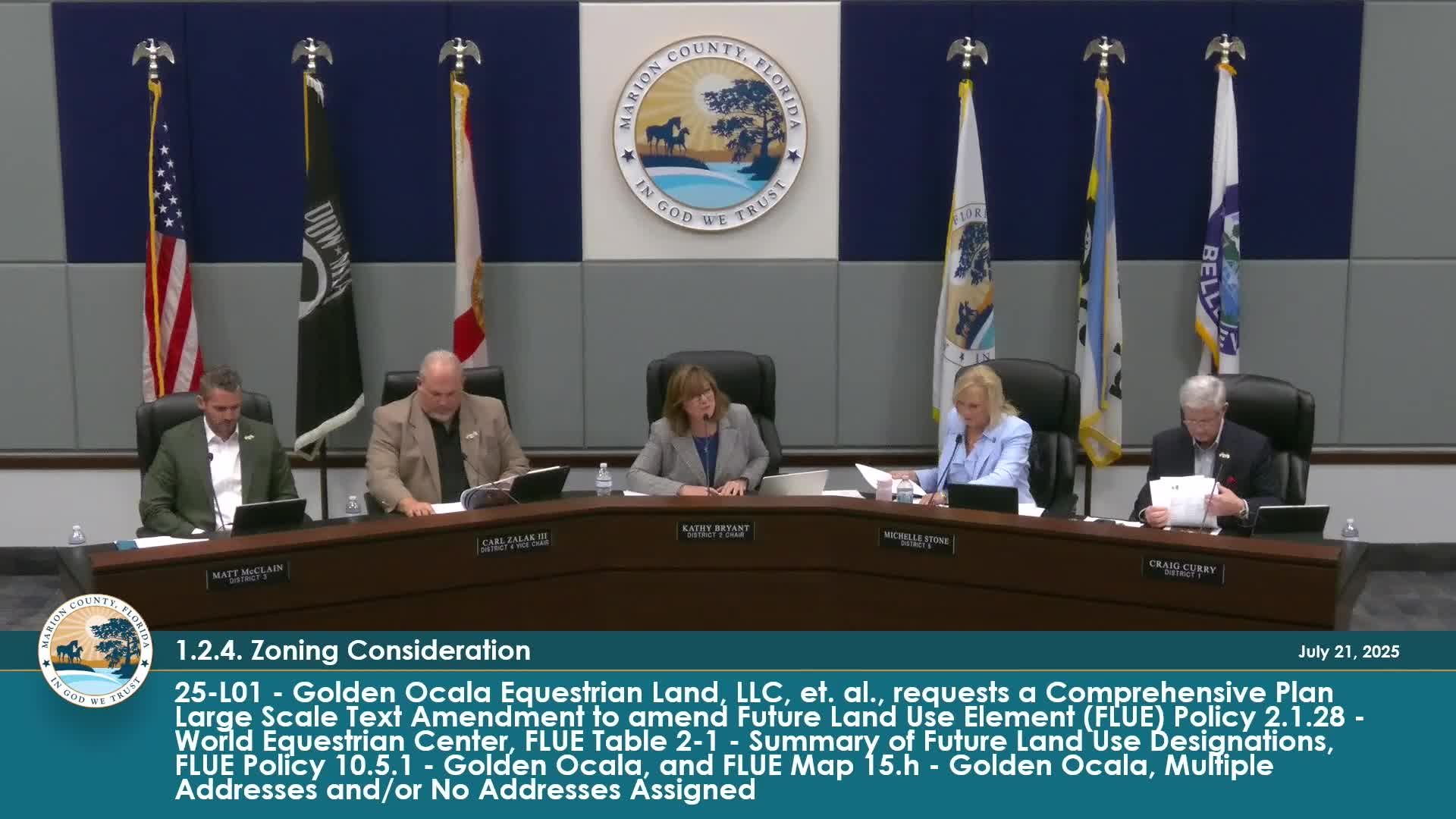
The Marion County Board of County Commissioners voted unanimously July 21 to transmit two large‑scale comprehensive plan amendments for the Golden Ocala World Equestrian Center — a text change adding sports facilities to the WEC land use and a map amendment converting roughly 250.86 acres from low residential to WEC — to state agencies for coordinated review.
The Marion County Board of County Commissioners on July 21 voted to transmit two large‑scale comprehensive plan amendments related to the Golden Ocala World Equestrian Center to state and regional agencies for coordinated review. The items were: a text amendment to the WEC future land use definition to explicitly add "sports facilities" (indoor and outdoor) to the list of allowed/supporting uses, and a map amendment to convert roughly 250.86 acres of low‑density residential land north of State Road 40 to the WEC land‑use designation.
Staff summary and proposed changes: County planner Chris Reisen told the board the amendments are large‑scale and require coordinated state review (a 60‑day comment period by state agencies). The proposed text change would add sports facilities (examples listed included soccer fields, softball fields, indoor/outdoor arenas) to the WEC designation and update WEC policies and tables. The map amendment proposed expanding the geographic WEC boundary by about 251 acres on the north side of State Road 40. The applicants also requested program changes that include shifting how some event capacities are measured (moving from seat counts to acreage thresholds in some cases) and increasing the potential number of hotel rooms on the overall WEC campus by 300 rooms to a total of 1,650 rooms. Staff noted no change is proposed for the existing recreational vehicle area or the commercial square footage caps.
Traffic, water and related studies: Reisen said the applicant has supplied a traffic methodology that staff approved and that a traffic study was underway; FDOT and other state agencies are expected to comment during the coordinated review. The county attorney and staff advised the board that state review after transmittal will focus on state facilities (for example, State Road 40 and other state assets), while local impacts still must be addressed before final adoption. County staff referenced the West Marion multimodal/transportation analyses and said those results would be used as part of an overall analysis of long‑range impacts.
Applicant presentation and phasing: Agent Jimmy Gooding and consultants described phasing the sports facilities across multiple years: phase 1 targeting a 2026 opening for outdoor synthetic turf and natural turf fields and supporting restrooms/concessions; phase 2 (2027) for an indoor multipurpose building that includes courts and an ice rink; phase 3 (2028) further field development and multipurpose diamonds; hotel and auxiliary amenities proposed later. Consultants estimated early economic impacts for the first phase and a larger impact at full build‑out. They said the intent was to expand the campus uses beyond equestrian events to support multi‑sport programming and better use of hotels and services on site.
Public comment and major issues raised: The hearing drew extended public comment lasting more than two hours. Speakers in opposition included multiple nearby horse farm owners and long‑time residents who said the change conflicts with prior agreements and the settlement that established equestrian estate lots as a buffer to the farmland preservation area. Key concerns raised repeatedly: - Traffic and access: opponents said a full traffic impact analysis should be complete before transmittal; staff and the county engineer said the methodology is approved and the applicant will complete the full traffic study as part of subsequent steps and the coordinated review. FDOT is expected to comment during the 60‑day review. - Water and springs: commenters asked whether county water supply and consumptive use permits were sufficient for the expanded campus and hotel rooms. County utilities staff confirmed Golden Ocala contributed funds and property toward a Northwest Regional water treatment plant under a May 20 agreement; the county is updating water use permitting and will analyze project water needs as required. - Settlement agreement and farmland preservation: attorneys for adjacent landowners argued the 2016–2017 settlement, and the comprehensive plan language adopted afterward, provided for equestrian estate lots and transitions that are inconsistent with an intensified sports/concert venue. County legal counsel said the previously agreed settlement related to the 2016 amendments and that the county ordinance adopted then did not bar future amendments; the commission retains discretion to consider new plan amendments but must ensure internal consistency at adoption. - Noise, lighting and compatibility: neighbors sought enforceable limits for outdoor noise, lighting, hours of operation, concert caps and seating to reduce off‑site impacts on horses and farms. WEC consultants said they would design lighting to limit spill and use acoustic engineering for event sound; they said pool play and weekday uses typically have limited PA usage, with full stadium announcing limited to finals or championship events.
Board action and next steps: After the presentation and public comment, staff recommended affirmative findings to transmit the text and map amendments to state agencies for coordinated review. Commissioners voted unanimously to transmit both amendments (items 1.204 and 1.205). Staff and the county attorney emphasized the hearing was a transmittal hearing: transmission will initiate state agency review and comment; the board will consider adoption in a later public hearing after state comments and completion of required studies (traffic study, responses to state comments, and any required modifications to the proposed PUD and development agreement). Several commissioners listed issues and potential conditions they expect to see before final adoption, including acoustical analyses, lighting plans, specific hours/venue limits, and detailed traffic mitigation plans.
Why this matters: The proposed changes would expand allowed uses at a campus that already generates regional visitors. Supporters — including youth‑sports organizers, elected officials and some coaches — said the fields and indoor facilities would create local programming for youth, reduce travel burdens for families and attract sporting events and associated economic activity. Opponents said the amendment substantially changes the nature of the WEC land use, risks impacts to adjacent horse farms, and should not be sent to the state until traffic, water and compatibility questions are resolved.