Get Full Government Meeting Transcripts, Videos, & Alerts Forever!
Get email alerts on the Public Safety topic
No spam. Unsubscribe anytime.
Prince George's task force reviews police facility adequacy; administration backs temporary suspension of response-time test
Summary
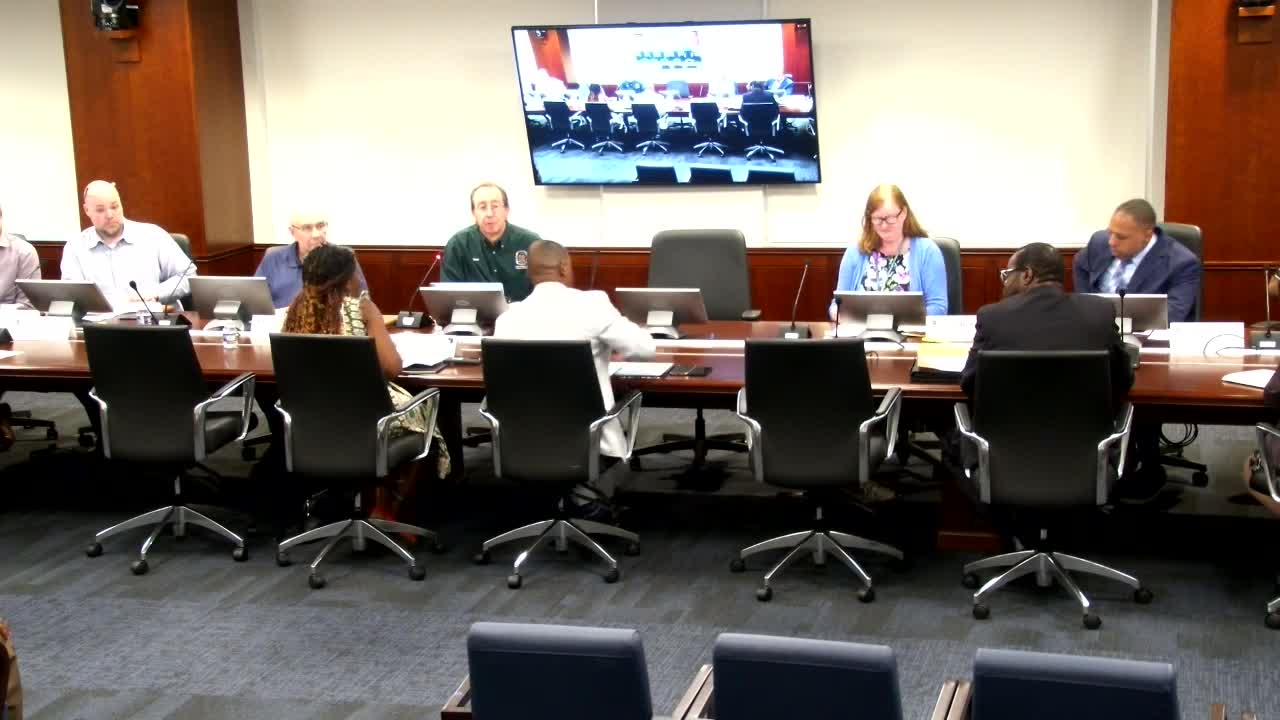
The Plant Prince George's 20 35 Implementation and Infrastructure Task Force on July 21 heard an update from the Planning Department on police facility adequacy and discussed shifting the adequacy test from response time to staffing, while county administration said it supports a temporary suspension of the current response-time test (CR 80) to develop a new method.
The Plant Prince George's 20 35 Implementation and Infrastructure Task Force on July 21 heard an update from the Planning Department on police facility adequacy and the county’s Adequate Public Facilities Ordinance (APFO), and discussed two pieces of recently introduced legislation: CB 29, which seeks to remove the police facility adequacy requirement, and CR 80, a draft resolution to temporarily suspend the current response-time testing method.
Planning Director Lakeisha Hall, Planning Director for Prince George's County, told the task force that APFO implementation must align with state law and the county’s Plan 20 35 policies adopted in 2014. Hall said the county’s code implementing APFO is in section 24-4501 and described the review process that leads to a certificate of adequacy, which can be issued with conditions, denied, or appealed to the planning board. Hall noted the county previously adopted a facilities management master plan (adopted in 2008 with a horizon to 2018) that has not been updated and said a reinitiated fiscal impact study will inform updates.
Why it matters: APFO outcomes affect whether residential projects can proceed, what mitigations or fees are required, and where impact money is spent. Task force members focused on whether the response-time metric accurately measures police adequacy, whether mitigation fees and the countywide public safety surcharge duplicate charges for developers, and on transparency about how surcharge revenue has been spent.
County administration representative Calvin L. Tyson, council liaison for the Office of the County Executive, said the administration favors CR 80’s draft language to "temporarily suspending the use of the current, police response time testing, in order for us to actually work with our stakeholders to develop a better testing instrument." Tyson added, “we don't feel that, response time is an actual, accurate indicator of police adequacy. We'd rather use police staffing, as the the...testing instrument.” He described staffing as the preferred metric while work continues on developing a methodology to measure staffing accurately.
Several task force members questioned the practical effects of changing the test. A task force attendee who identified himself as representing the business community, Foreman, argued against a mitigation fee and for relying on the public safety surcharge. He said, “I do not think that there should be the mitigation fee. We have the public safety surcharge... Since the public safety surcharge was introduced, I don't think we even know how much has been paid by developers and where it goes.”
Task force member Mr. Weiss asked whether the county can audit surcharge receipts and spending; Tyson replied that the Office of Management and Budget (OMB) can provide a summary and that OMB already gives an annual update to the county council that includes prior-year data. Hall said the fiscal impact study that has been reinitiated will provide recommendations for updating the public safety master plan and for implementation consistent with recent case law.
Technical details discussed: task force members noted the existing response-time thresholds cited in the discussion: a 10-minute target for emergency calls and 25 minutes for non-emergency calls. Members debated geography for adequacy testing (eight police districts versus smaller beats or sectors) and whether mitigation fees assessed when tests fail are proportional and appropriately spent in the affected area.
Legislative status: Hall said CB 29—introduced earlier in the year to remove the police facility adequacy requirement—is currently held at the council committee and is not moving forward. CR 80 was presented as under active administrative support but was not voted on by the task force; the administration's position is to suspend the current response-time test while stakeholders refine a staffing-based metric.
Outcome at the meeting: no formal task force vote was taken on CB 29 or CR 80. Planning staff and the administration said they will continue work with stakeholders and OMB as the fiscal impact study proceeds.
What’s next: Planning staff signaled that the fiscal impact study will drive updates to the public safety facilities master plan and inform any changes to APFO implementation. Task force members asked for more detailed maps (districts, sectors, beats) and clearer accounting from OMB about surcharge receipts and spending.
Ending: Task force members and county staff agreed to continue stakeholder consultations and use the fiscal impact study results to shape any proposed changes to APFO testing and mitigation approaches.