Get Full Government Meeting Transcripts, Videos, & Alerts Forever!
Get email alerts on the Short Term Rental And Party Enforcement Fees topic
No spam. Unsubscribe anytime.
Howard County Council introduces emergency bill to raise penalty for for‑profit residential parties
Summary
Council member Deb Young introduced Council Bill 58-2025 to raise the civil violation fee for residential properties used for for‑profit parties from $250 to $5,000; a public hearing is scheduled for July 3, 2025. Several council members questioned the use of emergency procedure and whether four votes for emergency passage have been secured.
Council member Deb Young introduced emergency Council Bill 58-2025 on behalf of the county executive, a measure that would add a provision to Title 8, Subtitle 9 of the Howard County Code to prohibit "parties or entertainment for profit" at residential properties and increase the county's civil violation fee from $250 to $5,000.
The bill was read into the record by the council administrator. A hybrid public hearing is scheduled for Wednesday, July 3, 2025, at 9:30 a.m., with a wrap-up session immediately following the hearing. Members were told testimony may be given in person or virtually via WebEx and that written comments may be submitted to councilmail@howardcountymd.gov.
The legislation's sponsor, Council member Deb Young, said the change mirrors recent action in Montgomery County, which last week raised a comparable civil violation to $5,000, and that the county is seeing commercial parties at residential addresses in multiple council districts. "In particular, in one neighborhood where there are as many as 10, 12 parties a week ... 2 to 300 cars with extremely loud music, huge bags of trash resulting from these parties on a regular basis," Young said, describing the neighborhood impacts she said the bill is intended to stop.
Several members objected to the use of emergency procedures. Council Chairperson Walsh raised procedural concerns and said she would not be present at next week's meeting, warning that the bill requires four votes to pass as emergency legislation: "I will not be here, next week. So, if you need my fourth vote for this bill to pass, then you need to have that hearing before I leave," she said.
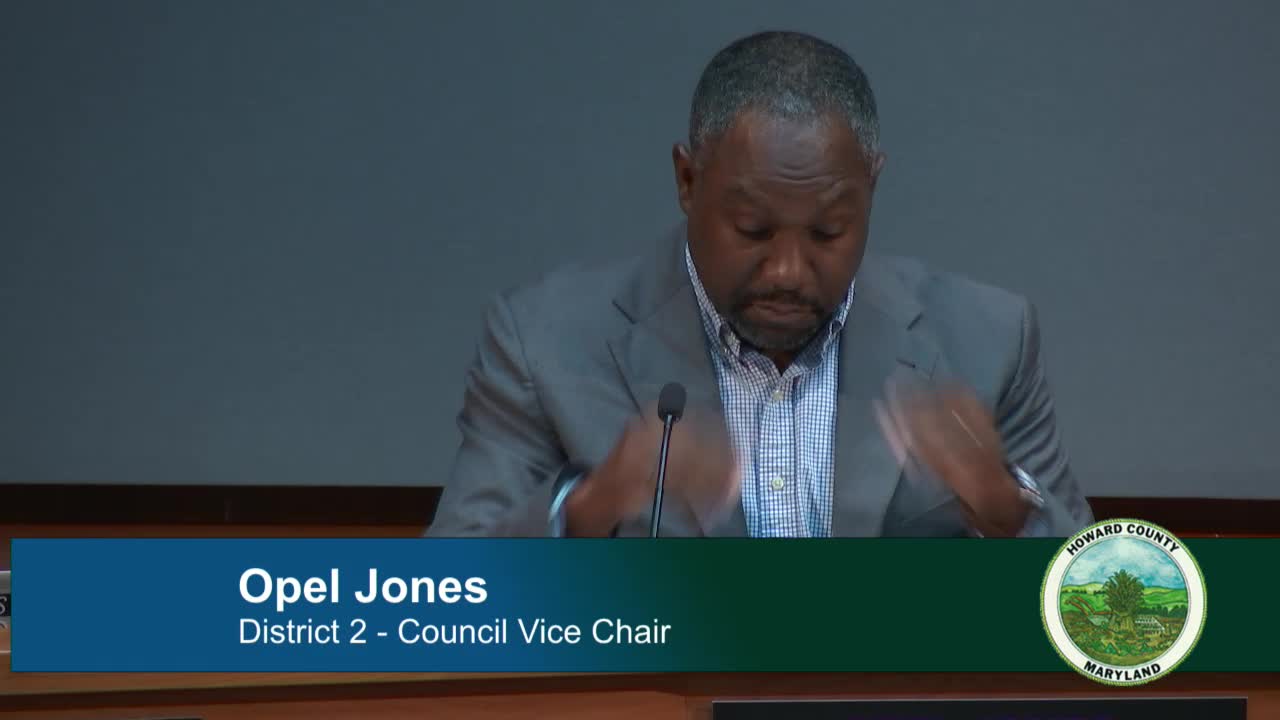
Council member Dr. Jones said he shared concerns about how the session was called and said past emergency sessions have generally addressed natural disasters or urgent funding needs. "In the almost seven full years that we've been together, I don't recall it happening in this manner," Dr. Jones said, adding that his staff's review of past emergency legislation showed they typically had multiple sponsors and clear, time‑sensitive emergencies.
Council member Dr. Johnson said she supports addressing the neighborhood disturbances but questioned the rush of the emergency process and the timing of a 9:30 a.m. weekday public hearing, saying the schedule could limit public participation and raise the risk of unintended consequences. "I'm unclear about and concerned about is the rush nature of this piece of legislation wherein people may not get a chance to know about it," Dr. Johnson said.
The council administrator read the bill's introductory text into the record as: "Council Bill 58‑2025, introduced by Deb Young, enact adding a provision to Title 8, Subtitle 9 of the Howard County Code prohibiting parties or entertainment for profit at a residential property, establishing the penalty for violation ... declaring that this act is an emergency bill necessary to meet an immediate emergency affecting public health, safety, or welfare and generally relating to for profit parties or entertainment." No vote on the bill was taken at the introduction.
Next steps: the public hearing on July 3, 2025, and a wrap‑up session immediately afterward. Several council members indicated the emergency designation's success is uncertain because emergency passage requires four votes and not all members signaled support for emergency passage. The bill will proceed to the scheduled public hearing where members of the public may testify.