Get Full Government Meeting Transcripts, Videos, & Alerts Forever!
Get email alerts on the Drainage Utility topic
No spam. Unsubscribe anytime.
Richardson reviews drainage-utility program and models fee increases to fund gabion, detention and retrofits
Summary
City staff presented an overview of the Drainage Utility Program, described recent channel maintenance and inspection work, explained new state stormwater-permit duties, and modeled how incremental drainage-fee increases would translate into project capacity.
City staff presented an overview of the Drainage Utility Program, described recent channel maintenance and inspection work, explained new state stormwater-permit duties, and modeled how incremental drainage-fee increases would translate into project capacity.
Nick (presenting) said the city encompasses 12 watersheds, about 44.5 miles of creeks, roughly 10,415 inlets and 362 miles of storm-drain pipeline that drain to White Rock Lake or Lake Ray Hubbard. The drainage utility fee, established in 2011 to meet stormwater-permit and environmental obligations, supports contract services, city operations and capital improvements including watershed studies, channel maintenance and erosion-control projects.
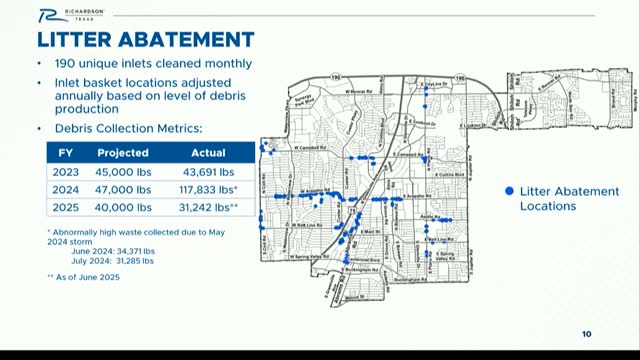
Staff summarized FY25 accomplishments (14 channel-maintenance locations addressed, significant inlet-basket trash removal after a major windstorm, CCTV inspections and a pilot program with a robotics vendor to capture 3D scans and high-definition footage of pipes). For FY26 staff proposed continued channel maintenance (Fox Creek, Texas Channel, Santa Fe Channel among prioritized sites), pipe inspections and stormwater repairs (nine locations anticipated). Nick said a prior citywide creek-erosion assessment identified about 300 sites in 2020 (high/medium/low); the city plans to reassess 140 priority locations to reprioritize work and bring projects forward.
Staff also described larger capital work now moving toward construction: a multi-component Cottonwood Creek drainage-improvement project (planned for bid and award soon) and the Lowest Branch flood mitigation project, a roughly $25 million multi-phase project for which staff completed a 30% preliminary design in a prior year and suggested phasing or bond consideration for construction. The presentation noted new TCEQ permit requirements: an obligation to retrofit 20% of structural flood-control devices to reduce pollutants and to inspect 100% of stormwater devices annually (up from 20%), which will require contracting for inspections at an estimated $40,000 per year.
To illustrate funding trade-offs, staff presented model outcomes: a $0.50 monthly increase to the residential drainage fee would generate roughly $400,000 and could fund about one gabion erosion project a year; $0.75 would produce about $600,000 (one gabion project plus design start on another); $1 would yield about $750,000 (approximately two gabion projects).
Council members asked about trash captured in inlet baskets (staff said the contractor empties baskets monthly and the baskets have capacity so they do not typically block flow) and about the distribution of fees between residential and commercial properties; staff noted commercial fees are charged on impervious-area equivalents and suggested council could evaluate alternative allocations if desired.
Ending
Staff will reassess erosion-site priorities, continue planned inspections and maintenance, bring the Cottonwood Creek project to bid, and return with financing options and drainage-fee proposals for council's budget deliberations.