Get Full Government Meeting Transcripts, Videos, & Alerts Forever!
Get email alerts on the Information Technology topic
No spam. Unsubscribe anytime.
Richardson IT outlines legacy-system replacements and utility-billing changes ahead of Tyler implementation
Summary
City Information Technology staff briefed the Richardson City Council on the FY26 IT work plan, the legacy-system replacement program and details of the utility-billing migration to a Tyler Technologies platform. Staff outlined proposed changes to customer billing policies intended to simplify the data conversion and improve customer service.
City Information Technology staff briefed the Richardson City Council on the FY26 IT work plan, the legacy-system replacement program and details of the utility-billing migration to a Tyler Technologies platform. Staff outlined proposed changes to customer billing policies intended to simplify the data conversion and improve customer service.
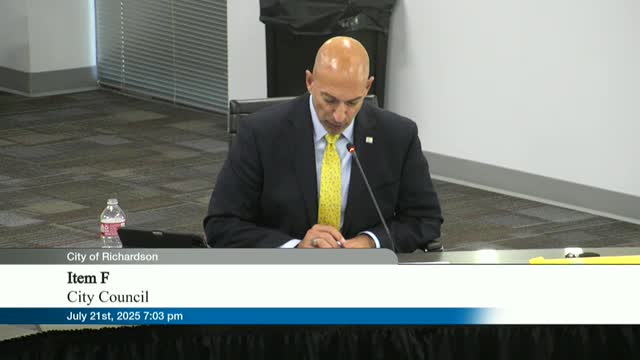
Dan Steah, the city's chief information officer, said the city has delivered several Tyler modules already (municipal court, finance, payroll/time entry, human resources) and is currently implementing the utility-billing module with a go-live target next October. Staff noted challenges in the multiyear program including staff turnover, a City Hall fire that affected deployment schedules and the rapid evolution of technology (including AI considerations).
Keisha Morrison, customer service manager, outlined three customer-impact changes staff will ask council to approve: 1) residential customer deposits: new customers currently pay a $75 deposit per meter; staff recommended applying refunds to customers with one year of on-time payment history and requested council approval in August so refunds could begin in September to reduce the data converted for Tyler; commercial deposits would remain unchanged. 2) Winter quarter average (WQA) sewer cap: staff proposed changing the WQA calculation from an average over three years (Nov–Feb) at 98% to a one-year calculation (same months) at 100% with the highest month dropped; staff said Tyler's rounding behavior and operational simplicity motivated the change and recommended implementing it in September 2026 (before Tyler go-live). 3) Budget billing: the city currently offers a 12-month averaged budget-billing feature used by about 255 customers; staff recommended discontinuing the budget-billing feature (customers to be notified, credits applied, and payment-plan options offered) with discontinuation to begin January (year following implementation) and staff said they would proactively contact affected customers and offer payment plans where needed.
Council members asked about cybersecurity posture (staff said the city uses extended detection and response/XDR tools and vendor road maps) and about the use of AI; Dan Steah said the city is preparing acceptable-use guidance and evaluating AI integrations but cautioned about data sensitivity. Council also asked about hardware lifecycle and cooperative purchasing; staff said they use DIR and other cooperatives and plan replacements on multi-year cycles (desktop replacement on roughly a four-year rotation).
Ending
Staff will bring an ordinance/resolution amendment in August for residential deposit policy and will continue the Tyler implementation and customer outreach ahead of the planned October go-live.