Get Full Government Meeting Transcripts, Videos, & Alerts Forever!
Get email alerts on the Municipal Budget topic
No spam. Unsubscribe anytime.
Fort Pierce commission narrows budget options: keep millage, trim new hires, set employee increases
Summary
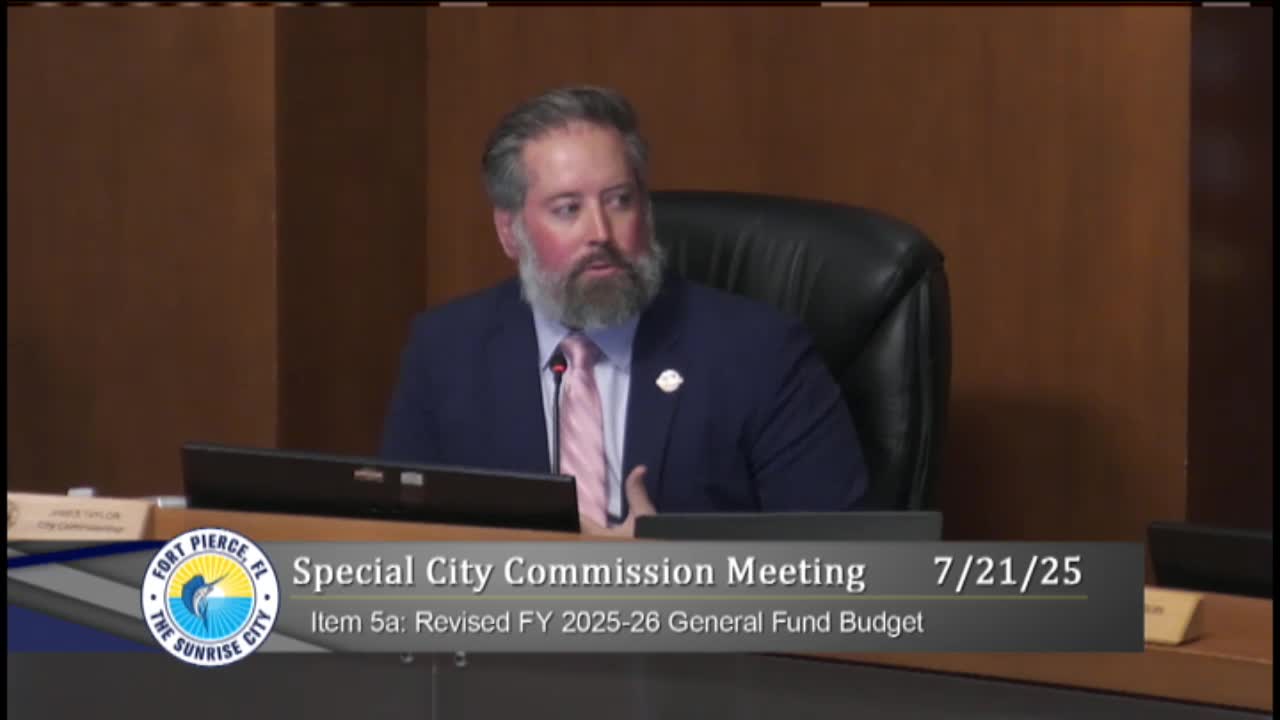
The Fort Pierce City Commission on Thursday reviewed seven budget scenarios and gave staff direction to hold the citys millage at the current 6.9 rate while seeking a path to fund pay increases and capital needs without raising property taxes.
The Fort Pierce City Commission on Thursday reviewed seven budget scenarios and gave staff direction to hold the citys millage at the current 6.9 rate while seeking a path to fund pay increases and capital needs without raising property taxes.
Commissioners and staff spent more than two hours weighing options that ranged from a combination of across-the-board raises and larger, targeted increases for police to deeper cuts in capital and new positions. Finance staff presented seven scenarios showing how various combinations of pay adjustments, 3% operating reductions and capital cuts would affect the general fund and the millage needed to balance the budget.
The commissions working consensus was to ask staff to draft the budget reflecting: 5% increases for nonbargaining employees, 5% for bargaining employees, and a police package of step plus 6 (the workshop language: "step plus 6"). Commissioners also directed staff to reduce the planned complement of new hires and to fund a limited subset of positions: a deputy city manager and a city engineer, plus two position requests in the police department that had been recommended by a third-party study. Finance staff estimated those retained hires would reduce the new-positions cost by about $472,000 compared with the full original request.
Why it matters: Commissioners repeatedly emphasized the citys limited ability to rely on continued ad valorem growth and warned that depleting reserves to fund recurring salary increases would leave the city exposed if taxable values or state revenues decline.
What staff presented - General fund baseline: $67,787,211, a $3.12 million (4.8%) increase from the prior projection tied to revised revenue estimates and selected transfers and grants. - A set of seven budget options combining varying percentages of increases for nonbargaining employees, bargaining units (including Teamsters), and the police step program. The most generous option would have required raising the millage above 6.9; staff and several commissioners said a millage increase was unacceptable. - Capital tradeoffs: many scenarios required cutting roughly $1.3 million from capital outlay or restricting capital to the $600,000 annual transfer for general fund capital. Staff noted several deferred public-works and equipment items are near critical failure and would be affected by capital reductions. - Proposed new positions: the original package totaled about $752,285 in recurring costs. After discussion, commissioners asked staff to prioritize the deputy city manager and a city engineer and to eliminate or defer the other requested hires; staff calculated the selective retention would lower the new-hires total by roughly $472,828.
Key concerns raised by commissioners - Sustainability: multiple commissioners warned that one-time fund-balance transfers to pay capital or recurring salaries would create risk in the next fiscal year if property valuations fall. Commissioner Broderick said, "I'm not voting for [a millage increase]," and several commissioners said they would not support increasing the millage. - Police pay equity: City leadership and the city manager repeatedly flagged a potential equity problem if large percentage raises for lower-ranked police personnel outpace increases for supervisors (captains, majors). The manager recommended a middle-ground option (options 5, 6 or 7 in staff materials) to reduce that risk while addressing recruitment/retention concerns. - New hires vs. revenue generation: Commissioners debated the timing and necessity of an in-house real-estate/asset manager ("real estate czar") to identify underused or undervalued city properties. Some members argued that hiring or contracting for that capacity could produce significant revenue, while others insisted staffing additions were imprudent when the overall budget showed red ink.
Staff direction and next steps - Millage: the commission directed staff to prepare the trim/levy information based on holding the millage at 6.9 (no millage increase was directed). - Salary guidance: staff was directed to model the budget using 5% nonbargaining, 5% bargaining and police step plus 6; staff will return revised budget numbers reflecting that direction. - New hires: the commission asked that only a limited set of new positions be included in the draft (deputy city manager and city engineer plus the police positions recommended by the CPSM study); the remainder of the new-positions request would be removed or deferred for now. - Clerk salary: commissioners discussed adjusting the city clerk's compensation and gave direction to include a proposed gross salary target in the revised budget (staff and commissioners referenced a target gross figure for modeling purposes). - Schedule: staff will return with updated budget numbers and the commission scheduled a follow-up review (a workshop was tentatively discussed for Aug. 11) before final votes.
Quotes drawn from the workshop - "Option 5 gives us the opportunity to still reward the employees," City Manager Mr. Chess said when explaining his preference among the staff scenarios. - "I'm not voting for it," Commissioner Broderick said referring to a millage increase.
Ending: Staff will present updated budget documents reflecting the commissions direction so the commission can review a balanced draft budget at a follow-up meeting before finalizing the millage and adopting the fiscal-year budget. The commission emphasized maintaining the current millage and limiting use of reserves for recurring expenses.