Get Full Government Meeting Transcripts, Videos, & Alerts Forever!
Get email alerts on the Budget Taxation topic
No spam. Unsubscribe anytime.
Council signals support for flat residential stormwater fee; staff to return with phased commercial approach
Summary
On July 21 the Flower Mound Town Council continued a work session on stormwater fees — the consultant recommended an ERU median of 4,675 square feet, and council favored a flat residential fee with phased commercial increases.
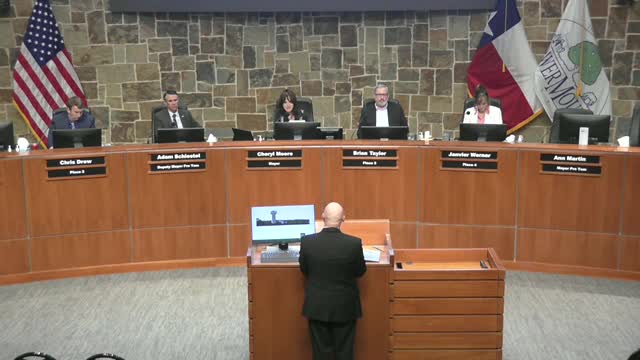
On July 21 the Flower Mound Town Council continued a work‑session review of proposed changes to the town’s stormwater fee structure, receiving a presentation from consultant NuGen and town staff on impervious‑area methodology, residential tiering and impacts on commercial customers.
Chris (NuGen) and town staff described the technical basis of an impervious‑area‑based fee. The consultant reported a revised equivalent residential unit (ERU) median of 4,675 square feet (the team said the median better accommodates statistical outliers than the mean). Using that ERU, staff presented alternative charging models: (1) retain a three‑tier residential structure (based on lot acreage) with fees scaled to median impervious areas in each tier; or (2) set a single flat residential fee for all households and charge nonresidential customers per ERU.
The nut graf: Councilors expressed skepticism about increasing charges for very large residential acreage tiers and favored simplicity and predictability for homeowners — several members advocated a single flat residential fee and a phased approach for any substantial commercial increases.
Key points presented by the consultant and staff included: current annual stormwater revenue under the existing method is about $2,190,000; under the median ERU of 4,675 sq ft nonresidential ERUs increase because the ERU value decreased; some alternative tier formulas would raise bills significantly for large lots (examples shown: the largest residential tier could move from about $4.40 to roughly $19.26 per month under a strict impervious‑area tiering while smaller‑lot tiers would fall); staff noted an existing detention‑credit mechanism in the code that has rarely been applied and would require neighborhood‑level application to qualify.
Council direction and staff recommendations: several council members favored a flat residential fee (treating all residences the same) and discussed raising the base from $6 to approximately $6–$7 to fund mapping, capital needs and to rebuild the stormwater reserve depleted by recent storm cleanup. Council asked staff to return at the next budget workshop (August 21) with final rate recommendations and a commercial phase‑in plan. Town staff emphasized the need for flood‑plain remapping, contracted maintenance work and replenishing the storm‑drain fund so future storm responses do not rely on the general fund.
The ending: Staff said it will use council direction to prepare proposed rates and phase‑in options for a formal August 21 discussion tied to the town’s budget workshop.