Get Full Government Meeting Transcripts, Videos, & Alerts Forever!
Get email alerts on the Nonprofit Funding topic
No spam. Unsubscribe anytime.
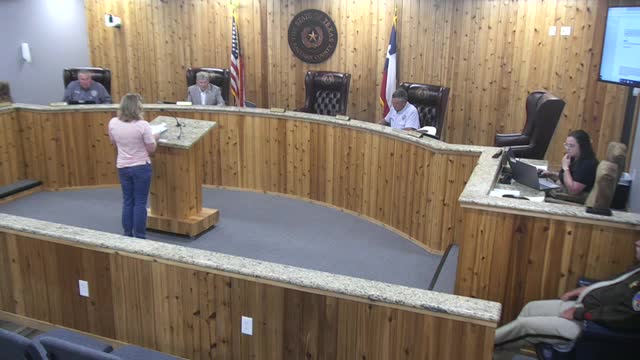
Kaufman County hears funding requests from shelters, child-advocacy and transit groups at nonprofit budget workshop
Summary
Kaufman County Commissioners Court held a nonprofit budget workshop where local nonprofits presented funding requests and program updates, including a $207,000 operational request from the Children’s Advocacy Center and a request from Lone Star CASA to increase county support to $82,000 plus $10,000 to start a juvenile-justice program.
Kaufman County Commissioners Court held a nonprofit budget workshop where local nonprofits presented funding requests and program updates, including a $207,000 operational request from the Children’s Advocacy Center and a request from Lone Star CASA to increase county support to $82,000 plus $10,000 to start a juvenile-justice program.
The Children’s Advocacy Center, represented by board president Randy Squib and Executive Director Shannon (last name not provided), told commissioners the center served 959 clients last year, including about 690 new customers, and that 67% of cases were sexual-abuse related; Shannon said the center must meet Texas Family Code requirements to provide multidisciplinary child-abuse investigations and forensic interviews. "The Texas Family Code says we have to," Shannon said, describing the center’s statutory role and the cost of professional services, training and secure digital systems the center must maintain.
Lone Star CASA Executive Director Lauren Rowe said the organization has seen a 32% increase in children served this fiscal year and asked the court to raise the county’s contribution from $35,000 (about 4.2% of the organization’s costs) to 11% — $82,000 — to cover ongoing casework; she also requested $10,000 to start a post-adjudication juvenile-justice pilot intended to reduce recidivism. "For every child that we serve, it costs us about $3,500 a year to serve them," Rowe said, noting the organization provides roughly 112 separate services per child in a typical year and that it currently relies on more than 100 volunteers.
Amanda Lewis, representing Genesys Center (a faith-based shelter on Highway 34), asked the court for part of a $90,000 kitchen-and-dining-room remodel. Lewis said the project has been split into four phases; the county was being asked to help fund phase 3. She said the organization had raised about 43% of the total and earlier in the presentation confirmed an earlier county request figure of about $27,700. "We are a shelter for women and children in crisis," Lewis said, describing programs that include a thrift store that funds operations and long-term residential programming.
Star Transit representative Tommy (last name not provided) asked for an approximately $10,000 increase in county support to help meet local matching requirements that unlock state grants. Tommy said Star Transit provides both demand-response and same-day on-demand service in Kaufman County and reported county ridership rose about 28% year over year (to roughly 54,000 rides). "We provide about 215,000 rides per year," he said of the agency’s regional operations, and added that local matches allow the agency to draw additional state funds.
A representative from the regional Council of Governments (Area Agency on Aging) requested roughly $16,115 in county support to satisfy a local match tied to federal and state nutrition and transportation pass-through funds; the speaker outlined services that include home-delivered meals, case management, ombudsman visits to long-term care facilities and caregiver supports and noted eligibility generally begins at age 60.
Other presenters included Ronnie Snow of Celebrate Forever Families, which operates an emergency domestic-violence shelter and said the county has provided $30,000 annually; Snow presented 2024 service counts (about 355 calls and 322 shelter requests, with roughly 98 people sheltered) and said about 87% of clients come from Kaufman or adjoining counties. Bridge to Gap Foundation’s co-founders Sharonda and Crystal described a licensed residential program for up to seven girls in state custody (Region 3) that is reimbursed monthly by the state but relies on founders’ savings for start-up and gap funding.
Commissioners did not take final funding votes at the workshop. Commissioner comments indicated staff would consult the judge and auditor about available funds and constraints; one commissioner told presenters, "we're going to get with the judge and the auditor and everybody else, we're trying to determine how much money we can actually give." The court adjourned at the end of the session.
The presentations highlighted common themes: rising demand for services (child-abuse cases, shelter needs, transit trips), constrained nonprofit revenue and the county’s role in providing matching funds that unlock state and federal grants. Presenters repeatedly described programs that operate under statutory or contractual requirements (for example, the Children’s Advocacy Center’s duties under the Texas Family Code and DFPS/region-based placement rules for residential programs).
Commissioners did not promise specific award amounts at the workshop and directed staff to gather additional financial details before budget deliberations.