Get Full Government Meeting Transcripts, Videos, & Alerts Forever!
Get email alerts on the Cemetery Preservation topic
No spam. Unsubscribe anytime.
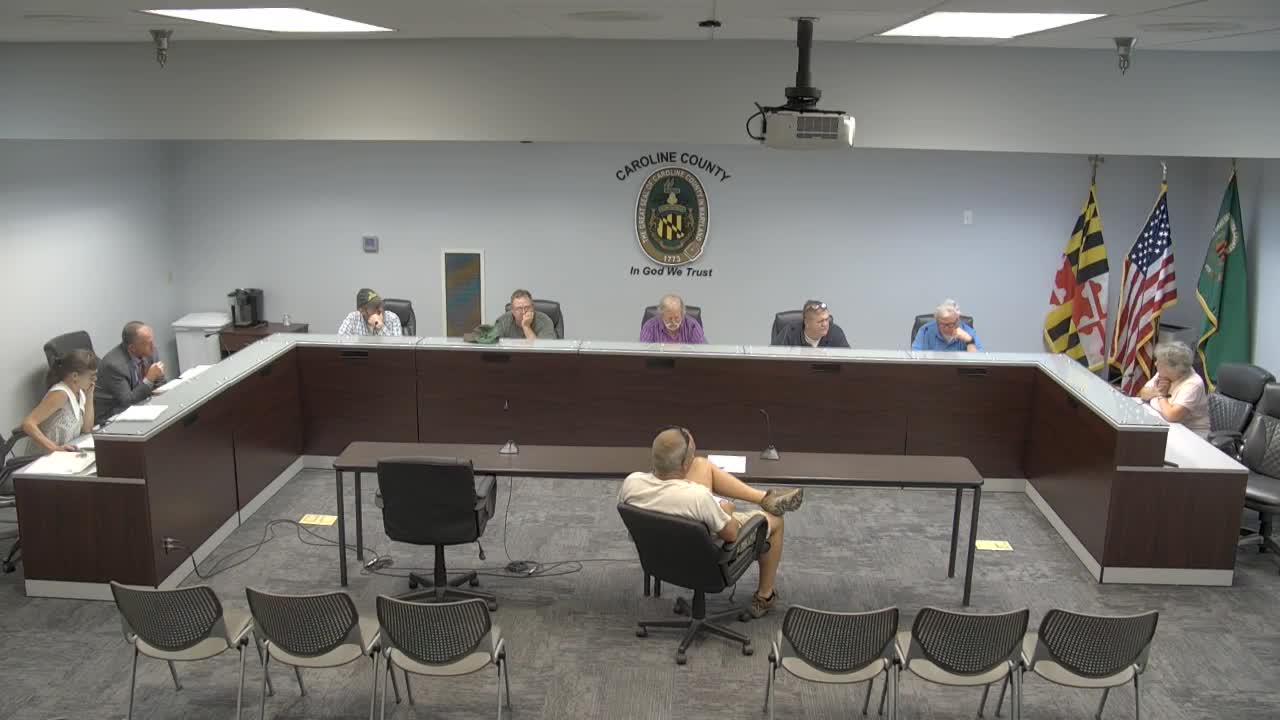
Caroline County board accepts Cherrywood plan to restore cemetery found at solar site
Summary
The Caroline County Burial Sites Preservation Board voted to accept Cherrywood's restoration plan for human remains and burial features disturbed during work at a leased solar site and added a recommendation that the developer submit an updated site plan showing exact cemetery boundaries.
The Caroline County Burial Sites Preservation Board voted to accept Cherrywood’s plan to restore and protect graves disturbed during earthwork at a leased solar site, the board decided at its regular meeting.
Board members said the Cherrywood submission included unusually detailed fieldwork, mapping and proposed remediation steps. Chip Winters, vice chairman of the board, moved that members accept the plan; Jeff Poor, chairman, seconded the motion and the board approved the plan by show of hands.
The board’s approval does not create new legal authority over the project but recognizes Cherrywood’s proposed avoidance, fencing and reporting measures. Jesse Pemmick, the attorney acting as county counsel for the boards, told members “It needs to be included in an abandoned site plan that they will submit to planning and code.” He also summarized the county and state roles: the county can recommend standards and supervise reconstruction while the Maryland Historical Trust (MHT) issues statutory guidance when a landowner discovers a burial site older than 50 years.
The board added a separate recommendation that Cherrywood submit a revised site plan that marks the cemetery’s precise location on the property record. That amendment was proposed and approved by the board after discussion about long-term protection and how a future owner or farmer would treat the area once panels are removed. The board’s additional recommendation directs planning and codes staff to require the updated site plan as part of the site record.
Members noted parts of Cherrywood’s plan that influenced their decision: the developer proposed an avoidance buffer and fencing around the burial feature, pictorial and written documentation of remediation steps, and signage. David Baker, a member of the Upper Shore Genealogical Society and a board member of the Caroline County Historical Society, told the board he performed deed and newspaper searches and encouraged developers to do basic title research before construction. “I actually tried to, do some searches of Denton Journal, census records, trying to identify if I could figure out any deaths in the family,” Baker said, describing his own research that helped confirm the presence of an old family plot.
Board members discussed technical details raised in Cherrywood’s submission. The plan described multiple potential burial features on the tract: five features the consultant identified as disturbed and nine additional potential features (14 potential locations in total). Members reported Cherrywood proposed an avoidance buffer that, with its adjacent protective area, amounts to more than an acre for the cemetery and surrounding buffer within a project of roughly 738 acres.
The board emphasized limits to its authority and to local permitting. As Winters and others said during discussion, local officials lack broad land-use permitting over solar installations; state permitting and MHT advice govern certain compliance steps. Jesse Pemmick said the board can recommend that the state permitting agency require legal research and that planning and codes require visual documentation and an updated site plan. He suggested the board use Cherrywood’s submission as a benchmark for future projects.
Next steps recorded by the board included: acceptance of Cherrywood’s restoration plan; a formal recommendation that Cherrywood submit an updated site plan showing the cemetery’s precise boundaries; and an encouragement that Cherrywood continue attempts to identify possible descendants for signage or notification. The board also discussed supervisory follow-up (periodic review by county staff) and urged planning and codes to include the cemetery on official plats and site maps to preserve notice in title and county records.
The board’s vote accepted Cherrywood’s report and authorized staff follow-up to require the updated site plan and documentation for the county’s records. Members said they will continue to consider whether the standards reflected in Cherrywood’s work should be recommended more broadly for similar projects.