Get Full Government Meeting Transcripts, Videos, & Alerts Forever!
Get email alerts on the Arts Funding topic
No spam. Unsubscribe anytime.
Austin launches rewrite of arts funding guidelines after citywide feedback; debate over eligibility, scoring and bonus points
Summary
The newly created Austin department for Arts, Culture, Music and Entertainment (ACME) proposed a consolidated funding framework for Thrive, Elevate and Nexus after months of community outreach. Staff and public speakers debated eligibility rules, scoring categories, fiscal sponsorship and a controversial bonus-point proposal.
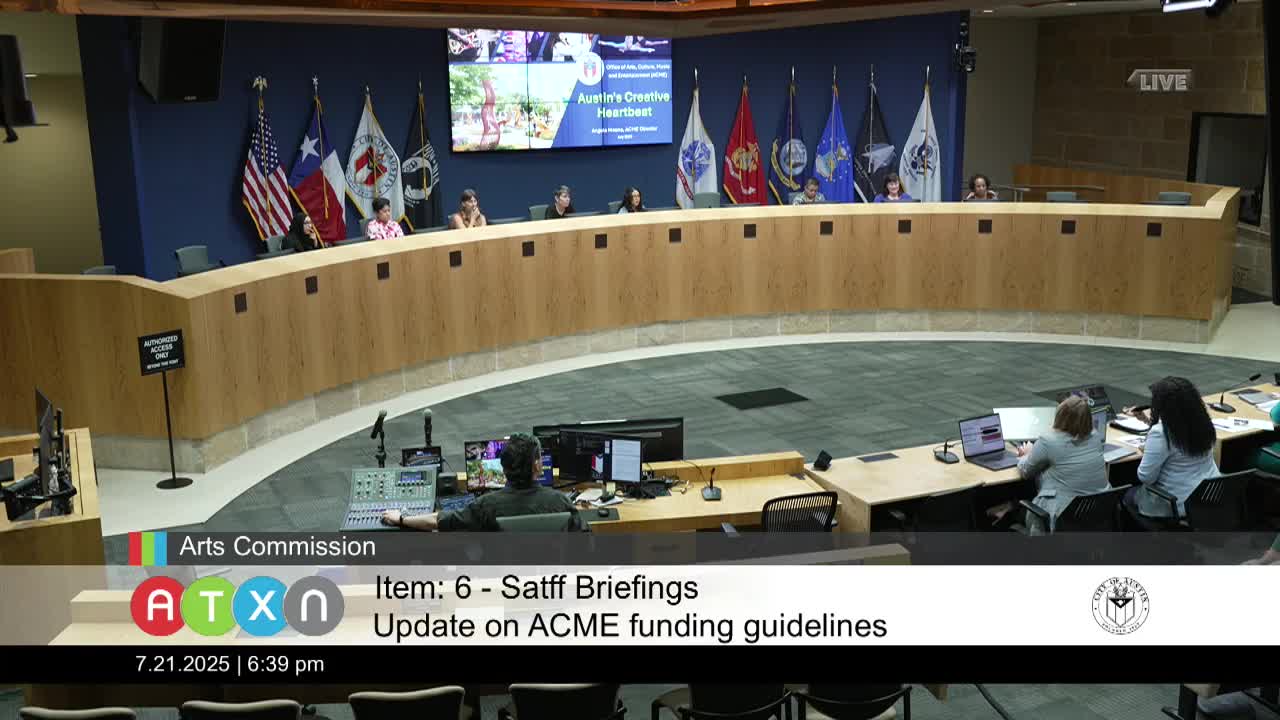
ACME Director Angela Means presented a draft of consolidated funding guidelines and an engagement summary to the Arts Commission on July 21, saying the new rules are the department’s first step in a year-long “Creative Reset.” ACME said it collected more than 1,200 survey responses within the initial weeks of outreach and held multiple listening sessions, focus groups and one-on-one meetings to shape a simpler, more transparent grant system.
The draft consolidates multiple program rules into a single guideline document and keeps the familiar Thrive, Elevate and Nexus programs while changing eligibility, scoring and award tiers. ACME staff said changes include pre-application eligibility screening, clearer evaluation criteria, a universal appeals process and separate “buckets” so nonprofit applicants who own creative space compete separately from nonprofits without creative space. Staff also proposed allowing fiscal sponsorship in some programs, making some awards available to fiscally sponsored projects, and standardizing scoring across creative work, ability to deliver, public connection and bonus points.
Why it matters: City grants supply a significant portion of operating resources for Austin arts groups, particularly smaller and mid-size companies. Changes to eligibility or scoring could shift which organizations receive the largest awards and how smaller producers compete for program support.
Public speakers, many of them local nonprofit leaders, urged ACME to preserve access for organizations that do not own space and to avoid procedural features that could disadvantage historically underfunded groups. Laura Esparza, executive director of A3 Art Alliance Austin, warned against language or evaluation elements that could expose arts funding to state-level anti-DEI actions: “City grants are the lifeblood of our arts ecosystem,” she said, and added that staff should avoid reforms that might put the arts community’s funding at risk.
Representatives of Glass Half Full Theater — co-artistic directors Caroline Recht and Griselda Silva — appealed directly to the commission over specific provisions they said would disadvantage companies that create new work but do not own rehearsal or performance venues. Recht said the draft “restrict[s] the highest funding amounts to organizations with creative space,” which would “undermine companies like ours that do not already have those resources.” Silva recommended revising a proposed rule that would require 51% of an organization’s activity to take place within the Austin region, arguing that touring can still sustain Austin artists and contribute back to the local economy.
Staff defended the approach as responsive to community feedback and peer-city benchmarking. Candace Cooper, interim chief administrative officer at ACME, summarized the engagement findings and emphasized three priorities emerging from the outreach: affordability, process clarity, and structural equity changes. Morgan Mesic, assistant director, reviewed program specifics: Thrive would remain restricted to 501(c)(3) nonprofits (staff said they would clarify the documentation required), Elevate would include multiple budget-tiered awards intended for capacity building and project support, and Nexus would continue as the program for individuals and small arts groups with awards from $2,500 to $20,000.
Points of contention included: whether Texas-state nonprofit registration (rather than federal 501(c)(3) status) should be treated as equivalent for some awards; how fiscal sponsorship would be allowed and documented; a proposed cap tying awards to a percentage of an applicant’s operating budget; and a bonus-point mechanism that would award points to organizations that had not had federal grants rescinded while penalizing organizations that had lost federal funding. Multiple commissioners and public commenters urged staff to remove the bonus-point provision and to avoid reintroducing budget-linked caps that advocates said in prior rounds had locked organizations into a narrow funding tier.
Next steps: ACME staff told the commission the public comment period for the draft closed July 20 and that staff would continue to revise the draft in the following two weeks, aiming for a fall launch of the reworked programs. Director Means asked commissioners to continue submitting feedback and to expect a final draft before the department seeks implementation and a briefing to city leadership.
Ending: Commissioners asked ACME to publish the underlying survey and analysis on a public microsite and to provide clearer documentation of eligibility rules, scoring questions and planned award counts.