Get Full Government Meeting Transcripts, Videos, & Alerts Forever!
Get email alerts on the Pretrial Detention Appeals topic
No spam. Unsubscribe anytime.
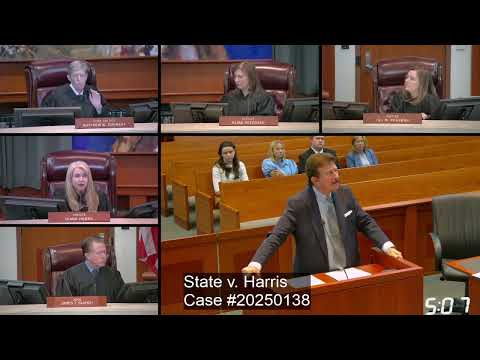
Utah Supreme Court hears appeal over pretrial detention, disputes whether new DNA evidence warrants release
Summary
The Utah Supreme Court heard arguments in State v. Harris over whether a defendant may appeal as of right from a district court—denial of a motion to modify pretrial detention and whether recently produced DNA and phone records amount to a "substantial and material" change of circumstances that should alter detention.
The Utah Supreme Court heard oral argument in State v. Harris on whether a defendant has an appeal as of right from a denial of a motion to modify a pretrial detention order and whether new DNA and phone evidence requires reconsideration of detention.
At the start of the argument, a court staff member noted, "We have 1 case for today, State v Harris. Justice Pierce has recused himself" and said a visiting judge from the trial court, James Bullhatch of the Third District, would sit with the Court. The dispute framed by counsel and justices centered on two questions: (1) whether the Utah bail statute permits an appeal as of right from a modification denial of a pretrial detention order, and (2) whether newly received DNA and mirrored phone data constitute a "substantial and material change of circumstances" under the controlling statutory framework.
David Drake, counsel for the appellant, told the Court that newly received DNA results and a mirror image of the alleged victim's phone undercut the prosecution's case. Drake argued the DNA report showed "absolutely no none of his DNA on her," and said that the phone data corroborated prior statements the alleged victim made to Oregon officers indicating her travel to the defendant was voluntary. Drake urged the Court to treat the new evidence as a material change under the statute and to reverse the district court's denial of his motion to amend the pretrial detention order; he also highlighted that the defendant had been detained about 16 months while discovery continued.
The state's principal argument, presented by Simon Doucette, countered that the bail statute's plain language limits appeals as of right to a pretrial status order that detains the defendant and does not confer an automatic appeal as of right from every inter-district ruling that touches on bail. Doucette argued the statute specifically defines a pretrial status order and "says that of the 3 types of pretrial status orders that a court can issue, the defendant gets to appeal the 1 that is detaining him," and that a denial of modification is not the same as a new detaining status order.
Justices pressed both sides on legal limits and remedies. A justice asked whether DNA evidence that leaves no reasonable basis for a guilty verdict would lead to dismissal instead of release; counsel responded that where an element of a crime cannot be proven, dismissal could be the remedy. During argument, a justice observed of the "substantial evidence" standard, "That's a pretty low standard, isn't it?" prompting further discussion about whether a change in the quantum or weight of evidence is the sort of "circumstance" the statute contemplates.
Counsel for the appellant also flagged practical concerns: he described difficulty obtaining discovery (including an FBI mirror image of the alleged victim's phone), the case's multi-jurisdictional nature (involving Utah and Oregon authorities), and urged that less restrictive alternatives to incarceration were available. The state emphasized statutory construction, precedent (including Court of Appeals decisions), and the risk of disrupting the appellate process if every modification denial were appealable as of right.
The Court did not issue a ruling at argument. A court staff member closed the session and the justices took the matter under advisement.
The record before the Court includes: counsel's claims that DNA testing and phone data undermine the prosecution's evidence; a district court minute entry finding "no material change of circumstances" and denying the motion to modify the detention order; and the parties' briefing about statutory scope, Court of Appeals precedent, and practical consequences for defendants detained pretrial.